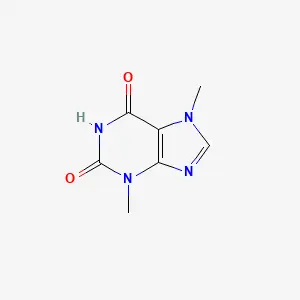
Theobromine is the main methylxanthine in cocoa. It is a stimulant and a close relative of caffeine. In an older survey of cocoa products, cocoa powder held about 1.9% theobromine by weight and 0.21% caffeine. That is roughly nine times as much theobromine.
Plants are thought to make these alkaloids mostly to defend themselves. A 2026 study found caffeine more toxic than theobromine to three Phytophthora pathogens that rot cacao pods. A disease-tolerant cacao line made mostly caffeine in its young leaves, while a susceptible line made mostly theobromine.
The name is older than the chemistry. Linnaeus named the cacao tree Theobroma in 1753, “food of the gods,” and the compound took its name from the tree. It has nothing to do with bromine. The molecule is built from only carbon, hydrogen, nitrogen and oxygen (C7H8N4O2).
Here is the part most people do not know. Your body makes theobromine too: about 11% of the caffeine you take in is turned into it, so coffee drinkers carry some. In a trial, theobromine at food-sized doses did not lift mood or alertness the way caffeine did. Both block the same receptors, but theobromine does it more weakly.
Health benefits of theobromine
The top findings from 24 studies, strongest evidence first
What the stars mean
- Strong. Several randomized trials, pooled in a meta-analysis, point the same way, or regulators (FDA or EFSA) have approved the claim.
- Moderate. Good randomized trials support it, but there are fewer of them, or their results vary.
- Limited. Small, short or single trials, or mixed results. Promising, but it needs confirmation.
Population and lab studies get no stars: they show a link or a mechanism, not proof.
How we rate evidence →- ★★Mixed effects on HDL and LDL cholesterolPure theobromine (850 mg a day) raised HDL by 0.16 mmol/L in 152 adults and lowered LDL. At 500 mg a day in 44 adults, LDL fell but HDL did not clearly rise.
- ★★High doses worsened mood; food-level doses did notIn 80 healthy people, doses of 500 and 1,000 mg made mood worse and raised heart rate. In 24 men, 100 to 400 mg in a cocoa drink did not change mood.
- ★★A theobromine cough product did not clearly helpIn 289 people with persistent cough, quality-of-life scores rose 2.4 points on the product and 2.2 on placebo, a gap that could be chance.
- ★Lower blood pressure and less calm within hoursIn 24 healthy women, 700 mg of theobromine lowered blood pressure at 1 hour and calmness at 3 hours. It did not change scores on psychomotor tests.
- ★No clear change in blood vessel wideningIn 44 overweight adults, 500 mg a day for 4 weeks did not change flow-mediated dilation, the main test of vessel widening. A stiffness measure fell while fasting.
All 24 studies, strongest evidence first
Pure theobromine, 850 mg a day, raised HDL by 0.16 mmol/L
This randomized, placebo-controlled trial in 152 healthy adults aged 40 to 70 lasted 4 weeks and used a two-by-two design. They drank cocoa (150 mg of theobromine and 325 mg of flavonoids), pure theobromine, both (1,000 mg of theobromine in all), or neither. Theobromine also lowered LDL, the “bad” cholesterol, and raised apolipoprotein A-I and lowered apolipoprotein B (proteins that carry cholesterol). Cocoa alone did not clearly change HDL, and the lead author works for Unilever.
Higher single doses of theobromine worsened mood and raised heart rate
In this placebo-controlled trial, 80 healthy people took 250, 500 and 1,000 mg of theobromine, 200 mg of caffeine and placebo on separate occasions. At 250 mg the effects on mood were limited; higher doses made mood worse, and heart rate rose as the dose went up. Caffeine had the expected effects on alertness and heart rate. The authors say 1,000 mg is the highest theobromine dose studied in people. Usual intakes may add to chocolate’s appeal, they conclude, but higher ones turn unpleasant.
A theobromine cough product did not clearly improve cough quality of life
289 people with persistent cough took a product called BC1036 or a placebo twice a day for 14 days. The Leicester Cough Questionnaire score rose 2.4 points on BC1036 and 2.2 on placebo, a gap that could be chance. Cough severity fell by similar amounts, and side effects were similar in both groups. The abstract does not give the dose, and the maker, Infirst Healthcare, funded the trial.
In metabolic syndrome, 450 mg daily raised HDL 1.72 mg/dL
80 overweight or obese adults aged 40 to 55 with metabolic syndrome took theobromine or a placebo for 12 weeks, with a low-calorie diet. Of them, 72 finished, and waist size fell 0.86 cm more than on placebo. Blood pressure, weight, total and LDL cholesterol, triglycerides, blood sugar, insulin and BMI did not change. The journal later published a correction, and a 2025 paper from the same trial reports a rise in the HDL2 subtype.
Theobromine lowered LDL but did not raise HDL
44 healthy adults with low HDL took 500 mg of theobromine a day for 4 weeks, and placebo in another period (a crossover trial). LDL fell 0.21 mmol/L, but HDL only tended to rise (0.03 mmol/L, which could be chance). Blood sugar and insulin rose more after a meal, and the inflammation marker hsCRP rose by 1.2 mg/L. The authors conclude that cocoa’s heart benefits are unlikely to come from theobromine. Two further papers from this trial, on HDL particle types and on HDL’s ability to remove cholesterol, also found no effect on HDL.
500 mg daily did not improve blood vessel function in overweight adults
Same trial as the 2018 Smolders study above (44 overweight and obese adults, 4 weeks, placebo-controlled crossover). Flow-mediated dilation, the main test of vessel widening, did not change, but a stiffness measure (central augmentation index) fell 1.7 points while fasting. After a high-fat meal, theobromine widened the brachial artery by 0.03 cm and lowered the peripheral augmentation index by 6.3 points. The authors say this does not suggest theobromine alone explains cocoa’s heart benefits.
979 mg in cocoa raised 24-hour systolic pressure 3.2 mm Hg
In this placebo-controlled crossover trial, 42 healthy older adults with mildly raised blood pressure had each drink for 3 weeks. The drinks were flavanol-rich cocoa with its natural 106 mg of theobromine, or with 979 mg. Central systolic pressure, measured near the heart, was 4.3 mm Hg lower 2 hours after the high dose, and the natural dose changed neither measure. This is a cocoa mixture, so the result cannot be credited to theobromine alone.
Food-level theobromine did not consistently change mood or vigilance
In this double-blind trial, each of 24 men had six drinks, three of them theobromine doses (100, 200 and 400 mg) in a cocoa-based drink. The others were 400 mg in a non-cocoa drink, a 0 mg control and 100 mg of caffeine. Caffeine cut fatigue and raised vigor. The authors conclude that theobromine at doses found in foods does not influence mood or vigilance.
700 mg of theobromine lowered calmness and blood pressure within hours
In this placebo-controlled trial, 24 healthy women took theobromine, caffeine, both together, or placebo. Theobromine lowered blood pressure at 1 hour and calmness at 3 hours, while 120 mg of caffeine raised alertness and blood pressure. Caffeine plus theobromine acted like caffeine on mood, with no blood pressure rise, and no treatment changed psychomotor test scores. The lead author works for Unilever.
Theobromine with a little caffeine made people like a paired drink more
In this double-blind, placebo-controlled trial, 64 people took 250 mg of theobromine and 19 mg of caffeine, or a placebo, with a drink. Over six mornings, the mix increased their liking for that drink. The doses match a 50 g chocolate bar, but the capsules held both compounds, so theobromine alone cannot get the credit. The authors suggest methylxanthines may add to liking for chocolate, especially dark chocolate.
560 mg of theobromine changed mood in some people, not on average
In this small study of 7 volunteers who avoided methylxanthines, 5 of 7 learned to tell theobromine from placebo. The lowest dose those 5 could detect ranged from 100 to 560 mg. Caffeine at 178 mg raised well-being, energy and alertness in the group. The authors call the effects of theobromine modest.
Theobromine suppressed provoked cough in a small human study and guinea pigs
This randomized, double-blind, placebo-controlled study in people came with tests in guinea pigs and in human vagus nerve tissue. There, theobromine blocked the nerve signal that capsaicin, the pepper compound used to provoke cough, triggers. The abstract gives no dose or group size and reports no side effects. A larger trial of a theobromine product in persistent cough, shown above, did not clearly beat placebo.
In young asthma patients, theobromine opened airways about as much as theophylline
A single 10 mg/kg dose of theobromine was compared with 5 mg/kg of theophylline, a related asthma drug. Lung function did not clearly differ between the two drugs. Airway opening peaked at 2 hours and lasted 6, though for theobromine the effect was not always clear. Peak blood levels and half-life were similar for both.
Theobromine plus citrate did not clearly beat citrate for uric acid crystals
This randomized crossover trial included 47 people with uric acid kidney stones. Each treatment lowered the risk of uric acid crystallization compared with the start. The combination scored lower than citrate alone, but not clearly so. The abstract gives no theobromine dose, and because it tested a combination, the effect cannot be credited to theobromine alone.
In one small exercise trial, theobromine beat placebo and matched caffeine
This systematic review of studies in healthy people found eight on theophylline and only one on theobromine, with 7 to 15 people each. In that study, theobromine beat placebo and matched caffeine in a 3 km treadmill time trial, with no adverse effects reported. The author notes contradicting results and too little data for solid conclusions.
In 12 men, chocolate delivered 80% as much theobromine as a solution
Theobromine handling was measured twice in 12 men. The first time came after 14 days off all methylxanthines, the second after a week of 6 mg/kg a day as dark chocolate. Its half-life was about 10 hours: 10.0 hours before, and the half-life did not change after the week of chocolate. About 42% of a dose reached the urine as 7-methylxanthine.
People with more blood theobromine showed slower biological aging in two cohorts
In 509 TwinsUK members, serum theobromine went with lower GrimAge acceleration and longer DNAmTL, blood markers of biological age. Both links replicated in 1,160 people in KORA, another European cohort. The link held after adjusting for other cocoa and coffee compounds. It cannot show cause, because people with higher theobromine may differ in other ways.
Older Americans with most theobromine scored higher on three of four tests
This snapshot study (cross-sectional) used NHANES 2011 to 2014, a US health survey, and included 2,845 adults aged 60 or older. The top intake group scored higher on memory and thinking tests of delayed recall, animal fluency and digit symbol, but not on immediate recall. A single snapshot cannot show which came first. The authors call for more research.
In a US survey, more theobromine went with more depressive symptoms
This snapshot of NHANES 2017 to 2018 was adjusted for background factors, with depression defined as a PHQ questionnaire score of 5 or above. The odds were 1.17 times as high (95% range 1.02 to 1.34), so the low end is barely above no effect. It cannot show whether theobromine raises risk or low mood leads people to eat more chocolate. The authors say more research is needed.
In US adults, theobromine intake went with lower triglycerides and CRP
This snapshot study of 8,531 adults aged 20 to 70 in NHANES 2015 to 2020 measured intake from one 24-hour dietary recall. Per 100 mg of theobromine, glycohemoglobin (HbA1c, a long-term blood sugar marker) was 0.05 percentage points lower. Triglycerides (blood fats) were 5.4 mg/dL lower and hs-CRP, an inflammation marker, 0.26 mg/L lower, but insulin was higher. Eating cocoa itself was not linked to heart risk factors, and the links were small.
In fat-fed mice, theobromine reduced obesity by browning white fat
This study in C57BL/6 mice on a high-fat diet, not people, found that theobromine blocked the enzyme PDE4D. It also activated brown fat and raised energy use, through a pathway that involves the β3-adrenergic receptor. The one human trial above that measured weight, with a low-calorie diet, found no extra weight loss.
Aging mice fed theobromine did better on a short-term memory test
Senescence-accelerated SAMP8 mice, a model of age-related memory loss, were fed 0.05% theobromine for 50 days. Brain growth factors (BDNF and NT-3) rose, and inflammation and fat damage fell, but the effects were minimal in normal-aging SAMR1 mice. Docking work (computer modeling) suggested theobromine binds PDE enzymes more weakly than selective drugs do. Mouse results often do not carry over to people.
Theobromine re-hardened artificial enamel lesions about as well as fluoride toothpaste
This lab study used tooth blocks cut from 30 extracted teeth, with lesions made in acid gel and treated in artificial saliva for 28 days. Surface hardness rose 38% with theobromine (0.0011 mol/L) and 29% with fluoride toothpaste, a difference that could be chance. No people were involved.
In a lab model, theobromine did not help enamel lesions repair
This plaque-fluid lab model tested theobromine at 10 to 200 ppm (parts per million) on 272 cow enamel specimens with early lesions. Tests ran at pH 5.5 and 7.0, with 0.2 or 1 ppm of fluoride. The authors conclude that, on current evidence, theobromine cannot be recommended against tooth decay. This disagrees with the 2013 result above.
Foods high in theobromine
Cocoa is the main dietary source, and the amount follows how much cocoa solid a food has. In the USDA (US Department of Agriculture) data behind the ranking below, cocoa powder holds 2,057 mg per 100 g. That is 111 mg in a tablespoon (5.4 g).
The ranking lists only cocoa powder, so the table that follows adds chocolate products from the USDA’s older SR Legacy table, plus tea. An older survey of cocoa products agrees on cocoa powder, at about 1.9% theobromine.
For scale, by our arithmetic from the USDA figures, 28 g of 70 to 85% dark chocolate holds about 225 mg. A 50 g milk chocolate bar holds about 100 mg.
The trial doses above, 450 to 1,000 mg a day, equal about 56 to 125 g of that dark chocolate. That is the same as 22 to 49 g of cocoa powder. A 240 mL cup of tea holds only about 6 to 11 mg, by the average values of EFSA, the EU’s food safety agency.
Per serving. No daily amount is set, so bars compare each food with the top food.
Per 100 g. No daily amount is set, so bars compare each food with the top food.
Per 100 kcal: the same calories of each food, for a fair comparison. Bars compare each food with the top food.
Food labels have no Daily Value or Reference Intake for theobromine, so the % compares each food with the top food.

| Food | Amount per 100 g (unless noted) | Source |
|---|---|---|
| Cocoa powder, unsweetened | 2,057 mg (about 1.9% in an older survey) | 1, 3 |
| Baking chocolate, unsweetened | 1,300 mg | 1 |
| Dark chocolate, 70 to 85% cacao solids | 802 mg | 1 |
| Dark chocolate, 60 to 69% cacao solids | 632 mg | 1 |
| Dark chocolate, 45 to 59% cacao solids | 493 mg | 1 |
| Semisweet chocolate | 486 mg | 1 |
| Milk chocolate | 205 mg | 1 |
| Chocolate bar used in a UK study | 250 mg per 50 g bar | 4 |
| Homemade hot cocoa | 68 mg | 1 |
| White chocolate | 0 mg | 1 |
| Black tea, brewed | 26 mg per liter (EFSA average) | 2 |
| Green tea, brewed | 45 mg per liter (EFSA average) | 2 |
Sources
- USDA FoodData Central, SR Legacy foods (FDC IDs 167568, 170273, 170272, 170271, 167976, 167587, 167571 and 171277). US Department of Agriculture. The cocoa powder value is the one used in the ranking above.
- EFSA Panel on Food Contact Materials, Enzymes, Flavourings and Processing Aids (CEF). Scientific opinion on Flavouring Group Evaluation 49, Revision 1 (FGE.49Rev1): xanthine alkaloids from the priority list. EFSA J. 2017. Tea values are the averages EFSA used in its exposure estimate.
- Shively CA, Tarka SM Jr. Methylxanthine composition and consumption patterns of cocoa and chocolate products. Prog Clin Biol Res. 1984.
- Smit HJ, Blackburn RJ. Reinforcing effects of caffeine and theobromine as found in chocolate. Psychopharmacology (Berl). 2005.
How theobromine works
Most of what we know about how theobromine works comes from test tubes, rodents and a few small human studies. Four ideas keep coming up. It blocks adenosine receptors, it may slow an enzyme called PDE, it calms cough nerves, and the body makes and clears it slowly. Here is each one, and what has been seen in people.
It blocks adenosine receptors, but weakly
Adenosine is a natural signaling molecule, and its receptors sit on cells all over the body. Reviews name blocking these receptors as the main way theobromine and caffeine act. Theobromine crosses the blood-brain barrier, the filter between blood and brain.
In rat brain tissue, though, it took more than twice as much theobromine as caffeine to block half of the A1 receptor binding. That took 210 to 280 µM (micromoles per liter) of theobromine, against 90 to 110 for caffeine. Against a second type, the A2 receptor, theobromine had not blocked half of the activity even at 1,000 µM. Caffeine needed 80 to 120 µM.
EFSA also notes that caffeine is the more pharmacologically active of the two.
Drawn to scale at the middle of each reported range. Lower numbers mean stronger blocking. Rat brain membranes, not people.
It may slow an enzyme called PDE
Phosphodiesterases (PDEs) are enzymes, and reviews list blocking them as theobromine’s second main action. In mice on a high-fat diet, theobromine bound PDE4D and cut its activity in fat tissue. That went with “browning” of white fat and more energy use.
In aging mice, docking work suggested it binds PDE enzymes more weakly than selective drugs. Whether this matters in people is not known.
A simplified pathway from one mouse study, with no scale. The drawing shows the direction of each step, not its size.
It calms cough nerves
In guinea pigs and in human vagus nerve tissue, theobromine blocked the nerve’s response to capsaicin. Capsaicin is the compound in hot peppers used to provoke cough in tests. The authors say the action appears to be peripheral, on the sensory nerves, rather than in the brain.
A small human study agreed, but a larger trial of a theobromine product in persistent cough did not clearly beat placebo. Both are among the study cards above.
Your body makes it from caffeine and clears it slowly
When you drink coffee, your liver breaks caffeine down into other methylxanthines. In six men, EFSA reports, about 80% of a caffeine dose became paraxanthine, 10.8% theobromine and 3.7% theophylline. Those three add up to 94.5%, and theophylline has its own page.
Drawn to scale. The grey end of the bar is the 5.5% that the three measured products do not account for.
Theobromine then lingers. After single doses in six men, its half-life (the time to clear half of it) was 7.2 hours, against 4.1 for caffeine. Other studies measured 6.1 hours in men on xanthine-restricted diets and 10.0 hours in 12 men who had stopped all methylxanthines. EFSA gives 7 to 12 hours.
In one study, five daily doses lengthened the half-life by almost two-thirds, but a week of daily dark chocolate did not change it.
Drawn to scale. Hours are from a single oral dose of each compound in the same six men.
What has been seen in people
The weak receptor blocking fits the trials on mood. At 100 to 400 mg, theobromine did not change mood or vigilance, while 100 mg of caffeine did. At 250 mg its effects on mood were limited. At higher doses, up to 1,000 mg, mood turned worse and heart rate rose with the dose.
The HDL changes, the best-known finding, are not explained by any mechanism on this page. One trial found a rise and another did not. Two papers that looked at HDL particles and cholesterol removal in that second trial found no change. The cough and PDE ideas rest on animal work, nerve tissue and one small human study.
Sources
- Daly JW, Butts-Lamb P, Padgett W. Subclasses of adenosine receptors in the central nervous system: interaction with caffeine and related methylxanthines. Cell Mol Neurobiol. 1983.
- Martínez-Pinilla E, Oñatibia-Astibia A, Franco R. The relevance of theobromine for the beneficial effects of cocoa consumption. Front Pharmacol. 2015.
- Judelson DA, Preston AG, Miller DL, et al. Effects of theobromine and caffeine on mood and vigilance. J Clin Psychopharmacol. 2013.
- Jang MH, Mukherjee S, Choi MJ, et al. Theobromine alleviates diet-induced obesity in mice via phosphodiesterase-4 inhibition. Eur J Nutr. 2020.
- Sumiyoshi E, Matsuzaki K, Katakura M, et al. Chronic theobromine administration attenuates short-term memory decline via neurotrophic, anti-inflammatory and antioxidant mechanisms in senescence-accelerated mouse prone 8 (SAMP8). J Nutr Biochem. 2026.
- Usmani OS, Belvisi MG, Patel HJ, et al. Theobromine inhibits sensory nerve activation and cough. FASEB J. 2005.
- EFSA Panel on Food Contact Materials, Enzymes, Flavourings and Processing Aids (CEF). Scientific opinion on Flavouring Group Evaluation 49, Revision 1 (FGE.49Rev1): xanthine alkaloids from the priority list. EFSA J. 2017.
- Lelo A, Birkett DJ, Robson RA, Miners JO. Comparative pharmacokinetics of caffeine and its primary demethylated metabolites paraxanthine, theobromine and theophylline in man. Br J Clin Pharmacol. 1986.
- Drouillard DD, Vesell ES, Dvorchik BH. Studies on theobromine disposition in normal subjects. Alterations induced by dietary abstention from or exposure to methylxanthines. Clin Pharmacol Ther. 1978.
- Shively CA, Tarka SM Jr, Arnaud MJ, et al. High levels of methylxanthines in chocolate do not alter theobromine disposition. Clin Pharmacol Ther. 1985.
- Jacobs DM, Smolders L, Lin Y, et al. Effect of theobromine consumption on serum lipoprotein profiles in apparently healthy humans with low HDL-cholesterol concentrations. Front Mol Biosci. 2017. Several authors work for Unilever.
- Talbot CPJ, Mensink RP, Smolders L, Bakeroot V, Plat J. Theobromine does not affect fasting and postprandial HDL cholesterol efflux capacity, while it decreases fasting miR-92a levels in humans. Mol Nutr Food Res. 2018.
Is theobromine safe? Supplements, dose and interactions
Theobromine in normal amounts of chocolate and cocoa is not known to harm healthy adults. In two trials, daily doses of 106 to 150 mg were well tolerated for 3 to 4 weeks. That is about 1.5 to 2.1 mg per kg of body weight. We found no EFSA acceptable daily intake or upper limit for theobromine itself.
In 2017, EFSA assessed it as a flavouring, using “conservative reference points” borrowed from its caffeine limits. These are 0.6 mg per kg a day for adults, and 0.3 for children, teenagers, and pregnant and breastfeeding women. That is about 42 mg a day for a 70 kg adult, by our arithmetic. A 28 g piece of dark chocolate is over five times that.
EFSA says going over the reference does not necessarily mean a safety concern. The true no-effect level is not known, it adds, but is probably higher. As reported by EFSA, IARC (the WHO’s cancer agency) put theobromine in Group 3 in 1991. That means “not classifiable” as a cause of cancer in humans, because of lack of data.
- Trial doses and side effects. Trials gave 450 to 1,000 mg a day of pure theobromine, or cocoa drinks enriched with it. At 979 mg a day for 3 weeks, 10 of 42 people had a laxative effect, and two stopped because of nausea or headache. At 850 mg, EFSA counted 43 adverse events against 10 on placebo. The most common in that trial were nausea, vomiting, headache and diarrhea. In single doses of 500 to 1,000 mg, mood turned worse and heart rate rose.
- Heart, blood pressure and blood sugar. The high cocoa-drink dose raised 24-hour systolic pressure by 3.2 mm Hg. In another trial, though, 700 mg lowered pressure 1 hour after dosing. In one small trial, 500 mg a day raised hsCRP, an inflammation marker, by 1.2 mg/L. It also raised blood sugar and insulin after a meal. People with diabetes or heart rhythm problems should ask their doctor about concentrated doses.
- Dogs and cats. Theobromine is why chocolate poisons pets. Most animals clear it much more slowly than people do, and dogs are poisoned by even small amounts of dark chocolate. The Merck Veterinary Manual puts mild signs at about 20 mg/kg of methylxanthines. It puts heart effects at 40 to 50, and seizures at 60 or more. It gives an oral LD50, a lethal dose, of 100 to 200 mg/kg for each of theobromine and caffeine. By our arithmetic, 28 g of 70 to 85% dark chocolate gives a 10 kg dog about 22 mg/kg of theobromine. Veterinary guidance says chocolate is toxic to cats too, and that darker, more bitter chocolate is riskier. Cats are more sensitive than people, it adds. Call a veterinarian or a pet poison line if a pet eats chocolate.
- Pregnancy, children and medicines. EFSA’s lower reference applies to pregnancy and breastfeeding. We found no safety trial of theobromine supplements in pregnancy and no controlled study of theobromine with prescription drugs. In rats fed theobromine during pregnancy at levels over 50 times human chocolate intake, fetal bone formation was delayed at the top dose. Even so, the authors judged neither cocoa nor theobromine a hazard to the fetus.
How to get more theobromine
- Best food. Cocoa powder holds 111 mg in a tablespoon. Dark chocolate (70 to 85%) holds 802 mg per 100 g, against 205 mg in milk chocolate and none in white chocolate.
- Expect it to linger. Theobromine from dark chocolate was absorbed at 80% of the level of a plain solution. Its half-life is 7 to 12 hours, so cocoa in the afternoon is still in your blood in the evening. No trial here tested time of day.
- Food, not a supplement. Trials used 450 to 1,000 mg of pure theobromine, and we found no official limit for it. Cocoa also brings flavanols, but a chocolate high in theobromine is not always high in flavanols. Labeled cocoa content did not always match measured flavanols.
Sources
- EFSA Panel on Food Contact Materials, Enzymes, Flavourings and Processing Aids (CEF). Scientific opinion on Flavouring Group Evaluation 49, Revision 1 (FGE.49Rev1): xanthine alkaloids from the priority list. EFSA J. 2017. It summarizes the trials of van den Bogaard (2010) and Neufingerl (2013), the 1991 IARC listing and the reference points above.
- Chocolate toxicosis in animals. Merck Veterinary Manual, Merck & Co. Full review by Cristine Hayes, DVM, September 2024.
- Is chocolate toxic to cats? VCA Animal Hospitals, written by Renee Schmid, DVM, for Pet Poison Helpline. Last updated June 26, 2026.
- Rijntjes M. Knowing your beans in Parkinson’s disease: a critical assessment of current knowledge about different beans and their compounds in the treatment of Parkinson’s disease and in animal models. Parkinsons Dis. 2019. It notes that most animals clear theobromine much more slowly than humans.
- Baggott MJ, Childs E, Hart AB, et al. Psychopharmacology of theobromine in healthy volunteers. Psychopharmacology (Berl). 2013.
- Smolders L, Mensink RP, Boekschoten MV, de Ridder RJJ, Plat J. Theobromine does not affect postprandial lipid metabolism and duodenal gene expression, but has unfavorable effects on postprandial glucose and insulin responses in humans. Clin Nutr. 2018.
- van den Bogaard B, Draijer R, Westerhof BE, et al. Effects on peripheral and central blood pressure of cocoa with natural or high-dose theobromine: a randomized, double-blind crossover trial. Hypertension. 2010.
- Neufingerl N, Zebregs YE, Schuring EA, Trautwein EA. Effect of cocoa and theobromine consumption on serum HDL-cholesterol concentrations: a randomized controlled trial. Am J Clin Nutr. 2013. The lead author works for Unilever.
- Mitchell ES, Slettenaar M, vd Meer N, et al. Differential contributions of theobromine and caffeine on mood, psychomotor performance and blood pressure. Physiol Behav. 2011.
- Tarka SM Jr, Applebaum RS, Borzelleca JF. Evaluation of the perinatal, postnatal and teratogenic effects of cocoa powder and theobromine in Sprague-Dawley/CD rats. Food Chem Toxicol. 1986.
- Shively CA, Tarka SM Jr, Arnaud MJ, et al. High levels of methylxanthines in chocolate do not alter theobromine disposition. Clin Pharmacol Ther. 1985.
- Alañón ME, Castle SM, Siswanto PJ, Cifuentes-Gómez T, Spencer JPE. Assessment of flavanol stereoisomers and caffeine and theobromine content in commercial chocolates. Food Chem. 2016.
- Langer S, Marshall LJ, Day AJ, Morgan MR. Flavanols and methylxanthines in commercially available dark chocolate: a study of the correlation with nonfat cocoa solids. J Agric Food Chem. 2011.
- USDA FoodData Central, SR Legacy foods. US Department of Agriculture. Used for the dark chocolate values in our arithmetic.
History of theobromine
The tree came first. The Maya called a cocoa drink prepared with hot water the “food of the gods”. In 1753 the Swedish scientist Carl Linnaeus gave the cacao tree the name Theobroma cacao, using that same phrase.
A cultural history counts more than 100 medicinal uses of cacao in European and colonial texts. They date from the 16th to the early 20th century, and range from helping thin patients gain weight to stimulating tired ones.
The compound came later. The chemist Alexander Woskresensky described it in a paper titled “Ueber das Theobromin,” published in 1842 in the journal Annalen der Chemie und Pharmacie. Some reference works, including Wikipedia, date the discovery to 1841. But the paper itself is dated 1842, and a 2019 review also gives 1842 for the first isolation from cocoa.
In 1882 Hermann Emil Fischer published a way to turn xanthine into theobromine and caffeine.
Milk chocolate was invented in 1876, an event a review of cocoa products calls the backbone of today’s chocolate industry. By the 1980s doctors had tested theobromine as an asthma drug, and in 2005 researchers reported that it eased provoked cough. A 2017 trial of a theobromine product for persistent cough did not reach significance.
Sources
- Montagna MT, Diella G, Triggiano F, et al. Chocolate, “food of the gods”: history, science, and human health. Int J Environ Res Public Health. 2019.
- Dillinger TL, Barriga P, Escárcega S, et al. Food of the gods: cure for humanity? A cultural history of the medicinal and ritual use of chocolate. J Nutr. 2000.
- Rijntjes M. Knowing your beans in Parkinson’s disease: a critical assessment of current knowledge about different beans and their compounds in the treatment of Parkinson’s disease and in animal models. Parkinsons Dis. 2019.
- Woskresensky A. Ueber das Theobromin. Annalen der Chemie und Pharmacie. 1842;41:125-127.
- Fischer E. Umwandlung des Xanthins in Theobromin und Coffein. Berichte der deutschen chemischen Gesellschaft. 1882;15:453-456.
- Shively CA, Tarka SM Jr. Methylxanthine composition and consumption patterns of cocoa and chocolate products. Prog Clin Biol Res. 1984.
- Theobromine. Wikipedia.
Frequently asked questions about theobromine
What does theobromine do for the body?
Less than its reputation. It blocks adenosine receptors and may slow the enzyme PDE. But at food-sized doses of 100 to 400 mg, it did not change mood or alertness in a 24-man trial. The best-known finding is higher HDL cholesterol, 0.16 mmol/L at 850 mg a day in 152 people. A 44-person trial at 500 mg found no rise, and no finding here reaches strong evidence.
Is theobromine the same as caffeine?
No, but they are close relatives. Both are methylxanthines, and your body turns about 11% of caffeine into theobromine. Theobromine blocks adenosine receptors more weakly (210 to 280 µM against 90 to 110 in rat brain). In a trial, 100 mg of caffeine cut fatigue where 400 mg of theobromine did not. Theobromine also lasts longer, with a half-life of 7.2 hours against 4.1 for caffeine. See the caffeine page.
Which foods are high in theobromine?
Cocoa and dark chocolate. Per 100 g, USDA lists 2,057 mg in cocoa powder and 1,300 mg in unsweetened baking chocolate. Dark chocolate (70 to 85%) has 802 mg and milk chocolate 205 mg, while white chocolate has none. Tea has only small amounts, about 26 to 45 mg per liter by EFSA’s averages.
How much theobromine is too much?
No official limit exists for theobromine itself. EFSA’s caffeine-based reference points are 0.6 mg per kg a day for adults, and 0.3 for children and for pregnant and breastfeeding women. EFSA says exceeding them is not necessarily a concern. Trials saw more nausea, headache and diarrhea at 850 mg or more a day, and worse mood at 500 mg or more in one dose.
Is theobromine toxic to dogs and cats?
Yes. Most animals clear theobromine slowly. The Merck Veterinary Manual gives mild signs in dogs at about 20 mg/kg of methylxanthines. Heart effects come at 40 to 50 and seizures at 60 or more. Veterinary guidance says chocolate is toxic to cats too, and that darker, more bitter chocolate is riskier. If a pet eats chocolate, call a veterinarian or poison line.
Does theobromine help a cough?
Possibly, but it has not been proved. A 2005 study found that it suppressed capsaicin-induced (pepper-provoked) cough in a small placebo-controlled human study and in guinea pigs. A trial in 289 people with persistent cough found 2.4 points of improvement on a theobromine product. Placebo gave 2.2, so the gap could be chance.
Does theobromine raise HDL cholesterol?
Sometimes, and only a little. In 152 people, 850 mg a day for 4 weeks raised HDL by 0.16 mmol/L. In 80 people with metabolic syndrome, 450 mg for 12 weeks raised it by 1.72 mg/dL. A third trial of 500 mg a day in 44 people found no HDL rise, and blood sugar and insulin were higher after a meal. Those doses equal about 56 to 106 g of 70 to 85% dark chocolate a day, by USDA figures.
How long does theobromine stay in your body?
Longer than caffeine. Its half-life was 7.2 hours in one study of six men and 10.0 hours in another group of 12. EFSA gives 7 to 12 hours, which means half of a dose is still in your body 7 to 12 hours later. Caffeine’s half-life in the six-man study was 4.1 hours.