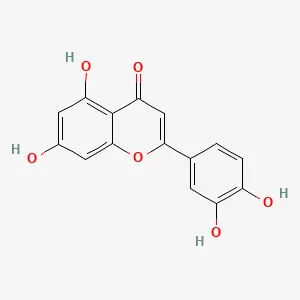
Luteolin is a yellow flavone, a plant compound in the flavonoid family. It turns up across the plant kingdom, in mosses, ferns, conifers and flowering plants. It comes as luteolin itself and as sugar-bound forms called glycosides.
One of its jobs was found in 1986. In alfalfa exudates, substances the plant releases, it is a signal that switches on the nodulation genes of the soil bacterium Rhizobium meliloti. The bacterium needs these genes for the nitrogen-fixing root nodules that form on the plant.
People used luteolin long before they knew its name. Michel Eugène Chevreul named it in 1829. It is the main yellow dye of weld (Reseda luteola), a dye plant used since at least the first millennium B.C.
Do not mix it up with lutein. The two names look alike, but luteolin is a flavonoid and lutein is a carotenoid. Lutein is the yellow pigment best known from the eye (see our lutein page).
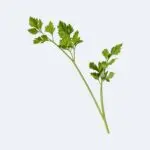
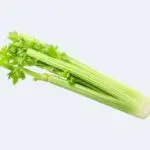
In food, luteolin is found in celery, peppers, carrots, olive oil and herbs such as thyme, peppermint, rosemary and oregano. In the USDA data on this page, thyme leads with 45.3 mg per 100 g.
Here is what most readers do not know. Most human trials of “luteolin” did not test luteolin alone. They tested products that combine it with palmitoylethanolamide (PEA, a fatty compound the body also makes), artichoke extract, chlorogenic acid or mango leaf extract. So their results cannot be credited to luteolin.
The amounts are also far from food. US adults with type 2 diabetes ate a median of 0.355 mg a day. One trial gave 140 mg a day as part of a PEA product, roughly 400 times as much.
Health benefits of luteolin
The top findings from 22 studies, strongest evidence first
What the stars mean
- Strong. Several randomized trials, pooled in a meta-analysis, point the same way, or regulators (FDA or EFSA) have approved the claim.
- Moderate. Good randomized trials support it, but there are fewer of them, or their results vary.
- Limited. Small, short or single trials, or mixed results. Promising, but it needs confirmation.
Population and lab studies get no stars: they show a link or a mechanism, not proof.
How we rate evidence →- ★May help smell recovery after COVID-19, with trainingIn 185 people, 92% improved on a PEA-luteolin supplement plus smell training, against 42% on placebo plus training. Luteolin was not tested alone, and a 50-person trial found no clinically meaningful extra gain.
- ★Slower decline in one small dementia trialIn frontotemporal dementia, PEA plus luteolin slowed decline on a rating scale over 24 weeks (0.53 against 1.39 points on placebo). Other measures showed no effect, and the result cannot be credited to luteolin alone.
- ★Better blood sugar, weight on artichoke supplementOver 6 months, a supplement with chlorogenic acid and luteolin extracts lowered HbA1c (average blood sugar) by 0.95% and weight by 2.4% against placebo. This was 100 people with metabolic syndrome, and the luteolin amount is unknown.
- ★No benefit alone for Gulf War illnessIn 21 male veterans with Gulf War illness, luteolin did no better than placebo at a lower or higher dose. Resveratrol did reduce symptoms.
- ★Better sprints with mangiferin plus luteolinIn 12 active men, sprint performance improved at both doses (50 mg and 100 mg of luteolin) when taken with mango leaf extract. The effect cannot be credited to luteolin alone.
All 22 studies, strongest evidence first
PEA-luteolin with training beat standard care for smell recovery after COVID-19
This meta-analysis (a study pooling earlier studies) covered 5 studies with 441 patients whose smell loss lasted long after COVID-19. All tested CoUltraPEALut, which combines micronized palmitoylethanolamide (PEA) with luteolin, added to smell training. The abstract gives no effect size and no luteolin dose, and the result cannot be credited to luteolin alone.
PEA-luteolin plus training: 89.2% gained over 3 smell-test points, against 36.8%
This double-blind trial had 202 people whose smell loss had lasted over 6 months after COVID-19, split into four groups for 90 days. The supplement alone reached 41.6% (once a day) and 40% (twice a day), close to the comparison group, which did training with placebo. It was ultramicronized PEA with luteolin, and the abstract gives no luteolin dose, so the effect cannot be credited to luteolin alone. All patients finished and no adverse events were reported.
PEA-luteolin plus training: 92% improved against 42% on placebo plus training
This double-blind trial had 185 people with smell loss lasting over 6 months after COVID-19: 130 on the supplement and 55 on placebo. All did smell training for 90 days, and average recovery was 12.8 points against 3.2. The daily dose was 770 mg of ultramicronized PEA and luteolin together, and the abstract does not give the luteolin share. So the effect cannot be credited to luteolin alone.
Artichoke supplement cut HbA1c 0.95% and weight 2.4% against placebo
This double-blind trial gave 100 people with metabolic syndrome (50 per group) the supplement or a placebo for 6 months. The product, Altilix, holds chlorogenic acid and luteolin extracts, and the abstract gives no luteolin amount, so the effect cannot be credited to luteolin. A fatty liver index fell 21.83%, flow-mediated dilation (how well arteries widen) rose 10.56% and carotid wall thickness fell 39.48%. A 2023 post-hoc analysis of the 50 people with pre-obesity in this trial reported similar gains.
PEA-luteolin plus training raised smell scores from 21.8 to 29.7
This randomized trial followed 85 people for 6 months whose smell loss and parosmia (distorted smell) after COVID-19 had not responded to training. Groups were PEA-luteolin plus training (17), alpha-lipoic acid plus training (21), both (28) and training alone (23), which showed no clear score change. Parosmia resolved in 96% on both supplements, 65% on training alone, 53% on PEA-luteolin and 29% on alpha-lipoic acid. So on this measure PEA-luteolin did not beat training alone, and all regimens were well tolerated.
PEA-luteolin with training raised smell-test scores 10.7 points on average, uncontrolled
This longitudinal study followed 69 people with long COVID smell loss for three months. They were grouped by earlier smell training, then randomized to the supplement alone or with training. Parosmia was present in 79.7% and improved, and mental clouding (37.7%) eased in severity (p = 0.02). With no placebo group and no luteolin dose in the abstract, the product cannot be judged on its own.
In 50 people, PEA-luteolin plus training gave no clinically meaningful extra gain
Fifty people with persistent smell loss, mainly after COVID-19, were randomized to smell training with PEA-luteolin or training alone. The supplement group improved on odor discrimination and the overall smell score, and the control group did not. Yet when only clinically meaningful gains were counted, the groups did not differ. The authors say the result contrasts with some earlier studies.
PEA-luteolin slowed decline in frontotemporal dementia: 0.53 against 1.39 points
This phase 2 double-blind trial at one center had 48 people with probable frontotemporal dementia; 45 finished. They took 700 mg PEA plus 70 mg luteolin twice a day, or a placebo, for 24 weeks. Decline on the rating scale differed by 0.86 points, and daily-living and aphasia (language) scores also declined less, but other secondary measures showed no effect. One author reports funding from PIAM Farmaceutici and Epitech Group and fees from Epitech, and the effect cannot be credited to luteolin alone.
Luteolin alone did no better than placebo for Gulf War illness
This placebo-controlled, pseudo-randomized crossover study had 21 male veterans. Each took a month of placebo, a month of lower dose and a month of higher dose of each botanical they were assigned. Luteolin did not differ from placebo at either dose. Resveratrol did reduce symptoms, and fisetin did not; the abstract does not give the doses.
Mangiferin plus luteolin improved sprint performance in 12 active men
In this double-blind crossover trial, sprints improved at both doses, measured after 48 hours and after 15 days. The low dose was 50 mg of luteolin (from peanut husk extract) with mango leaf extract holding 100 mg of mangiferin. The high dose was 100 mg of luteolin with more mango extract; since mangiferin was taken too, the effect cannot be credited to luteolin. The study was partly financed by Nektium Pharma, which supplied the compounds and took part in the design.
PEA-luteolin went with gains on every measure in 250 stroke patients
This was the observational arm, with no control group, of a paper that also tested rats. Patients in neurorehabilitation took co-ultraPEALut (PEA and luteolin, 10 to 1 by mass) for 60 days, with checks at the start and after 30 days. The authors say the gains were more than spontaneous recovery would give, and call for controlled trials. With rehabilitation going on too, the result cannot be credited to luteolin alone.
In an open-label autism trial, a luteolin-quercetin-rutin formula went with skill gains
This prospective trial, with no placebo group, gave 50 children aged 4 to 10 a formula of luteolin, quercetin and rutin for 26 weeks. Each capsule held 100 mg luteolin, 70 mg quercetin and 30 mg rutin in olive kernel oil, one per 10 kg body weight a day. 40 finished; adaptive skills rose 7 to 8 months, aberrant behavior scores fell 26.6 to 34.8%, and 27 of 50 had brief irritability. A related 2017 PEA-luteolin autism paper in mice and one child carries a 2024 Expression of Concern, and we did not use it.
In the same children, IL-6 and TNF fell after 26 weeks
This follow-up of the open-label cohort above has no control group either. Blood IL-6 and TNF, both inflammation signals, were raised at the start (means 61.95 and 313.8 pg/mL, with wide spread). They fell, most in children whose behavior improved the most, while CRH and neurotensin stayed high. It shows a link in this group, not that luteolin caused the change, and the formula held quercetin and rutin too.
Nurses eating most luteolin had 34% less ovarian cancer
The Nurses’ Health Study followed 66,940 US nurses and found 347 cases from 1984 to 2002, over 950,347 person-years. Diet came from questionnaires, and the highest fifth of luteolin intake had 0.66 times the rate of the lowest (range 0.49 to 0.91). Total intake of the 5 flavonoids studied showed no clear link (0.75, range 0.51 to 1.09), and kaempferol was linked to 40% lower incidence. The authors say more studies are needed.
Luteolin and four other flavonoids were not linked to lower cancer risk
The Women’s Health Study followed 38,408 women for 11.5 years and found 3,234 new cancers. Quercetin, kaempferol, myricetin, apigenin and luteolin were estimated from food questionnaires. Across fifths of total flavonoid intake, the risk ratios for any cancer were 1.00, 1.00, 0.93, 0.94 and 0.97. Single flavonoids behaved like the total, and the authors say the results do not support a major role in cancer prevention.
In Chinese adults, more luteolin went with lower metabolic syndrome risk
The Harbin cohort followed 6,417 Chinese adults for 5.3 years, with 1,283 new cases. The top quarter of total flavonoid intake had 0.58 times the risk of the bottom quarter. Luteolin had a similar link, stronger together with a high magnesium intake (0.52, range 0.38 to 0.71). The abstract does not give luteolin’s own ratio, and it shows an association only.
In diabetes, more luteolin went with lower death rates, especially cardiac
This NHANES cohort followed 2,461 US adults with type 2 diabetes for a median 8.4 years, with 561 deaths (136 cardiac). Each unit rise in intake, a rise in the natural log of intake, went with 7.0% lower all-cause and 22.6% lower cardiac mortality. Intake came from one 24-hour recall, and the median was only 0.355 mg a day. Higher intake also went with lower CRP (an inflammation marker) at baseline; this is association only, in people who already had diabetes.
In kidney disease, more luteolin went with lower death rates, especially cardiac
This NHANES cohort followed 2,393 US adults with chronic kidney disease for a median 93 months, with 682 deaths (217 from cardiovascular disease). Each unit rise in luteolin intake went with 27% lower all-cause and 34% lower cardiac mortality. Intake came from one 24-hour recall; the median was 0.305 mg a day (range 0.105 to 0.775 across the middle half). This is association only, in people who already had kidney disease.
In 19 animal studies, luteolin eased signs of ulcerative colitis
This meta-analysis pooled animal models of colitis, a gut inflammation, with 327 animals in all. Colon length, disease activity, weight loss and tissue damage scores improved, inflammatory signals fell and gut barrier proteins rose. Luteolin had no clear effect on the diversity of gut bacteria. The authors say human studies are needed, and we found none.
In animals, luteolin reduced heart damage after blocked and restored blood flow
This meta-analysis pooled preclinical studies of myocardial ischemia-reperfusion injury: damage when blood flow to the heart stops and then returns. Infarct size (the area of dead heart muscle) fell by 2.50%, 2.14% and 2.54% in three subgroups. Heart pumping pressures improved in two models (left ventricular systolic pressure by 21.62 and 35.40 mmHg). The authors point to antioxidant, anti-inflammatory and anti-cell-death effects, and there are no human data.
Aged mice fed luteolin did better on a spatial working memory test
This was a mouse study, not people. Mice aged 22 to 24 months ate a diet with luteolin (20 mg a day) for 4 weeks, and their brain inflammation markers calmed. Young adult mice (3 to 6 months) were not affected. In cells, luteolin also protected nerve cells from damage caused by activated microglia, the brain’s immune cells.
In old mice, luteolin nearly halved the share of inflammatory microglia
Mice aged 22 to 24 months ate a diet with luteolin (6 g/kg) for 4 weeks. Microglia staining for MHC class II fell from 23% to 12% of the total. For IL-1β the share fell from 25% to 13%, and for IL-6 from 25% to 12%. In young adult mice given a bacterial toxin it lowered IL-1β and IL-6, but not in old mice; these are mouse results.
Foods high in luteolin
In the USDA data on this page, thyme tops the list per 100 g at 45.3 mg, then peppermint (12.7 mg). Olives (2.8 mg), artichoke (2.3 mg) and rosemary (2.0 mg) follow.
Herbs are eaten in small amounts, so per serving the order changes. One artichoke (128 g) gives 2.94 mg, a cup of kohlrabi 1.76 mg, one lemon 1.1 mg and a cup of cantaloupe 1.02 mg.
Real intakes are small. Two groups of US adults, one with kidney disease and one with type 2 diabetes, ate a median 0.305 and 0.355 mg a day. That came from a single 24-hour food recall. One artichoke is about 8 to 10 times that.
A supplement dose of 140 mg a day, as used in one trial above, equals about 48 artichokes, before absorption is counted.
Per serving. No daily amount is set, so bars compare each food with the top food.
Per 100 g. No daily amount is set, so bars compare each food with the top food.
Per 100 kcal: the same calories of each food, for a fair comparison. Bars compare each food with the top food.
Food labels have no Daily Value or Reference Intake for luteolin, so the % compares each food with the top food.
- 1.
- 2.
- 3.

- 4.
- 5.
- 6.
- 7.

- 8.
- 9.
- 10.


- 1.
- 2.
- 3.
- 4.
- 5.
- 6.
- 7.
- 8.
- 9.
- 10.


- 1.
- 2.
- 3.
- 4.
- 5.
- 6.
- 7.
- 8.
- 9.
- 10.

Sources
- USDA Database for the Flavonoid Content of Selected Foods, Release 3.3. Bhagwat S, Haytowitz DB. US Department of Agriculture, Agricultural Research Service. 2018. The ranking above is built from it.
- López-Lázaro M. Distribution and biological activities of the flavonoid luteolin. Mini Rev Med Chem. 2009.
- Yao X, Zhou Z. Dietary intake of luteolin is negatively associated with all-cause and cardiovascular mortality in chronic kidney disease patients. BMC Public Health. 2024.
- Zhang W, Li D, Shan Y, et al. Luteolin intake is negatively associated with all-cause and cardiac mortality among patients with type 2 diabetes mellitus. Diabetol Metab Syndr. 2023.
- Assogna M, Di Lorenzo F, Bonnì S, et al. Phase 2 study of palmitoylethanolamide combined with luteoline in frontotemporal dementia patients. Brain Commun. 2025.
How luteolin works
Most of what we know about how luteolin works comes from test tubes, cells and animals. Three ideas come up most.
The body changes it on its way into the blood. It quiets mast cells. It also turns down inflammation switches, in different ways in different cells. Here is each one, and what has been seen in people.
It is changed on its way into the blood
In artichoke leaf extract, luteolin comes as glycosides, luteolin joined to sugars. 14 healthy volunteers were given extracts that supplied 14.4 or 35.2 mg of luteolin this way. No glycoside and no free luteolin was found in their blood or urine. Luteolin showed up only as sulfate or glucuronide forms, with blood levels peaking within half an hour.
This does not mean free luteolin never circulates. An earlier study found free luteolin and a monoglucuronide in human serum after people ate luteolin itself. A 2024 review says luteolin has an unfavorable oral bioavailability, meaning the body absorbs it poorly, and stays in plasma mostly as glucuronides and sulfates.
A diagram, not to scale. The yellow circle is luteolin, the grey circle a sugar, and the green circle a sulfate or glucuronide group. The sugar step is shown in rats; the artichoke result comes from people.
It quiets mast cells
Mast cells are immune cells known for allergic reactions, and they also release chemicals that drive inflammation. In cultured human mast cells triggered with IgE (allergy antibodies) and anti-IgE, luteolin, quercetin and baicalein each cut the release of several such chemicals. These were histamine, leukotrienes, prostaglandin D2 (PGD2) and GM-CSF.
Luteolin and quercetin also blocked calcium entering the cell and the activation of protein kinase C (PKC). They held back the ERK and JNK signals that come just before release, while the p38 pathway was not affected.
A diagram, not to scale. With luteolin, less histamine, leukotrienes, PGD2 and GM-CSF were released, in a way that rose with the concentration.
A 2024 cell-line study from a different lab compared luteolin with cromolyn at equal concentration. The authors call cromolyn the only available mast cell blocker drug. Luteolin cut the release of histamine, tryptase, metalloproteinase-9 and VEGF more than cromolyn did. It also lowered IL-1β, IL-6, IL-8 and TNF, which cromolyn did not.
These are cell results. We found no trial of luteolin for allergies in people.
It turns down inflammation switches
In a mouse macrophage cell line, luteolin cut the TNF-α and IL-6 released after a bacterial toxin (LPS). Luteolin and quercetin were the most potent of the flavonoids tested. They had a 50% effect on TNF-α at under 1 µM for luteolin and 5 µM for quercetin. Luteolin also stopped the breakdown of IκB-α, the brake on the inflammation switch NF-κB, and it reduced NF-κB-driven gene activity.
Drawn to scale. The abstract says only “less than 1” for luteolin, so its bar is drawn at 1 and is an upper limit.
The switch is not the same in every cell. In mouse microglia, the brain’s immune cells, luteolin lowered LPS-triggered IL-6 without changing NF-κB binding or IκB-α breakdown. Instead it blocked JNK activation and AP-1, a different switch.
In mice that drank water with luteolin for 21 days, plasma IL-6 after LPS was lower. So was IL-6 gene activity in the hippocampus, a memory area of the brain, but not in the cortex or cerebellum.
A diagram, not to scale. The green pill marks the step where each study found luteolin acting. Both results are from mouse cells.
It blocks an enzyme that makes uric acid
Xanthine oxidase is an enzyme that makes uric acid. In a test tube, luteolin and other flat flavones and flavonols blocked it at low concentrations. These included chrysin, kaempferol, quercetin, myricetin and isorhamnetin, with a 50% effect at 0.40 to 5.02 µM. We found no human trial of luteolin on uric acid.
What has been seen in people
Few of these ideas have been tested in people. In the open-label autism cohort, blood IL-6 and TNF fell over 26 weeks. But there was no control group, and the formula also held quercetin and rutin. In US adults with type 2 diabetes, higher luteolin intake went with lower CRP at baseline, an association only.
The smell-loss trials were designed around the idea that brain inflammation holds back recovery, but the abstracts report no inflammation measure. The blood carries mostly sulfate and glucuronide forms. So it is unclear whether free luteolin reaches the concentrations used in cell studies, and we found no study that settled this. The human cards above are the better guide to what to expect.
Sources
- Wittemer SM, Ploch M, Windeck T, et al. Bioavailability and pharmacokinetics of caffeoylquinic acids and flavonoids after oral administration of Artichoke leaf extracts in humans. Phytomedicine. 2005.
- Shimoi K, Okada H, Furugori M, et al. Intestinal absorption of luteolin and luteolin 7-O-beta-glucoside in rats and humans. FEBS Lett. 1998.
- Shi M, Chen Z, Gong H, et al. Luteolin, a flavone ingredient: anticancer mechanisms, combined medication strategy, pharmacokinetics, clinical trials, and pharmaceutical researches. Phytother Res. 2024.
- Kimata M, Shichijo M, Miura T, et al. Effects of luteolin, quercetin and baicalein on immunoglobulin E-mediated mediator release from human cultured mast cells. Clin Exp Allergy. 2000.
- Tsilioni I, Theoharides T. Luteolin is more potent than cromolyn in their ability to inhibit mediator release from cultured human mast cells. Int Arch Allergy Immunol. 2024.
- Xagorari A, Papapetropoulos A, Mauromatis A, et al. Luteolin inhibits an endotoxin-stimulated phosphorylation cascade and proinflammatory cytokine production in macrophages. J Pharmacol Exp Ther. 2001.
- Jang S, Kelley KW, Johnson RW. Luteolin reduces IL-6 production in microglia by inhibiting JNK phosphorylation and activation of AP-1. Proc Natl Acad Sci U S A. 2008.
- Nagao A, Seki M, Kobayashi H. Inhibition of xanthine oxidase by flavonoids. Biosci Biotechnol Biochem. 1999.
Is luteolin safe? Supplements, dose and interactions
People have always eaten luteolin in food, at a median of 0.305 to 0.355 mg a day in the two US groups above. We found no safety warning for food amounts, and no official position on supplements.
The FDA’s GRAS notice inventory (its list of substances notified as generally recognized as safe) lists no notice with luteolin in the substance name. We found no EFSA acceptable daily intake, Health Canada limit or NIH upper level for luteolin.
- Trial doses and side effects. Trials gave 50 to 100 mg of luteolin a day with mango extract, and 70 mg twice a day with PEA in the dementia trial. The autism trial used 100 mg per capsule, one capsule per 10 kg of body weight a day. It saw brief irritability in 27 of 50 children. A 202-person smell trial reported no adverse events, and an 85-person trial said all regimens were well tolerated. But none of these trials ran longer than 6 months.
- Prescription drugs. A 2024 review calls luteolin a potent inhibitor of the drug transporters OATP1B1 and OATP2B1. That may change how the body handles other substances. This comes from lab work, and we found no controlled interaction study in people. So ask a pharmacist if you take prescription drugs.
- Pregnancy, breastfeeding and children. We found no safety trials in pregnancy or breastfeeding. Children aged 4 to 10 took a luteolin formula in one open-label trial, which cannot establish safety. Ask your doctor first.
- A paper we left out. A 2017 paper on PEA and luteolin in mice and one child with autism carries a 2024 Expression of Concern from its journal. So we did not use it.
How to get more luteolin
- Best food. Artichoke gives the most per serving in the USDA data, 2.94 mg in one 128 g artichoke. Thyme has the most per 100 g, 45.3 mg, but is eaten in small amounts.
- Cook with care. In artichokes, boiling, steaming and frying all lowered flavonoids as a group, frying most. The paper does not report luteolin alone. In heated lab solutions, luteolin held up best at pH 3 and broke down progressively at pH 5 and 7.
- Food versus supplement. Blood carries mostly sulfate and glucuronide forms either way. Absorption depends on the form. In rats, luteolin dissolved in propylene glycol peaked in blood within 15 to 30 minutes. The autism trial used an olive-oil formula to raise absorption. We found no study that compared food with a pill.
Sources
- GRAS Notice Inventory. US Food and Drug Administration. Searched for luteolin in October 2026: no records found.
- Shi M, Chen Z, Gong H, et al. Luteolin, a flavone ingredient: anticancer mechanisms, combined medication strategy, pharmacokinetics, clinical trials, and pharmaceutical researches. Phytother Res. 2024.
- Taliou A, Zintzaras E, Lykouras L, Francis K. An open-label pilot study of a formulation containing the anti-inflammatory flavonoid luteolin and its effects on behavior in children with autism spectrum disorders. Clin Ther. 2013.
- Di Stadio A, Gallina S, Cocuzza S, et al. Treatment of COVID-19 olfactory dysfunction with olfactory training, palmitoylethanolamide with luteolin, or combined therapy. Eur Arch Otorhinolaryngol. 2023.
- Cantone E, D’Ascanio L, De Luca P, et al. Persistent COVID-19 parosmia and olfactory loss post olfactory training. Eur Arch Otorhinolaryngol. 2024.
- Expression of concern: Beneficial effects of co-ultramicronized palmitoylethanolamide/luteolin in a mouse model of autism and in a case report of autism. CNS Neurosci Ther. 2024.
- Ferracane R, Pellegrini N, Visconti A, et al. Effects of different cooking methods on antioxidant profile, antioxidant capacity, and physical characteristics of artichoke. J Agric Food Chem. 2008.
- Hostetler GL, Riedl KM, Schwartz SJ. Effects of food formulation and thermal processing on flavones in celery and chamomile. Food Chem. 2013.
- Shimoi K, Okada H, Furugori M, et al. Intestinal absorption of luteolin and luteolin 7-O-beta-glucoside in rats and humans. FEBS Lett. 1998.
History of luteolin
Luteolin was a dye before it was a molecule. It is the main yellow dye of weld, Reseda luteola, in use by the first millennium B.C. and seen in the Bayeux Tapestry. Mixed with blue from woad, weld gave greens such as Lincoln green.
Michel Eugène Chevreul isolated the pure yellow compound and named it in 1829. Modern analysis lists luteolin and two of its glycosides as weld’s main yellow dye constituents.
The chemistry came later. The Austrian chemists Heinrich Hlasiwetz and Leopold Pfaundler worked out its formula in 1864. The English chemist Arthur George Perkin proposed the correct structure in 1896. Stanisław Kostanecki and his students confirmed it in 1900 by making luteolin in the lab.
In 1986 researchers showed that luteolin from alfalfa is a plant-to-microbe signal.
Its life as a supplement is recent. A luteolin, quercetin and rutin formula was tested in children with autism in 2013, and a PEA and luteolin product in stroke patients in 2016. The first COVID-19 smell trial of the supplement was published in 2021. Each of these tested a combination, which is why the evidence for luteolin alone is still thin.
Sources
- Luteolin. Wikipedia.
- Reseda luteola. Wikipedia.
- Villela A, van der Klift EJ, Mattheussens ES, et al. Fast chromatographic separation for the quantitation of the main flavone dyes in Reseda luteola (weld). J Chromatogr A. 2011.
- Peters NK, Frost JW, Long SR. A plant flavone, luteolin, induces expression of Rhizobium meliloti nodulation genes. Science. 1986.
- Taliou A, Zintzaras E, Lykouras L, Francis K. An open-label pilot study of a formulation containing the anti-inflammatory flavonoid luteolin and its effects on behavior in children with autism spectrum disorders. Clin Ther. 2013.
- Caltagirone C, Cisari C, Schievano C, et al. Co-ultramicronized palmitoylethanolamide/luteolin in the treatment of cerebral ischemia: from rodent to man. Transl Stroke Res. 2016.
- D’Ascanio L, Vitelli F, Cingolani C, et al. Randomized clinical trial “olfactory dysfunction after COVID-19: olfactory rehabilitation therapy vs. intervention treatment with palmitoylethanolamide and luteolin”: preliminary results. Eur Rev Med Pharmacol Sci. 2021.
Frequently asked questions about luteolin
What does luteolin do for the body?
No effect of luteolin on its own is proven in people. Most trials gave it with other ingredients, and the best-studied product is PEA plus luteolin for smell loss after COVID-19. In food, higher luteolin intake went with lower mortality in US adults with kidney disease and with type 2 diabetes, which shows association only. Mast cell and inflammation findings come from cells and animals.
Which foods are high in luteolin?
Thyme has the most per 100 g in the USDA data, 45.3 mg. Then come peppermint at 12.7 mg, olives at 2.8 mg and artichoke at 2.3 mg. Per serving, one artichoke gives 2.94 mg, a cup of kohlrabi 1.76 mg and one lemon 1.1 mg. Celery, parsley and broccoli also appear in the ranking at 0.8 to 1.09 mg per 100 g.
How much luteolin should you take a day?
No dose is proven or recommended, and we found no official limit. Trials used 50 to 100 mg a day with mango extract, and 100 mg per capsule in an autism trial. A dementia trial used 140 mg a day as part of a PEA product.
Food gives a median of about 0.3 mg a day. Talk to a clinician before taking a supplement.
Does luteolin have side effects?
Few were reported, but the data are thin. An autism trial saw brief irritability in 27 of 50 children. A 202-person smell trial reported no adverse events, and an 85-person trial said all regimens were well tolerated.
A review says luteolin inhibits two drug transporters, so ask a pharmacist if you take prescription drugs. Pregnancy and breastfeeding have not been studied.
Does luteolin help with smell loss after COVID-19?
A PEA and luteolin supplement plus smell training did better than training alone in several trials. But it is a combination, and the results cannot be credited to luteolin. In a 202-person trial, 89.2% of people on the combination with training improved by more than 3 points, against 36.8% on training with placebo. A separate 50-person trial found no clinically meaningful extra gain over training.
Is luteolin good for allergies?
The evidence is from cells only. In cultured human mast cells, luteolin reduced the release of histamine and other chemicals. A 2024 cell study found it more potent than cromolyn at the same concentration. We found no trial of luteolin for allergies in people, so it is not a proven treatment.
What is the difference between luteolin and lutein?
They are different compounds. Luteolin is a flavone, a flavonoid found in herbs, celery and artichoke. Lutein is a carotenoid, a yellow pigment found in leafy greens and egg yolks and best known from the eye. The names look alike, but the studies for one do not apply to the other.
See our lutein page.
Does luteolin help with autism or memory?
Not proven. An open-label trial of 50 children, with no placebo group, saw gains of 7 to 8 months in adaptive skills. The formula also held quercetin and rutin. Aged mice fed luteolin did better on a memory test, but that is a mouse result.
A 2024 Expression of Concern on a related PEA-luteolin autism paper is a further reason for caution.