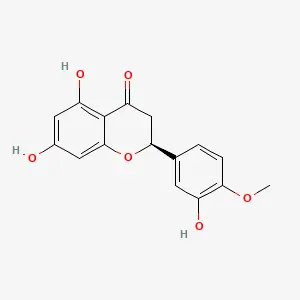
Hesperetin is a flavanone, a compound in the flavonoid family. In citrus fruit it mostly sits in a sugar-bound form called hesperidin. French chemist Lebreton first isolated hesperidin in 1828 from the white inner layer of citrus peel. Its name comes from hesperidium, the botanical term for a citrus fruit.
It is thought to help defend the plant. In the USDA data, lemons hold 27.9 mg of hesperetin per 100 g and oranges 27.3 mg, about 18 times more than grapefruit (1.5 mg). Peppermint has 10.2 mg.
Almost all the research on this page used hesperidin, not hesperetin. Trials give hesperidin as a supplement or in orange juice. Bacteria in the gut turn it into hesperetin, the form that reaches the blood, and each study card says which one was given.
Most readers do not know how slow this is. In 16 volunteers, blood hesperetin peaked about 7 hours after ordinary orange juice. It peaked after 0.6 hours when an enzyme had first turned the juice’s hesperidin into hesperetin-7-glucoside.
The same molecule is also the raw material for a drug. A European assessment report explains that diosmin can be made by extracting hesperidin from citrus rind and converting it. One leg-vein medicine holds 90% diosmin and 10% flavonoids counted as hesperidin. We include that drug only where the combination is named.
Health benefits of hesperetin
The top findings from 30 studies, strongest evidence first
What the stars mean
- Strong. Several randomized trials, pooled in a meta-analysis, point the same way, or regulators (FDA or EFSA) have approved the claim.
- Moderate. Good randomized trials support it, but there are fewer of them, or their results vary.
- Limited. Small, short or single trials, or mixed results. Promising, but it needs confirmation.
Population and lab studies get no stars: they show a link or a mechanism, not proof.
How we rate evidence →- ★★★Diosmin and hesperidin medicine eased heavy, painful legsIn 7 trials in chronic venous disease, the medicine Daflon (diosmin with hesperidin) beat placebo for heaviness (0.35 times the risk) and leg pain (0.53). It is a drug, not hesperetin or food.
- ★★The same medicine eased hemorrhoid symptomsPooled trials of MPFF (mostly diosmin with some hesperidin) found the odds of bleeding were 0.082 times as high and of discharge 0.12 times. After hemorrhoid surgery, 22 trials found less pain, bleeding and swelling.
- ★★Mixed effects on cholesterolIn 12 trials of hesperidin extracts, LDL cholesterol fell by 0.22 mmol/L. An earlier pool of 10 trials found no change in cholesterol or blood pressure.
- ★★Mixed effects on blood sugarOne pool of trials found fasting blood sugar fell with hesperidin. A pool of 6 trials found no change in fasting glucose or HbA1c (long-term blood sugar).
- ★★No effect on weight, fat or waistIn 11 trials of orange juice, hesperidin or both, body weight changed by -0.31 kg and waist by 0.07 cm, both within chance.
All 30 studies, strongest evidence first
A diosmin and hesperidin drug eased leg heaviness, swelling and pain
This meta-analysis pooled 7 double-blind, placebo-controlled trials in chronic venous disease, with 1,692 patients, mostly at low risk of bias. Against placebo, the risk ratios were 0.35 for heaviness, 0.39 for feeling of swelling and 0.53 for leg pain. Ankle circumference and quality of life improved too. The product is Daflon, a purified fraction of diosmin with hesperidin sold as a medicine, not hesperetin or food. The abstract does not say who paid.
In 12 trials, hesperidin lowered LDL cholesterol by 0.22 mmol/L
This meta-analysis pooled 12 randomized trials with 589 people taking hesperidin extracts or purified hesperidin. Total cholesterol fell 0.20 mmol/L. CRP, an inflammation marker, fell by 0.56 mg/L, a borderline result. The adhesion markers ICAM-1 and VCAM-1 fell too, while the other heart-risk factors did not clearly change.
Hesperidin lowered blood fats and systolic pressure in a dose analysis
This dose-response meta-analysis of randomized trials in adults gives no trial count or effect sizes in the abstract. Triglycerides, LDL and total cholesterol, systolic blood pressure (the top number) and TNF-alpha fell, and body weight went up. HDL, blood sugar, CRP, diastolic pressure, IL-6, BMI and waist did not change. The most effective dose was around 1,000 mg a day, and lower insulin needed more than 8 weeks.
Across 10 trials, hesperidin supplements did not change cholesterol or blood pressure
This meta-analysis pooled 10 randomized trials with 577 people, searched up to May 2018. Total cholesterol changed by -1.04 mg/dL, LDL by -1.96 mg/dL and systolic pressure by -0.85 mm Hg, all within chance. The newer analyses here include more trials, and some find small effects.
Another analysis: hesperidin lowered blood sugar, blood fats and systolic pressure
This meta-analysis of randomized trials was searched to August 2023, and the abstract gives no trial count or effect sizes. Fasting blood sugar, triglycerides, total cholesterol, LDL, systolic pressure and TNF-alpha fell. HDL, diastolic pressure, CRP, insulin and HOMA-IR did not change. Trials longer than 12 weeks and doses above 500 mg a day showed the clearest drops in blood sugar and cholesterol.
6 trials: hesperidin left blood sugar, insulin and HbA1c unchanged
This meta-analysis pooled 6 randomized trials with 318 people. Fasting glucose changed by -1.10 mg/dL and HbA1c by -0.04%, both within chance. That held whatever the design, duration or health of the people. The authors say animal studies could not be confirmed in humans.
Hesperidin lowered an insulin resistance score 0.43; not proven as treatment
This meta-analysis pooled 16 randomized trials with 845 people. HOMA-IR is a score of insulin resistance. The authors say the evidence does not support hesperidin as a treatment. A second index of insulin sensitivity, QUICKI, rose by 0.05, while fasting insulin, glucose and HbA1c did not change. Subgroups on high-dose, long-term purified hesperidin did better on insulin levels, but a trial sequential analysis found no clear improvement in HOMA-IR.
If overweight or obese, hesperidin lowered CRP 0.43 mg/L
This meta-analysis pooled 16 randomized trials of hesperidin and hesperidin-containing citrus products, with 845 overweight or obese people. The CRP result was graded moderate certainty. TNF-alpha fell 2.84 pg/mL and VCAM-1 fell 27.16 ng/mL, but both are graded very low certainty. IL-6, ICAM-1 and antioxidant capacity did not change, and forms and doses varied too much to advise on either.
In 10 trials, hesperidin lowered CRP and TNF-alpha, not IL-6
This meta-analysis pooled 10 randomized trials with 532 adults. CRP fell by -0.43 on a standard scale and TNF-alpha by -0.51. IL-6 did not clearly change overall (-0.25), though it fell in people with type 2 diabetes or a past heart attack (-0.38).
Orange juice or hesperidin did not change weight, fat or waist
This meta-analysis pooled 11 randomized trials with 512 people given orange juice, hesperidin or both. Body weight changed by -0.31 kg, BMI by 0.11 kg/m2 and waist by 0.07 cm, all within chance. Fat mass did not change either. The authors call for better trials.
For hemorrhoids, a diosmin-hesperidin drug cut bleeding and discharge
This meta-analysis pooled 4 of 11 randomized studies of micronized purified flavonoid fraction (MPFF, Daflon). It is a drug made mostly of diosmin with some hesperidin. The odds of bleeding were 0.082 times as high and of anal discharge 0.12 times. Pain tended to fall (0.11), but that could be chance. Servier, which makes Daflon, paid for the analysis and its statistics, as the full paper states.
After hemorrhoid surgery, MPFF eased pain, bleeding and swelling
This meta-analysis pooled 22 randomized trials of the flavonoid fraction MPFF, with 2,335 people. Clinical efficacy improved, and bleeding rate, pain score and edema (swelling) score fell, with no substantial effect on adverse reactions. Doses of 1,800 to 2,700 mg a day cut pain and edema scores. The authors note small samples and want more research.
450 mg hesperidin 2S did not improve blood vessel dilation
68 overweight adults took it or placebo daily for 6 weeks. Flow-mediated dilation, a test of artery widening, did not change, before or after a high-fat meal. Blood pressure and adhesion molecules only tended to fall. An exploratory subgroup with a healthier baseline looked better, without adjusting for multiple tests.
In COVID-19, hesperidin did not clearly cut the main symptoms
In this double-blind, placebo-controlled trial, 216 unvaccinated adults with the infection took 1 g of hesperidin a day or placebo for 14 days. On day 14, fever, cough, breathlessness or loss of smell remained in 58.5% of the placebo group and 49.4% of the hesperidin group. That is 0.69 times the odds, a gap that could be chance. A second analysis that counted missing reports as no symptoms gave a clear result, but 28 hesperidin and 15 placebo people did not report.
Hesperidin and diosmin lowered blood sugar, triglycerides and LDL
This randomized trial had 129 people with type 2 diabetes, metabolic syndrome and nerve damage. They took 1 g a day of hesperidin, diosmin or both for 12 weeks, and the pair worked best. The control group took only its usual diabetes drugs, so there was no placebo. Nerve scores improved in both treated groups, more with the combination.
500 mg hesperidin lowered systolic blood pressure and CRP in diabetes
In this double-blind trial, 64 people with type 2 diabetes took hesperidin or placebo for 6 weeks. In the hesperidin group, systolic pressure fell from 122.7 to 119.0 and hs-CRP from 1.9 to 1.1. The changes also differed from placebo after adjustment, and IL-6 and TNF-alpha fell too. It is a small trial.
Orange juice or 210 mg hesperidin did not improve artery widening
In this double-blind crossover trial, 37 overweight men drank 330 mL of juice, a control drink or a hesperidin-enriched drink for 6 weeks each. Blood levels of hesperetin metabolites were comparable from juice and the hesperidin drink. Yet neither changed flow-mediated dilation, fasting or after a meal, nor metabolic or body measures. Responses varied a lot between people.
Flavanone-rich orange juice improved global thinking skills in older adults
In this double-blind crossover trial, 37 healthy adults with a mean age of 67 drank 500 mL a day for 8 weeks. The juice gave 305 mg of flavanones a day, and the comparison drink was low in flavanones (37 mg). There was a 4-week washout between them. Mood and blood pressure did not change.
Hesperetin with resveratrol lowered fasting blood sugar 5%
In this placebo-controlled crossover trial, 29 overweight and obese adults took hesperetin with trans-resveratrol. In the most overweight (BMI above 27.5), fasting glucose fell 5%, glucose after a meal 8%, and plasma methylglyoxal 37%. The abstract gives no dose and says each compound alone was ineffective earlier, so hesperetin cannot be credited alone. A follow-up paper from the same trial says three authors hold a patent on the pair.
500 mg hesperidin widened arteries better in metabolic syndrome
In this placebo-controlled crossover trial, which the authors call exploratory, 24 people with metabolic syndrome took hesperidin or placebo daily for 3 weeks. Flow-mediated dilation rose from 7.78% to 10.26%. Inflammation markers (hs-CRP, serum amyloid A and soluble E-selectin) fell too. The same paper reports the cell experiments described below.
Juice or a hesperidin drink lowered diastolic blood pressure in men
In this randomized crossover trial, 24 overweight men aged 50 to 65 drank orange juice or a hesperidin drink. They had 500 mL a day for 4 weeks. Fasting vessel reactivity did not change. After a meal, at the time of peak hesperetin in blood, it improved with both. The abstract gives no size for the drop in diastolic pressure (the bottom number).
A single dose of orange juice did not change vessel function
In this crossover trial, 16 men aged 51 to 69 at moderate heart risk took orange juice, a matching supplement or a control. The juice held 320 mg of hesperidin, and vessels were measured 5 hours later. Juice raised blood levels of flavanone metabolites, but the hesperidin supplement did not differ from control, so absorption differed. Only one dose was tested.
Blood orange juice widened arteries more, but it also holds anthocyanins
In this crossover trial, 15 overweight adults drank 200 mL of blood orange juice twice daily for 2 weeks, or a sugar-matched drink. Flow-mediated dilation rose from 8.15% to 10.2% on juice, against 8.11% to 7.77% on the drink. Urinary hesperetin glucuronides rose, but blood orange also carries anthocyanins, so hesperidin cannot be singled out. Blood pressure, lipids and hs-CRP did not change.
Monoglucosyl hesperidin did not change a lymph-flow measure, except in a subgroup
In this placebo-controlled crossover trial, 30 healthy adults took 300 mg a day of monoglucosyl hesperidin. Thoracic duct width was measured by ultrasound. A change appeared only in people with no exercise habit. Authors work for Suntory Beverage & Food, which also funded their university.
A hesperetin glucoside complex raised skin blood flow in the cold
This randomized, placebo-controlled crossover trial in healthy adults tested 150 and 300 mg of a cyclodextrin complex during cold stress. They held 19.5 and 39 mg of hesperetin-7-glucoside, a form of hesperetin itself. Blood flow rose with the dose, and skin temperature recovered better. The abstract gives no sample size, and all authors work for the maker, Taiyo Kagaku.
Top flavanone intake linked to less ischemic stroke in women
This prospective study followed 69,622 women in the Nurses’ Health Study for 14 years, with 1,803 strokes. Women who ate the most flavanones had 0.81 times the risk of ischemic stroke (caused by a blocked artery). Citrus fruits and juices, the main source, showed a similar trend that could be chance (0.90). Total flavonoid intake was not linked to stroke, and food questionnaires cannot rule out other habits of citrus eaters.
Top flavanone intake linked to less ischemic stroke in men
This prospective study followed 43,880 men for 24 years, with 4,046 heart attacks and 1,572 strokes. Men who ate the most flavanones had 0.78 times the risk of ischemic stroke, but no lower heart attack risk. Flavanone intake was not linked to total stroke either. The ischemic stroke link was strongest in men aged 65 and over, and its trend test could be chance.
Top flavanone intake linked to fewer heart disease deaths in women
This prospective study followed 34,489 postmenopausal women in the Iowa Women’s Health Study for 16 years. The highest flavanone intake had a rate ratio of 0.78 for coronary heart disease death. Flavonoid intake was not linked to stroke death. Grapefruit was among the foods tied to fewer heart disease deaths.
In vein cells, hesperetin raised nitric oxide release; naringenin did not
This was a study in human vein cells. Hesperetin activated estrogen receptor alpha more than beta and raised eNOS, the enzyme that makes nitric oxide. An estrogen-receptor blocker and a gene-activity blocker (actinomycin D) stopped the response. The authors suggest a route that may matter most after menopause.
Hesperetin switched on the Nrf2 defense pathway in fatty liver models
This cell and animal study used liver cells loaded with oleic acid, and rats on a high-fat diet. Hesperetin switched on Nrf2, calmed NF-κB, raised antioxidant enzymes and cut TNF-alpha and IL-6. Silencing Nrf2 or blocking the enzymes SOD and GPx removed the anti-inflammatory effect. Rats also had less liver fat and fibrosis.
Foods high in hesperetin
Citrus is the main source. In the USDA data, lemons (27.9 mg per 100 g) and oranges (27.3 mg) lead, followed by peppermint (10.2 mg). One orange (131 g) gives 35.7 mg and one lemon (58 g) 16.2 mg, and the ranking below shows the rest.
USDA reports hesperetin, the sugar-free part, while the fruit carries it mostly as hesperidin. Orange juice is the other big source: a 500 mL portion held 345 mg of hesperidin in one trial.
Trial doses are far above a normal serving. Hesperidin weighs about twice as much as hesperetin (molar masses 610.6 and 302.3). So by our arithmetic, 500 mg of hesperidin holds about 250 mg of hesperetin, roughly the amount in 7 oranges by the USDA figure. 1,000 mg holds about 14 oranges’ worth.
That is a rough guide, since fruit varies. The ranking below is from USDA data.
Per serving. No daily amount is set, so bars compare each food with the top food.
Per 100 g. No daily amount is set, so bars compare each food with the top food.
Per 100 kcal: the same calories of each food, for a fair comparison. Bars compare each food with the top food.
Food labels have no Daily Value or Reference Intake for hesperetin, so the % compares each food with the top food.
- 1.

- 2.

- 3.

- 4.
- 5.


- 1.
- 2.
- 3.
- 4.
- 5.
- 1.
- 2.
- 3.
- 4.
- 5.
Sources
- Bhagwat S, Haytowitz DB. USDA Database for the Flavonoid Content of Selected Foods, Release 3.3 (2018). US Department of Agriculture, Agricultural Research Service, Nutrient Data Laboratory.
- Crescenti A, Caimari A, Alcaide-Hidalgo JM, et al. Hesperidin Bioavailability Is Increased by the Presence of 2S-Diastereoisomer and Micronization-A Randomized, Crossover and Double-Blind Clinical Trial. Nutrients. 2022.
- Hesperidin. Wikipedia. Molar mass and discovery.
- Hesperetin. Wikipedia. Molar mass.
- Garg A, Garg S, Zaneveld LJ, et al. Chemistry and pharmacology of the Citrus bioflavonoid hesperidin. Phytother Res. 2001.
How hesperetin works
Most of what we know about how hesperetin works comes from test tubes, cells and animals, and from a few small absorption trials in people. Three ideas keep coming up.
It has to be freed by gut bacteria before it can work. It nudges blood vessel cells to make nitric oxide. And it switches on the cell’s own defenses. Here is each one, and what has been seen in people.
It needs gut bacteria to set it free
Hesperidin is hesperetin with a sugar, rutinose, attached. Reviews say bacteria in the gut, mainly in the upper colon, cut that sugar off and release hesperetin.
A trial fed each form directly into the small intestine of healthy volunteers. About 80% of the hesperidin form was recovered unabsorbed, and no hesperetin metabolites appeared in blood. The glucoside form was split by the gut wall and absorbed, with only about 3% recovered. EFSA, the EU’s food safety agency, adds that only conjugated forms, such as hesperetin glucuronide, enter the blood.
Simplified path of hesperidin in the body, about absorption and not health effects. When each form was fed straight into the small intestine of healthy volunteers, about 80% of the hesperidin form came out unabsorbed, against about 3% of the glucoside form.
That is why timing and form matter. In the juice trial below, hesperetin-7-glucoside gave twice the total exposure of natural juice. Its peak was about 4 times higher and came in 0.6 hours instead of 7.0.
A micronized 2S-hesperidin extract was also better absorbed. 70% of the dose was recovered in urine as metabolites and breakdown products, against 55% for the micronized mix and 43% for the standard mix.
People differ too. A review suggests that gut bacteria that make the enzyme alpha-rhamnosidase explain part of why trial results disagree. In 8 men, a hesperetin-7-glucoside and cyclodextrin compound gave over 100 times the blood exposure of a hesperidin and dextrin mix. That was a small non-randomized study by authors at the maker, Taiyo Kagaku.
Drawn to scale; the 0.6 h bar is thin. Glucoside juice was orange juice treated with an enzyme so its hesperidin became hesperetin-7-glucoside. High-dose juice was fortified to hold three times the natural hesperidin. Peak blood levels were about 4 times higher with the glucoside juice than with the natural juice.
It nudges blood vessel cells to make nitric oxide
Nitric oxide relaxes blood vessels. In cultured artery cells, hesperetin switched on the kinases Src, Akt and AMPK, which switched on eNOS, the enzyme that makes nitric oxide. It also lowered the sticking of immune cells to the vessel lining.
In a separate study on human vein cells, hesperetin raised the amount of eNOS through estrogen receptor alpha. Naringenin did not raise nitric oxide at all.
Two routes found in cultured blood vessel cells, in two different studies. In the second study, naringenin, a related citrus flavanone, did not raise nitric oxide.
Not every test points the same way. In 16 men, a single dose of orange juice raised blood flavanone metabolites to 15.20 µmol/L in total. Vessel function still did not change. The dish studies do not show whether the amounts reached after a glass of juice are enough, and blood levels vary between people.
It switches on the cell’s own defenses
In liver cells loaded with fat, and in rats on a high-fat diet, hesperetin switched on Nrf2. Nrf2 is a control protein that tells cells to make their own protective enzymes, such as SOD and GPx. Hesperetin also held back NF-κB, a switch that turns on inflammation.
When Nrf2 was silenced, or those enzymes were blocked, the anti-inflammatory effect disappeared, so the two seem linked. A 2015 review adds that the antioxidant effect of hesperidin and hesperetin is not only direct radical scavenging. It also strengthens the cell’s own defenses, partly through an ERK and Nrf2 route. These are lab models, and they do not show that food amounts do the same in people.
What has been seen in people
The effects in people are smaller and less steady than those in dishes. In 24 people with metabolic syndrome, 500 mg of hesperidin a day raised flow-mediated dilation from 7.78% to 10.26%, which fits the nitric oxide findings. But 450 mg a day for 6 weeks in 68 overweight adults changed nothing in vessel function. Nor did 210 mg a day for 6 weeks in 37 men.
Some meta-analyses find small drops in CRP of about 0.4 to 0.6 mg/L, while others find none. Varying absorption may explain part of the mixed picture, according to one review. All of these are among the study cards above.
Sources
- Stevens Y, Rymenant EV, Grootaert C, et al. The Intestinal Fate of Citrus Flavanones and Their Effects on Gastrointestinal Health. Nutrients. 2019. Reviews hesperidin and gut bacteria; one author works for BioActor BV.
- Actis-Goretta L, Dew TP, Lévèques A, et al. Gastrointestinal absorption and metabolism of hesperetin-7-O-rutinoside and hesperetin-7-O-glucoside in healthy humans. Mol Nutr Food Res. 2015.
- Nielsen IL, Chee WS, Poulsen L, et al. Bioavailability is improved by enzymatic modification of the citrus flavonoid hesperidin in humans: a randomized, double-blind, crossover trial. J Nutr. 2006.
- Crescenti A, Caimari A, Alcaide-Hidalgo JM, et al. Hesperidin Bioavailability Is Increased by the Presence of 2S-Diastereoisomer and Micronization-A Randomized, Crossover and Double-Blind Clinical Trial. Nutrients. 2022.
- Moriwaki M, Kito K, Nakagawa R, et al. Bioavailability comparison between a compound comprising hesperetin-7-glucoside with β-cyclodextrin and a mixture of hesperidin and dextrin in healthy adult human males. Biosci Biotechnol Biochem. 2021. Authors work for the maker, Taiyo Kagaku.
- Mas-Capdevila A, Teichenne J, Domenech-Coca C, et al. Effect of Hesperidin on Cardiovascular Disease Risk Factors: The Role of Intestinal Microbiota on Hesperidin Bioavailability. Nutrients. 2020.
- EFSA Panel on Nutrition, Novel Foods and Food Allergens (NDA). Safety of glucosyl hesperidin as a Novel food pursuant to Regulation (EU) 2015/2283. EFSA J. 2024.
- Rizza S, Muniyappa R, Iantorno M, et al. Citrus polyphenol hesperidin stimulates production of nitric oxide in endothelial cells while improving endothelial function and reducing inflammatory markers in patients with metabolic syndrome. J Clin Endocrinol Metab. 2011.
- Liu L, Xu DM, Cheng YY. Distinct effects of naringenin and hesperetin on nitric oxide production from endothelial cells. J Agric Food Chem. 2008.
- Schär MY, Curtis PJ, Hazim S, et al. Orange juice-derived flavanone and phenolic metabolites do not acutely affect cardiovascular risk biomarkers: a randomized, placebo-controlled, crossover trial in men at moderate risk of cardiovascular disease. Am J Clin Nutr. 2015.
- Li J, Wang T, Liu P, et al. Hesperetin ameliorates hepatic oxidative stress and inflammation via the PI3K/AKT-Nrf2-ARE pathway in oleic acid-induced HepG2 cells and a rat model of high-fat diet-induced NAFLD. Food Funct. 2021.
- Parhiz H, Roohbakhsh A, Soltani F, et al. Antioxidant and anti-inflammatory properties of the citrus flavonoids hesperidin and hesperetin: an updated review of their molecular mechanisms and experimental models. Phytother Res. 2015.
Is hesperetin safe? Supplements, dose and interactions
Hesperidin from citrus is a normal part of diets. EFSA notes that hesperidin has a history of use in the EU from foods and supplements. Before 1997, supplements usually gave no more than 600 mg a day. We found no upper level for plain hesperidin or hesperetin from EFSA, the FDA or NIH (US National Institutes of Health).
Glucosyl hesperidin is hesperidin with an extra glucose. In 2024 EFSA found that up to 364 mg a day was safe for adults. It based this on a no-effect level of about 1,000 mg per kg of body weight in a 90-day rodent study. Human trials up to 3 g a day for 12 weeks showed no clinically relevant blood changes. The FDA had no questions about the same ingredient (GRN 901, 2019), as EFSA reports.
- Trial doses and side effects. Trials gave 210 to 1,000 mg of hesperidin a day for 2 to 12 weeks. The trial abstracts did not highlight side effects. One meta-analysis checked, in 22 trials of the diosmin and hesperidin fraction after hemorrhoid surgery, and saw no substantial effect on adverse reactions.
- The diosmin and hesperidin drug. A Hungarian assessment report describes a 450 mg diosmin and 50 mg hesperidin tablet, authorized in EU states under well-established use. It is a prescription-only medicine for chronic venous insufficiency and acute hemorrhoidal crisis. A review of its trials found the most common adverse events were digestive and autonomic. It is a drug, so use it under medical advice.
- Drug interactions. We found no controlled human study of hesperidin supplements with prescription drugs. The risk is unknown rather than shown to be absent, so ask a pharmacist if you take regular medicines.
- Pregnancy, breastfeeding and children. We found no safety trials of hesperidin supplements in pregnancy or breastfeeding. EFSA’s glucosyl hesperidin opinion covered children from age 1, but that is a different ingredient, so ask a doctor.
How to get more hesperetin
- Best food. Oranges and lemons, at 27.3 and 27.9 mg per 100 g, hold about 18 times more than grapefruit (1.5 mg). One orange gives 35.7 mg.
- Juice or fruit. Juice worked as a carrier. In 16 men, a juice raised flavanone metabolites to 15.20 µmol/L, while a hesperidin supplement matching its dose did not differ from control. In a newer trial of 37 men, juice and a 210 mg hesperidin drink gave comparable blood exposure.
- Food versus supplement. A form with the sugar changed gives faster, higher absorption. Micronized 2S-hesperidin gave 70% urinary excretion against 43% for a standard mix. Trial doses of 450 to 1,000 mg of hesperidin are many oranges’ worth, and results were mixed.
Sources
- EFSA Panel on Nutrition, Novel Foods and Food Allergens (NDA). Safety of glucosyl hesperidin as a Novel food pursuant to Regulation (EU) 2015/2283. EFSA J. 2024. Mentions GRAS notice GRN 901 (2019) for the same ingredient.
- Hungarian National Center for Public Health and Pharmacy. Public Assessment Report: VenoprotEP 500 mg film-coated tablets (diosmin/hesperidin 450/50 mg), HU/H/0612/001/MR.
- Lyseng-Williamson KA, Perry CM. Micronised purified flavonoid fraction: a review of its use in chronic venous insufficiency, venous ulcers and haemorrhoids. Drugs. 2003.
- Fu H, Guo W, Zhou B, et al. Efficacy and safety of micronized purified flavonoid fractions for the treatment of postoperative hemorrhoid complications: A systematic review and meta-analysis. Phytomedicine. 2022.
- Schär MY, Curtis PJ, Hazim S, et al. Orange juice-derived flavanone and phenolic metabolites do not acutely affect cardiovascular risk biomarkers: a randomized, placebo-controlled, crossover trial in men at moderate risk of cardiovascular disease. Am J Clin Nutr. 2015.
- Gilcher C, Milenkovic D, Taillandier M, et al. Orange juice and hesperidin increase flavanone exposure without detectable short-term vascular benefits: a randomized crossover trial. Food Funct. 2026.
- Crescenti A, Caimari A, Alcaide-Hidalgo JM, et al. Hesperidin Bioavailability Is Increased by the Presence of 2S-Diastereoisomer and Micronization-A Randomized, Crossover and Double-Blind Clinical Trial. Nutrients. 2022.
- Nielsen IL, Chee WS, Poulsen L, et al. Bioavailability is improved by enzymatic modification of the citrus flavonoid hesperidin in humans: a randomized, double-blind, crossover trial. J Nutr. 2006.
History of hesperetin
The story starts with hesperidin. French chemist Lebreton first isolated it in 1828 from the white inner layer of citrus peel. The name comes from hesperidium, the term for fruit of citrus trees, and hesperetin is what is left when the sugar is removed.
EFSA notes that hesperidin is still isolated from citrus peels, juice or seeds. A 2001 review called it an abundant, inexpensive by-product of citrus growing.
A drug grew out of it. A Hungarian assessment report says diosmin was first isolated in 1925 and has been used in medicine since the 1960s. It was first marketed in Europe in 1971 and reformulated in micronized form in 1986.
Diosmin differs from hesperidin by one double bond and can be made from it. That drug is the only hesperidin-related product with strong evidence on this page.
Supplements and cohort science came later. EFSA reports hesperidin supplements in the EU before May 1997, usually not above 600 mg a day. Glucosyl hesperidin has been sold in Japan since 1998, about 20 tons a year.
In 2007, a US study of 34,489 women used USDA flavonoid databases to link flavanone intake to fewer deaths from coronary heart disease. In 2024 EFSA concluded glucosyl hesperidin was safe up to 364 mg a day.
Sources
- Hesperidin. Wikipedia.
- Hungarian National Center for Public Health and Pharmacy. Public Assessment Report: VenoprotEP 500 mg film-coated tablets (diosmin/hesperidin 450/50 mg), HU/H/0612/001/MR.
- EFSA Panel on Nutrition, Novel Foods and Food Allergens (NDA). Safety of glucosyl hesperidin as a Novel food pursuant to Regulation (EU) 2015/2283. EFSA J. 2024.
- Garg A, Garg S, Zaneveld LJ, et al. Chemistry and pharmacology of the Citrus bioflavonoid hesperidin. Phytother Res. 2001.
- Mink PJ, Scrafford CG, Barraj LM, et al. Flavonoid intake and cardiovascular disease mortality: a prospective study in postmenopausal women. Am J Clin Nutr. 2007.
Frequently asked questions about hesperetin
What does hesperetin do for the body?
Most of the evidence is on hesperidin, the form in oranges, and it is mixed. One analysis of 12 trials found LDL cholesterol down 0.22 mmol/L and CRP down 0.56 mg/L. Another, of 10 trials, found no change in cholesterol or blood pressure. Only a drug, diosmin with hesperidin, reached strong evidence, for leg vein disease, and almost all results come from supplements, not food.
Is hesperetin the same as hesperidin?
No. Hesperidin is hesperetin with a sugar attached, and the sugar must be cut off by gut bacteria before hesperetin is absorbed. In 16 volunteers, blood hesperetin peaked after 7.0 hours with natural orange juice and 0.6 hours when the juice held hesperetin-7-glucoside. Nearly every trial on this page gave hesperidin.
Which foods are high in hesperetin?
Lemons (27.9 mg per 100 g) and oranges (27.3 mg) lead the USDA data, and peppermint has 10.2 mg. The ranking above shows the rest. Per serving, one orange gives 35.7 mg and one lemon 16.2 mg. Orange juice is a source too, with 345 mg of hesperidin in 500 mL in one trial.
How much hesperidin should you take a day?
No dose is proven best. Trials used 210 to 1,000 mg a day, and one analysis found about 1,000 mg the most effective for blood fats and pressure. We found no upper level from EFSA, the FDA or NIH for plain hesperidin. EFSA reports that supplements before 1997 usually stayed under 600 mg. Talk to a clinician before going higher, especially if you take medicines.
Does hesperidin lower blood pressure?
Results disagree. A meta-analysis of 10 trials found systolic pressure only 0.85 mm Hg lower, within chance. Two newer analyses found a clear drop in systolic pressure. In 24 men, 500 mL of orange juice a day for 4 weeks lowered diastolic pressure. In a 64-person diabetes trial, 500 mg a day lowered systolic pressure from 122.7 to 119.0.
Does hesperidin or hesperetin have side effects?
Few have been reported, but the trials are short. EFSA saw no clinically relevant blood changes in trials of glucosyl hesperidin up to 3 g a day for 12 weeks. For the diosmin and hesperidin drug, the most common events were digestive. We found no studies in pregnancy or of interactions with medicines, so ask a doctor or pharmacist.
What is diosmin, and how does it relate to hesperetin?
Diosmin is a flavone that can be made from hesperidin. The purified fraction sold as Daflon is 90% diosmin and 10% flavonoids counted as hesperidin. In 7 placebo-controlled trials with 1,692 patients it eased leg heaviness, swelling and pain, and in a hemorrhoid analysis it cut bleeding. These results are for the drug combination, not for hesperetin.
Is orange juice or a hesperidin supplement better?
Neither is proven. In 16 men, juice raised blood flavanone metabolites and a supplement matching its dose did not. In 37 men, juice and a 210 mg hesperidin drink gave comparable levels, and neither improved vessel function. No trial tested time of day, but one found blood hesperetin peaking about 7 hours after natural orange juice.