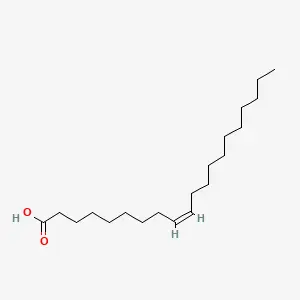
Gadoleic acid (cis-9-eicosenoic acid, 20:1 n-11, C20H38O2) is a monounsaturated fat with 20 carbons. It has one double bond. Researchers group it with erucic acid and similar fats as the long-chain monounsaturated fatty acids, or LCMUFA. These are monounsaturated fats with 20 or more carbons, mainly 20:1 and 22:1.
The name joins Gadus, the cod genus, with the Latin word for oil. It is a minor fat, and no health body sets a daily amount of it.
Do not confuse it with gondoic acid (20:1 n-9). It has the same length and the same number of double bonds, but the bond sits two carbons further along the chain. Fish oils carry mostly the n-11 type, according to one review, while rapeseed and mustard oils make the n-9 type beside erucic acid.
Even researchers mix the two names. USDA lists a single 20:1 value for both, so a food table cannot tell them apart. Its shorter cousin oleic acid has 18 carbons.
The health evidence is thin. We found no trial that gave gadoleic acid by itself. The nearest are small trials of saury, mackerel and herring oils, which carry 20:1 and 22:1 fats together. Blood-level studies exist too, but they cannot separate the two forms.
Results point in different directions. A saury oil trial lowered LDL particle count. But two large US cohorts linked blood 22:1 and 24:1, not 20:1, to more heart failure. A Chinese case-control study linked higher 20:1 to colorectal cancer.
Health benefits of gadoleic acid
The top findings from 11 studies, strongest evidence first
What the stars mean
- Strong. Several randomized trials, pooled in a meta-analysis, point the same way, or regulators (FDA or EFSA) have approved the claim.
- Moderate. Good randomized trials support it, but there are fewer of them, or their results vary.
- Limited. Small, short or single trials, or mixed results. Promising, but it needs confirmation.
Population and lab studies get no stars: they show a link or a mechanism, not proof.
How we rate evidence →- ★Mixed LDL results with related fish oilsIn 30 healthy adults, saury oil (rich in gadoleic and related fats) cut LDL particle count 12% versus a sardine and olive oil mix. A cetoleic concentrate cut LDL about 7% in 75 adults with excess weight; cetoleic-rich mackerel oil did not in 37 healthy women and 12 men.
- ★Saury oil improved blood vessel functionIn 60 people, 4 weeks of saury oil improved endothelial function (how well blood vessels relax) and lowered trimethylamine-N-oxide (TMAO). Saury oil holds several fats, so this is not specific to gadoleic acid.
- ★Raised blood levels of omega-3 fatsIn 37 healthy women and 12 healthy men, 4 weeks of cetoleic-rich mackerel oil (a related fat) raised plasma EPA more than a control oil. One grilled saury meal raised blood EPA, DHA and long-chain monounsaturated fats in 5 adults.
- Population studyLinked to higher colorectal cancer odds in ChinaPeople with colorectal cancer had higher serum C20:1 (1.98 times the odds) than controls, 680 in each group. This design cannot tell whether the fat raised risk or the disease changed levels.
- Population studyLinked to higher activity of an HDL enzymeIn 1,548 people, higher gadoleic acid intake from a food questionnaire went with higher paraoxonase 1 activity, an enzyme carried on HDL cholesterol. The questionnaire cannot tell the 20:1 isomers apart.
All 11 studies, strongest evidence first
Saury oil cut LDL particle count 12% versus an olive-sardine mix
In this double-blind crossover trial, 30 healthy adults took 12 g of saury oil a day for 8 weeks. The oil is rich in 20:1 and 22:1 fats. The comparison was a sardine and olive oil mix, with an 8-week washout between. The saury oil held 3.5 g of long-chain monounsaturated fats, with C20:1 and C22:1 isomers counted together. It also held 3.4 g of omega-3 fats. The control oil held 4.9 g of oleate and 3 g of omega-3 fats. LDL cholesterol rose 7.5% from baseline on the control oil but not on saury oil. The result cannot be credited to gadoleic acid alone.
In 60 people, saury oil improved blood vessel function and lowered TMAO
This double-blind, randomized, parallel-group trial at several centers gave healthy people saury oil, rich in long-chain monounsaturated fats, or olive and tuna oils. It lasted 4 weeks, and some authors work for a fish company (Nippon Suisan Kaisha). Saury oil improved endothelial function (how well blood vessels relax) and lowered trimethylamine-N-oxide (TMAO). In the same paper, mice prone to atherosclerosis ate a Western diet for 12 weeks. The diet held 3% gadoleic acid (C20:1) or, in a second group, cetoleic acid (C22:1). They had smaller lesions and less IL-6 and TNF-alpha (inflammation markers). Saury oil holds both fats together, so the human result is not specific to gadoleic acid.
A cetoleic concentrate cut LDL about 7% versus soybean oil
In this randomized, double-blind trial, 75 adults with overweight or obesity took capsules or a soybean oil comparator for 8 weeks. The capsules gave 1,480 mg a day of cetoleic acid (22:1 n-11, a longer fat than gadoleic acid) and 232 mg of EPA. The soybean oil held 258 mg of EPA. LDL cholesterol changed by a median of −0.1 mmol/L with the concentrate and by +0.2 mmol/L with the comparator.
Cetoleic-rich mackerel oil raised plasma EPA more than a control oil
In this double-blind randomized trial, 37 healthy women and 12 healthy men took mackerel oil rich in cetoleic acid for 4 weeks. The control oil had similar omega-3 content. Plasma EPA and eicosatetraenoic acid rose more on the mackerel oil. Cholesterol, glucose and C-reactive protein did not differ between the groups, so the LDL drop in the trial above did not show in healthy people. Cetoleic acid is 22:1 n-11, not gadoleic acid, and the paper’s summary gives no daily dose of the capsules.
Cetoleic-gondoic oil raised omega-3 index about as much as EPA-DHA oil
This pilot covered two double-blind, placebo-controlled trials of an oil from North Atlantic fish. In CetoIndex, 55 healthy volunteers had their omega-3 index measured from a blood spot. The oil, rich in cetoleic and gondoic acids, raised it about as much as an oil with more EPA and DHA. In Optihud, 28 women had skin photos, and the oil reduced skin redness, a marker of inflammation. Three of the five authors work for a fish oil maker, and the authors call the work preliminary.
One saury meal raised blood EPA, DHA and LCMUFA in 5 adults
The healthy adults had blood drawn before the 150 g grilled meal and at 2, 6 and 24 hours. Levels stayed raised through the 24 hours measured. C20:1 and C22:1 isomers were counted together. Plasma insulin rose while glucose and free fatty acids fell. This is a tiny study without a comparison meal, and the authors work for a fish company (Nippon Suisan Kaisha).
Blood 22:1 and 24:1, not 20:1, tracked heart failure
Two US cohorts measured plasma phospholipid fatty acids. They were the Cardiovascular Health Study (3,694 older adults) and the Atherosclerosis Risk in Communities Study (3,577 middle-aged adults). They followed people for 997 and 330 heart failure events. For 22:1 the hazard ratios were 1.34 and 1.57, top against bottom fifth; for 24:1 they were 1.75 and 1.92. In the paper’s results, gadoleic acid (20:1) showed no significant link. Blood levels tracked fish, poultry, meat, whole grains and mustard, and cause is unknown.
In 1,548 people, gadoleic acid intake went with higher paraoxonase 1 activity
Intake of six fatty acids, estimated by food frequency questionnaire, was tested against this enzyme, which travels on HDL (“good”) cholesterol. Four, including gadoleic acid (20:1), were independently linked to the enzyme activity. Myristic acid was also positive, and arachidonic acid and EPA negative. A questionnaire cannot tell the 20:1 isomers apart, and the authors say the mechanism needs more research.
Higher serum C20:1: 1.98 times the colorectal cancer odds
This case-control study in China compared 680 colorectal cancer cases with 680 controls aged 30 to 75. Serum fatty acids were measured by gas chromatography, and the odds ratio was adjusted for other factors. C22:1 (1.83) and C24:1 (6.33) were also higher in cases, while palmitoleic acid (C16:1) was lower (0.48). A case-control design cannot settle whether the fat raised risk or the disease changed blood levels.
Higher serum eicosenoic acid went with higher type 2 diabetes odds
This cross-sectional analysis of 3,760 adults in two NHANES cycles (a US national survey) shows a snapshot, not which came first. The study names the n-9 type, eicosenoic acid (20:1 n-9, gondoic acid), not gadoleic acid. Higher levels went with higher odds of diabetes, and so did oleic acid, while nervonic acid went with lower odds. The link for eicosenoic acid was nonlinear.
In atherosclerosis-prone mice, a C20:1 concentrate cut lesions over 40%
LDL receptor-deficient mice, prone to atherosclerosis, ate a Western diet for 12 weeks. The diet included 5% of either concentrate from saury oil. The C22:1 concentrate cut lesions by a similar amount. Plasma lipoproteins and liver fat changed little, but C-reactive protein fell. Both concentrates raised PPAR activity in liver cells. This is a mouse result, not a human dose.
Foods high in gadoleic acid
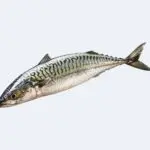
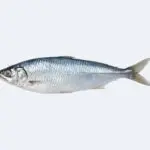
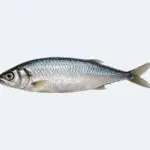
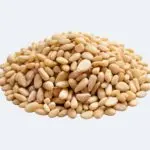
Fish and nuts fill our USDA ranking, and fish lead per serving. Mackerel gives 1.16 g in one fillet (112 g), and herring 0.61 g in 3 oz (85 g). Macadamia nuts, sardines and pine nuts come next.
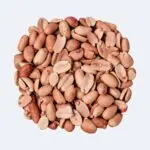
Per 100 g the order changes: macadamia nuts lead with 1.89 g, then mackerel at 1.04 g, with pine nuts, herring and peanuts next. Farmed Atlantic salmon and wild Atlantic salmon are in the ranking too. The ranking below shows every amount.
What the ranking counts matters. USDA’s documentation for its Standard Reference database lists one value called 20:1, named eicosenoic acid. It gives gadoleic acid as the common name of its most typical isomer (form).
It has no separate row for the n-11 and n-9 forms, and says that specific isomers, where known, are added into the total. So the ranking shows total 20:1, not gadoleic acid alone.
Fish and plants make different mixes, but labs do not always agree on which is which. A review names the n-11 types, gadoleic and cetoleic acid, as the main long-chain monounsaturated fats of marine oils like saury, pollock and herring. It names the n-9 types, gondoic and erucic acid, as those of rapeseed and mustard oils.
Yet an analysis of salted herring listed gadoleic acid as 20:1n-9 among its most abundant fatty acids. A lab that tested a store-bought cod liver oil listed 20:1 n-9 above both EPA and DHA in that sample.
Fish get these fats from their prey. A study of lanternfish suggests their 20:1 fats trace to the wax esters of the zooplankton they eat. It suggests the same for saury, herring and sprats.
Oils sit outside the ranking. Codex Alimentarius lists 20:1 at 5.0% to 13.0% of the fatty acids in mustardseed oil. Rapeseed oil not low in erucic acid has 3.0% to 15.0%, low-erucic rapeseed oil (canola) 0.1% to 4.3%, and peanut oil 0.7% to 1.7%.
Jojoba oil is a different thing: about 98% of it is wax, mainly wax esters built from 20:1 and 22:1 acids and alcohols. It is sold for skin, not for cooking. We found no study of how cooking, frying or refining changes 20:1 in these foods.
Per serving. No daily amount is set, so bars compare each food with the top food.
Per 100 g. No daily amount is set, so bars compare each food with the top food.
Per 100 kcal: the same calories of each food, for a fair comparison. Bars compare each food with the top food.
Food labels have no Daily Value or Reference Intake for gadoleic acid, so the % compares each food with the top food.
- 1.
- 2.
- 3.

- 4.
- 5.
- 6.
- 7.
- 8.
- 9.
- 10.



- 1.
- 2.
- 3.
- 4.
- 5.
- 6.
- 7.
- 8.
- 9.
- 10.


- 1.
- 2.
- 3.
- 4.
- 5.

- 6.
- 7.
- 8.
- 9.
- 10.


Sources
- FoodData Central. US Department of Agriculture, Agricultural Research Service. Values as shown in the ranking above.
- US Department of Agriculture, Agricultural Research Service. USDA National Nutrient Database for Standard Reference, Release 28: documentation and user guide. 2015 (revised 2016). Table 2 lists 20:1 as eicosenoic acid (gadoleic) with no isomer rows, and explains how isomers are summed.
- Yang ZH, Emma-Okon B, Remaley AT. Dietary marine-derived long-chain monounsaturated fatty acids and cardiovascular disease risk: a mini review. Lipids Health Dis. 2016.
- Aro TL, Larmo PS, Bäckman CH, et al. Fatty acids and fat-soluble vitamins in salted herring (Clupea harengus) products. J Agric Food Chem. 2005.
- Dalheim L, Svenning JB, Eilertsen KE, et al. In vitro intestinal digestion of lipids from the marine diatom Porosira glacialis compared to commercial LC n-3 PUFA products. PLoS One. 2021.
- Saito H, Murata M. The high content of monoene fatty acids in the lipids of some midwater fishes: family Myctophidae. Lipids. 1996.
- Codex Alimentarius. Standard for named vegetable oils (CODEX STAN 210-1999). Amendment 2015. Table 1, row C20:1.
- Gad HA, Roberts A, Hamzi SH, et al. Jojoba oil: an updated comprehensive review on chemistry, pharmaceutical uses, and toxicity. Polymers (Basel). 2021.
- Gadoleic acid. Wikipedia. For the origin of the name and cod liver oil as an example source.
How gadoleic acid works
Almost everything known about what a 20-carbon monounsaturated fat does comes from blood measurements, cells and mice, not from trials of gadoleic acid. This section covers the two names, where such a fat goes in the body, and what has been seen in people.
Two 20-carbon fats share one name
The same 20 carbons and one double bond, in two places. Positions follow the names used in a review of marine long-chain monounsaturated fats; the chain is drawn to scale, with the double bond highlighted. Many studies on this page write 20:1 without saying which type they measured.
The two fats share a formula, C20H38O2. Gadoleic acid is (9Z)-icos-9-enoic acid. Its double bond sits between carbons 9 and 10, counting from the acid end, which makes it n-11. Gondoic acid has the bond between carbons 11 and 12, which makes it n-9.
Papers use the names loosely. One NHANES study on this page measured the n-9 type and called it eicosenoic acid. Others wrote gadoleic acid or C20:1 without naming the type. So in the cohort studies, the label tells you the length, not the position.
Where a 20-carbon monounsaturated fat goes
Three links for 20-carbon monounsaturated fats. The food link comes from two US cohorts (3,694 and 3,577 adults), the fuel link from cell studies cited in that paper, and the signal links from liver cells and mice. A diagram, not to scale.
The authors of the heart failure cohort paper note that cell studies suggest 20:1 is burned in mitochondria more than 22:1. They add that long-chain monounsaturated fats in general are mostly burned in peroxisomes. They offer this as one reason 20:1 did not behave like the longer fats.
In the same cohorts, 20:1 went with a generally healthier profile of body fat and blood measures. But repeat blood samples showed that a single 20:1 level is only a rough guide to long-term levels.
In mice, a 20:1 concentrate and a 22:1 concentrate lowered plaque equally. Both raised PPAR activity in liver cells, a signal that helps control fat handling.
We found no human study of how gadoleic acid itself is absorbed. In fish oils the 20:1 and 22:1 fats arrive together with EPA and DHA, so the trials cannot say which fat did what. In the saury meal study, plasma 20:1 and 22:1 rose together within hours of eating.
What has been seen in people
The human evidence is small and mixed. Two fish oil trials found better lipid or vessel measures after saury oil or a cetoleic acid concentrate. But each tested a mix of fats, one involved a fish company, and the cetoleic trial in healthy people found no change in lipids.
The cohorts disagree too. In them, 20:1 was not linked to heart failure but was linked to more colorectal cancer in China. The n-9 type went with more type 2 diabetes in the US.
Our reading: gadoleic acid is a marker of eating fish and some plant foods. It is a minor part of fish oil, with no proven benefit of its own.
Sources
- Yang ZH, Emma-Okon B, Remaley AT. Dietary marine-derived long-chain monounsaturated fatty acids and cardiovascular disease risk: a mini review. Lipids Health Dis. 2016.
- National Center for Biotechnology Information. PubChem compound summary for gadoleic acid (CID 5282767). US National Library of Medicine. C20H38O2; (Z)-icos-9-enoic acid.
- Imamura F, Lemaitre RN, King IB, et al. Long-chain monounsaturated fatty acids and incidence of congestive heart failure in 2 prospective cohorts. Circulation. 2013.
- Yang ZH, Gordon SM, Sviridov D, et al. Dietary supplementation with long-chain monounsaturated fatty acid isomers decreases atherosclerosis and alters lipoprotein proteomes in LDLr(-/-) mice. Atherosclerosis. 2017.
- Tsutsumi R, Yamasaki Y, Takeo J, et al. Long-chain monounsaturated fatty acids improve endothelial function with altering microbial flora. Transl Res. 2021.
- Yang ZH, Miyahara H, Takeo J, Katayama M. Ingestion of a single serving of saury alters postprandial levels of plasma n-3 polyunsaturated fatty acids and long-chain monounsaturated fatty acids in healthy human adults. Lipids Health Dis. 2012.
- Liu S, Liu Y, Liu L, et al. Relationship between serum levels of unsaturated fatty acids and type 2 diabetes mellitus: a cross-sectional analysis of NHANES 2003-2004 and 2011-2012. J Diabetes Res. 2026.
- Li JH, Fang YJ, Ou QJ, Zhang CX. Higher serum concentrations of myristoleic acid, gadoleic acid, erucic acid, and nervonic acid, along with a lower concentration of palmitoleic acid, are associated with an increased risk of colorectal cancer. Nutr Res. 2026.
- Hansen K, Mjaatveit MA, et al. Supplementation with a cetoleic acid concentrate decreased the serum LDL-cholesterol concentration in healthy adults with overweight or obesity. Br J Nutr. 2026.
- Holven KB, Dahl TB, et al. Cetoleic acid-rich fish oil increases plasma levels of EPA and DHA in healthy volunteers: a double-blinded, randomised, controlled trial. Br J Nutr. 2026.
How much gadoleic acid do you need?
No daily amount of gadoleic acid is set, and the FDA and the EU have set no daily value for it. EFSA proposed no reference value for cis-monounsaturated fat in 2010. The FAO and WHO treat monounsaturated fat as what is left of total fat after saturated, polyunsaturated and trans fat.
For scale, a US survey analysis in the heart failure cohort paper estimated that adults ate about 239 mg of 20:1 a day. That was in 2003 to 2010, with foods such as seafood, poultry, meats and mustard among the sources. That is the paper’s estimate, not a target.
There is no deficiency to describe. We found no disease named for a lack of gadoleic acid, no accepted blood level and no trial that raised it to test an outcome. The fats that must come from food are linoleic acid and alpha-linolenic acid. The blood levels in the cohort studies on this page are markers of what people eat, not targets.
Sources
- EFSA Panel on Dietetic Products, Nutrition and Allergies (NDA). Scientific opinion on Dietary Reference Values for fats, including saturated fatty acids, polyunsaturated fatty acids, monounsaturated fatty acids, trans fatty acids, and cholesterol. EFSA J. 2010.
- FAO and WHO. Fats and fatty acids in human nutrition: report of an expert consultation. FAO Food and Nutrition Paper 91. Food and Agriculture Organization. 2010.
- Imamura F, Lemaitre RN, King IB, et al. Long-chain monounsaturated fatty acids and incidence of congestive heart failure in 2 prospective cohorts. Circulation. 2013.
Forms of gadoleic acid: absorption and effects
Gadoleic acid reaches you inside other fats, and the form depends on the source. It comes as triglycerides in fish oil, as wax esters in copepod and jojoba oils, and mixed with erucic acid in rapeseed and mustard oils.
We found no human trial of purified gadoleic acid, and no trial that compared one form of 20:1 with another. None measured how well gadoleic acid alone is absorbed. Claims that one form is absorbed or works better have no trial behind them.
The outcome trials above used saury oil (12 g a day), a cetoleic acid concentrate, mackerel oil and whole grilled fish. The wax ester trials below measured omega-3 status, not 20:1.
| Form | What it is | What studies show | Source |
|---|---|---|---|
| Fish oil triglycerides (saury, mackerel, herring) | Oil from oily fish, with 20:1 and 22:1 fats beside EPA and DHA | Saury oil at 12 g a day lowered LDL particle count against a sardine and olive oil mix in 30 healthy adults. A cetoleic acid concentrate lowered LDL cholesterol in adults with overweight, but mackerel oil did not change lipids in healthy adults. | 1, 2, 8, 10 |
| Cod liver oil | Oil from cod livers; one analysis of a store-bought product listed 20:1 n-9 above both EPA and DHA | We found no trial that followed its 20:1. | 4 |
| Wax ester oil (Calanus oil) | Oil from the copepod Calanus finmarchicus with fatty acids mostly bound as wax esters; a review lists it among marine oils rich in long-chain monounsaturated fats | In 36 older adults, 2 g a day for 12 weeks with exercise raised the omega-3 index from 6.07% to 7.37%. In 62 healthy people, 12 weeks of Calanus, fish or krill oil raised it by a similar amount. We found no trial that followed 20:1 from this oil. | 3, 5, 8 |
| Jojoba oil | Mostly liquid wax (about 98% wax), made of wax esters built from 20:1 and 22:1 acids and alcohols; sold for skin | Studies of jojoba oil test the whole oil on skin or in animals, not gadoleic acid. We found no human trial of eating it. | 6 |
| Rapeseed and mustard oils | Plant oils that carry the n-9 type, gondoic acid, beside erucic acid | Codex lists 20:1 at 5.0% to 13.0% of the fatty acids in mustardseed oil, 3.0% to 15.0% in rapeseed oil not low in erucic acid and 0.1% to 4.3% in low-erucic rapeseed oil (canola). We found no trial that tested these oils for their 20:1. | 7, 8 |
| Concentrates of 20:1 or 22:1 | Fractions made from saury oil, and a cetoleic acid concentrate | A 5% C20:1 concentrate lowered plaque in mice. In people, only a cetoleic acid (22:1) concentrate has been tested, in adults with overweight. We found no human trial of a 20:1 concentrate. | 2, 9 |
Sources
- Yang ZH, Amar M, Sorokin AV, et al. Supplementation with saury oil, a fish oil high in omega-11 monounsaturated fatty acids, improves plasma lipids in healthy subjects. J Clin Lipidol. 2020.
- Hansen K, Mjaatveit MA, et al. Supplementation with a cetoleic acid concentrate decreased the serum LDL-cholesterol concentration in healthy adults with overweight or obesity. Br J Nutr. 2026.
- Wasserfurth P, Nebl J, Boßlau TK, et al. Intake of Calanus finmarchicus oil for 12 weeks improves omega-3 index in healthy older subjects engaging in an exercise programme. Br J Nutr. 2020.
- Dalheim L, Svenning JB, Eilertsen KE, et al. In vitro intestinal digestion of lipids from the marine diatom Porosira glacialis compared to commercial LC n-3 PUFA products. PLoS One. 2021.
- Vosskötter F, Burhop M, Hahn A, Schuchardt JP. Equal bioavailability of omega-3 PUFA from Calanus oil, fish oil and krill oil: a 12-week randomized parallel study. Lipids. 2023.
- Gad HA, Roberts A, Hamzi SH, et al. Jojoba oil: an updated comprehensive review on chemistry, pharmaceutical uses, and toxicity. Polymers (Basel). 2021.
- Codex Alimentarius. Standard for named vegetable oils (CODEX STAN 210-1999). Amendment 2015.
- Yang ZH, Emma-Okon B, Remaley AT. Dietary marine-derived long-chain monounsaturated fatty acids and cardiovascular disease risk: a mini review. Lipids Health Dis. 2016.
- Yang ZH, Gordon SM, Sviridov D, et al. Dietary supplementation with long-chain monounsaturated fatty acid isomers decreases atherosclerosis and alters lipoprotein proteomes in LDLr(-/-) mice. Atherosclerosis. 2017.
- Holven KB, Dahl TB, et al. Cetoleic acid-rich fish oil increases plasma levels of EPA and DHA in healthy volunteers: a double-blinded, randomised, controlled trial. Br J Nutr. 2026.
Is gadoleic acid safe? Limits and who should watch it
At food amounts, we found no source that flags gadoleic acid as a concern, and no authority has set an upper limit for it. Its 22-carbon relative is different.
Animals fed large amounts of erucic acid stored fat in heart muscle, which led breeders to develop canola. EFSA set a tolerable daily intake of 7 mg per kilogram of body weight for erucic acid. Nothing like that has been shown for gadoleic acid.
- Trial safety. In the first-in-human trial, 30 healthy adults with normal lipids took 12 g a day of saury oil for 8 weeks. It was safe and well tolerated. That is one small trial, not a safe limit, and it says nothing about longer use.
- Heart failure. In two US cohorts, higher blood 22:1 and 24:1, not 20:1, went with more heart failure. These are observational findings. We found no trial of concentrated long-chain monounsaturated oils in people with heart failure. So people with that condition can ask their doctor before taking them.
- Colorectal cancer signal. One Chinese case-control study linked higher serum C20:1 to colorectal cancer. A single study of this design cannot show cause, and we found no trial on the question.
- Jojoba oil is a skin product. It is mostly wax, and we found no human trial of eating it, so do not treat it as a dietary source of gadoleic acid.
How to get more gadoleic acid, if you want to
- Eat oily fish you like. Mackerel gives 1.16 g in one fillet in our ranking, ahead of herring (0.61 g in 3 oz) and sardines (0.39 g in one can). The reason to eat them is EPA and DHA; there is no target for 20:1.
- Add nuts for variety. Macadamia nuts give 0.54 g in 1 oz and pine nuts 0.23 g, though our data cannot say which type of 20:1 they hold.
- Skip the supplement. No trial shows a benefit of purified gadoleic acid, and the oils tested held several fats at once.
Sources
- EFSA Panel on Contaminants in the Food Chain (CONTAM). Scientific opinion on erucic acid in feed and food. EFSA J. 2016.
- Imamura F, Lemaitre RN, King IB, et al. Long-chain monounsaturated fatty acids and incidence of congestive heart failure in 2 prospective cohorts. Circulation. 2013.
- Yang ZH, Amar M, Sorokin AV, et al. Supplementation with saury oil, a fish oil high in omega-11 monounsaturated fatty acids, improves plasma lipids in healthy subjects. J Clin Lipidol. 2020.
- Li JH, Fang YJ, Ou QJ, Zhang CX. Higher serum concentrations of myristoleic acid, gadoleic acid, erucic acid, and nervonic acid, along with a lower concentration of palmitoleic acid, are associated with an increased risk of colorectal cancer. Nutr Res. 2026.
- Gad HA, Roberts A, Hamzi SH, et al. Jojoba oil: an updated comprehensive review on chemistry, pharmaceutical uses, and toxicity. Polymers (Basel). 2021.
Frequently asked questions about gadoleic acid
What is gadoleic acid?
Gadoleic acid (20:1 n-11, C20H38O2) is a monounsaturated fat with 20 carbons and one double bond. It is named for the cod genus Gadus. It is a main long-chain monounsaturated fat in fish oils such as saury, pollock and herring oil. USDA reports it only inside a combined 20:1 value, and no daily amount is set.
Is gadoleic acid omega-9 or omega-11?
Strictly, it is omega-11 (n-11). The double bond sits 11 carbons from the methyl end, between carbons 9 and 10 counting from the acid end. The omega-9 fat of the same length is gondoic acid (20:1 n-9), with the bond between carbons 11 and 12. Many papers and food tables write gadoleic acid or 20:1 without saying which, so the omega label depends on the source.
Is gadoleic acid the same as gondoic acid or eicosenoic acid?
Not exactly. Eicosenoic acid is the general name for 20:1 fats, and gadoleic (n-11) and gondoic (n-9) acid are two of them. USDA lists 20:1 as eicosenoic acid and names gadoleic acid as its most typical isomer, so its numbers cover the whole group. Some studies use the names loosely, so check which type a paper measured.
Which foods are highest in gadoleic acid?
In our USDA ranking, mackerel lead per serving with 1.16 g in one fillet. Herring (0.61 g in 3 oz), macadamia nuts (0.54 g in 1 oz) and sardines (0.39 g in one can) follow. Per 100 g macadamia nuts lead with 1.89 g. The values are total 20:1 and count more than one fat.
What are the benefits of gadoleic acid?
None is proven for gadoleic acid itself. A small trial of saury oil, rich in 20:1 and 22:1 fats, lowered LDL particle count in 30 healthy adults over 8 weeks. Another improved endothelial function in 60 people over 4 weeks, but both tested a mix of fats. Cohort findings are mixed, and one Chinese study linked higher 20:1 to colorectal cancer.
Does gadoleic acid help skin?
Not shown. A pilot of 28 women saw less skin redness with a fish oil rich in cetoleic and gondoic acids. But three of its five authors work for a fish oil maker, and the oil held several fats. Studies of jojoba oil on skin test the whole oil. We found no trial of gadoleic acid on skin.
Should I take a gadoleic acid supplement?
No. We found no human trial of purified gadoleic acid and no health claim for it. The one saury oil trial that tested safety gave 12 g of oil a day for 8 weeks to 30 healthy adults. That says nothing about longer use or about people with heart disease.
Is gadoleic acid related to erucic acid?
Yes, as a chemical cousin: both are long-chain monounsaturated fats. Erucic acid (22:1 n-9) has 22 carbons and an EFSA tolerable daily intake of 7 mg per kilogram of body weight. Gadoleic acid has no limit. In two US cohorts, blood 22:1 and 24:1, not 20:1, went with more heart failure.