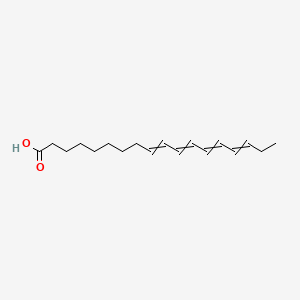
Parinaric acid (octadecatetraenoic acid; 18:4 n-3; C18H28O2) is a polyunsaturated fat with 18 carbons. Its four double bonds sit in an alternating row, which chemists call conjugated. It comes as two main forms: alpha-parinaric acid, the cis form (9Z,11E,13E,15Z), and the all-trans beta form.
Plants make it from alpha-linolenic acid with an enzyme called conjugase, and garden balsam (Impatiens) seed oil is a measured source. The name comes from Parinari, the tree genus where the acid was first found.
The most useful thing to know is what it is used for. Four conjugated double bonds make parinaric acid fluoresce (glow under light), and it loses that glow when it oxidizes. So scientists use it as a probe of cell membranes and of lipid peroxidation, the oxidation of fats.
We found no trial in people and no study of anyone eating it, so nothing here counts as a health benefit. The 17 studies below are cell, test-tube and plant-chemistry work.
Do not confuse it with stearidonic acid (SDA). Both are 18:4 n-3 and have the same formula. SDA has its double bonds at carbons 6, 9, 12 and 15, spaced apart. Parinaric acid has them at 9, 11, 13 and 15, side by side.
SDA is the one with human trials. In 15 people per group, it raised tissue EPA about 0.3 times as well as EPA itself, against 0.07 for alpha-linolenic acid. In 252 overweight adults, 4.2 g a day of SDA from enriched soybean oil raised the omega-3 index to 4.69%. On regular soybean oil it was 4.15%.
The lead author works for Monsanto. None of this applies to parinaric acid.
Health benefits of parinaric acid
We found no human health study of parinaric acid. No trial has given it to people, and no cohort has measured it in blood. No finding reaches strong, moderate or even limited evidence.
All 17 studies are labeled lab: cancer cells in dishes, purified proteins, test-tube membranes, computer models and plant seed analyses. The strongest-sounding finding is that cancer cell lines died at low concentrations while normal cells were spared. That is a cell-culture result, with no animal or human follow-up that we found.
All 17 studies, strongest evidence first
Cis-parinaric acid was toxic to cancer cells at 5 µM or less
Researchers grew human leukemia and retinoblastoma (eye cancer) cells in dishes (the U-937, THP-1, HL-60 and Y-79 lines). The antioxidant butylated hydroxytoluene blocked the toxicity, which points to lipid peroxidation. Differentiated U-937 cells resisted as much as 30 µM (micromoles per liter). Fibroblasts, endothelial cells and colon cells were much less sensitive. The authors suggest it may be a prototype for lipid chemotherapy drugs; no animal or person was tested.
12 µmol/L of cis-parinaric acid killed nearly 90% of glioma cells
The glioma (brain tumor) cells died within 24 hours in dishes, while fetal rat astrocytes lost 3%. Four malignant lines (rat, human and a leukemia line) reacted alike, and normal astrocytes showed only 20% toxicity at 40 µmol/L. Alpha-tocopherol (vitamin E) blocked the effect, and a 10-fold rise in 8-isoprostane, an oxidation product, fits an oxidative mechanism. Cells in a dish only.
Cis-parinaric acid kept a stress signal on in rat tumor cells
The study compared 36B10 malignant rat astrocytoma cells with fetal rat astrocytes. In the tumor cells, it kept the stress kinase JNK switched on. It also cut the activity of the antioxidant enzyme Mn-SOD, unlike in normal astrocytes. Inhibitors of JNK reversed the toxicity in the malignant cells, and the authors link the different responses to the greater sensitivity of the tumor cells.
Parinaric acid made up 5.93% to 70.21% of Impatiens seed fats
Gas chromatography and mass spectrometry measured four forms of parinaric acid in 21 Impatiens species. Three species (I. mengtszeana, I. racemulosa and I. oppositifolia) held more than 50% parinaric acid, and the related plant Hydrocera triflora had none. Alpha-linolenic acid made up 11.07% to 53.99%. This is plant chemistry, not a health study.
Two Impatiens seed oils held 43.44% and 36.12% parinaric acids
Liquid chromatography measured these conjugated acids by mole, as a share of all fatty acids, in garden balsam (I. balsamina) and I. walleriana seed oils. Beta-parinaric was 23.21% and 26.27% of the conjugated acids, and alpha-linolenic acid 24.5% and 28.2% of the fatty acids. Fifteen triacylglycerols (fat molecules) carried conjugated chains.
Zambian seed oils held alpha-eleostearic acid, not parinaric acid
This study of three traditional cooking-oil trees in Zambia found Parinari curatellifolia and Schinziophyton rautanenii seed oils were chiefly alpha-eleostearic acid (28.58% to 55.96%). Alpha-eleostearic acid (18:3) is a related conjugated fat. The abstract names no parinaric acid. So a seed from the genus that gave parinaric acid its name does not have to contain it.
In Burundi, Parinari curatellifolia seed oil was 58.41% erucic acid
Fatty acids were measured in seed oils of 12 wild plants, and this tree stood out from the 11 others. It gave a different profile than in the Zambian study, so location, variety or method may matter. The abstract names erucic acid, not parinaric acid.
A garden balsam gene made soybean embryos produce alpha-parinaric acid
The gene was cloned from developing Impatiens balsamina seeds, and soybeans normally lack this fat. It encodes a diverged Δ12-oleic acid desaturase that the authors call a conjugase. A similar enzyme from bitter melon gave alpha-eleostearic and alpha-parinaric acids up to 17% (wt/wt) of embryo fatty acids. The authors work at DuPont and aimed at drying oils for paints, not nutrition.
A brown seaweed extract turned alpha-linolenic acid into parinaric acid
The extract came from the brown seaweed Padina arborescens. Of lipids from 12 Japanese seaweed species, only this species held conjugated fatty acids. The abstract gives no yield. The aim is a supply of conjugated fatty acids for cancer research.
A chemistry method made four parinaric acid isomers at 65% combined yield
This chemistry paper started from alpha-linolenic acid. Bromination, dehydrobromination with a base and saponification turn it into the 4-double-bond conjugated chain. Treating the mixture gives only the all-trans beta-parinaric acid. The isomers were checked by NMR, UV and mass spectrometry.
In a test tube, cis-parinaric acid bound the human receptor PPARγ
PPARγ is a nuclear receptor, a protein that switches genes on and off. Binding raised the fluorescence and shifted the UV spectrum, and other known ligands competed it off. The authors call it the first direct demonstration of a fatty acid binding to PPARγ. It shows binding to a purified receptor, not an effect in cells or people.
The receptor PPARα bound unsaturated fats very tightly
Trans-parinaric acid and cis-parinaroyl-CoA served as glowing reporters (fluorescent ligands). With them, PPARα bound unsaturated long chain fatty acids and their CoA forms, as a group. The Kd values were 1 to 14 nM (a very tight bond), and the energy transfer distances 25 to 29 angstroms. Saturated fatty acids were not significantly bound; this is purified-protein work.
In rat heart cells, free cis-parinaric acid oxidized faster than other fats
Free cis-parinaric acid oxidized faster than parinaroyl, arachidonoyl or linoleoyl lipids, which oxidized at similar rates. The authors tested three radical-generating systems. They conclude that the free probe could overestimate damage, while parinaroyl-lipid is a better marker for the loss of ordinary polyunsaturated fats. Good evidence of how easily the conjugated chain oxidizes, not of a health effect.
In LDL, parinaric acid’s glow faded as soon as radicals formed
LDL is the “bad” cholesterol particle. Its parinaric acid fluorescence faded the moment peroxyl radicals formed, and ascorbate, cysteine and urate delayed the fading. The loss of fluorescence served as a quick screening test for chain-breaking antioxidants in lab dishes; caffeic and chlorogenic acids were strong. No person or animal took part.
Parinaric acid revealed gel domains in living yeast membranes
Trans-parinaric acid lifetimes above 30 ns gave the first direct evidence of gel domains in a living cell membrane. It was studied with diphenylhexatriene in cells, spheroplasts and isolated membranes. The authors conclude the gel domains are not ergosterol-rich rafts but are mainly made of sphingolipids. Parinaric acid here is a reporter, not a treatment.
Trans-parinaric acid’s glow told liquid-ordered from gel phases
In lipid bilayers of a three-lipid mixture, an intermediate fluorescence lifetime marked liquid-ordered samples. A long one marked gel and a short one the liquid-disordered phase. The authors built a phase diagram for DOPC, sphingomyelin and cholesterol at 23 °C. They note tPA is also sensitive to tiny domains that a microscope misses.
In simulations, trans-parinaric acid favored gel-phase membranes more than the cis form
All-atom and coarse-grained molecular dynamics modeled POPC (fluid) and DPPC (gel) lipid bilayers on a computer. The trans form partitioned more strongly into gel-phase membranes, with tighter lipid packing around it. The simulations agreed with published fluorescence data, which is why the two forms are used as membrane probes.
Foods high in parinaric acid
Parinaric acid is not a food nutrient in the usual sense. Our USDA ranking lists no food with a value, and we found no analysis of a common food for it. The published measurements come from seeds of garden plants in the genus Impatiens, which are not eaten in the sources we found. They also come from oil trees named Parinari.
The name does not guarantee the content. Reference works name the makita tree (Parinari laurina) of Fiji as the original source. But the one Parinari species with published oil analyses that we found, P. curatellifolia, gave alpha-eleostearic acid in Zambia and erucic acid in Burundi.
Among Impatiens species the range is wide: 5.93% to 70.21% of the fatty acids across 21 species. We found no study of how cooking or refining changes it.
| Food | Amount of fatty acids | Source |
|---|---|---|
| Impatiens balsamina (garden balsam) seed oil | Conjugated octadecatetraenoic acids (alpha- and beta-parinaric) 43.44 mole % of fatty acids; alpha-linolenic acid 24.5% | 1 |
| Impatiens walleriana seed oil | Conjugated octadecatetraenoic acids 36.12 mole %; alpha-linolenic acid 28.2% | 1 |
| 21 Impatiens species | Four forms of parinaric acid, 5.93% to 70.21% of fatty acids; above 50% in three species | 2 |
| Parinari curatellifolia seed oil, Zambia | No parinaric acid named; alpha-eleostearic acid 28.58% to 55.96% (two oils studied) | 3 |
| Parinari curatellifolia seed oil, Burundi | Erucic acid 58.41%; no parinaric acid named | 4 |
Sources
- Van Nguyen A, Vu ATN, Deineka VI, et al. Determination of triacylglycerol and fatty acid compositions of Impatiens seed oils using reverse phase high performance liquid chromatography. Turk J Chem. 2022.
- Puri R, Choudhary AK, Barman P, et al. Two unusual conjugated fatty acids, parinaric acid and α-eleostearic acid, are present in several Impatiens species, but not in congener Hydrocera triflora. Physiol Mol Biol Plants. 2022.
- Frankova A, Manourova A, Kotikova Z, et al. The Chemical Composition of Oils and Cakes of Ochna serrulata (Ochnaceae) and Other Underutilized Traditional Oil Trees from Western Zambia. Molecules. 2021.
- Niyukuri J, Raiti J, Ntakarutimana V, et al. Lipid composition and antioxidant activities of some underused wild plants seeds from Burundi. Food Sci Nutr. 2021.
- FoodData Central. US Department of Agriculture, Agricultural Research Service. Our ranking for parinaric acid is empty.
- α-Parinaric acid. Wikipedia. Names the makita tree of Fiji as the original natural source.
How parinaric acid works
Almost everything known about what parinaric acid does comes from cell dishes, purified proteins and computer models. This section covers how plants make it and why cancer cells in dishes reacted to it. It also covers why researchers use it to light up membranes and what it does to nuclear receptors in test tubes. Last comes what has been seen in people.
Plants build it from alpha-linolenic acid
Carbon chains drawn from the acid end on the left to the methyl end on the right; the double bonds sit between the numbered carbon and the next one. Alpha-linolenic acid has them spaced apart, while parinaric acid has four in an alternating row. Positions come from the chemical names; chain drawn to scale.
In soybean embryos, genes cloned from garden balsam and bitter melon seeds made conjugated fatty acids that soybeans do not make. The enzyme is a diverged form of the Δ12-oleic acid desaturase, called a conjugase.
Chemists can reach the same chain without plants. A bromination route gave four parinaric acid isomers from alpha-linolenic acid in 65% combined yield. An extract from the brown seaweed Padina arborescens made parinaric acid from alpha-linolenic acid. The Cahoon authors work at DuPont and aimed at industrial drying oils.
Cancer cells in dishes were more sensitive than normal cells
Toxicity of cis-parinaric acid after 24 hours in cultured cells, drawn to scale. A rat glioma line lost nearly 90% at 12 µmol/L, while fetal rat astrocytes lost 3%. Cells in a dish; no animal or person was tested.
Two groups at the University of Iowa found that leukemia, retinoblastoma and glioma cell lines died at low concentrations of cis-parinaric acid. Differentiated or normal cells tolerated far more. Antioxidants (butylated hydroxytoluene, alpha-tocopherol) blocked the toxicity, which points to lipid peroxidation. The conjugated chain oxidizes easily, and undifferentiated U-937 cells took up 3 to 4 times more of it than differentiated ones.
Follow-up work in rat astrocytoma cells found a sustained JNK stress signal and a fall in the antioxidant enzyme Mn-SOD. A 2025 review by Honma says the cell death caused by conjugated fatty acids is a programmed form called ferroptosis. That differs from how many anticancer drugs work. We found no animal or human study to show that any of this works in a body.
Parinaric acid concentrations from one cell-culture study, drawn to scale. Leukemia, retinoblastoma and other malignant lines were harmed at 5 µM or less; U-937 cells that had been differentiated resisted as much as 30 µM.
It glows, so researchers use it to map membranes
Intrinsically fluorescent probes are rare, and the two parinaric acids stand out as probes of membrane order and dynamics. The fluorescence lifetime of trans-parinaric acid tells fluid, liquid-ordered and gel lipid phases apart. That let one group find gel domains in living yeast membranes and another build a phase diagram of a three-lipid mixture. Simulations show the trans form packs more tightly and partitions more into gel membranes than the cis form.
Parinaric acid is also consumed quickly by oxidation. So a loss of its fluorescence reports lipid peroxidation in LDL, red blood cells and heart cells. A 1999 validation study warned that the free acid oxidizes faster than ordinary membrane fats, so it may overstate damage.
It binds nuclear receptors in test tubes
Cis-parinaric acid was the first fatty acid shown to bind the receptor PPARγ directly. Parinaric acid and its CoA form also served as glowing ligands in a PPARα study. There, unsaturated fatty acids as a group bound with Kd values of 1 to 14 nM.
These are binding results with purified proteins. They do not show that parinaric acid switches these receptors on in a body, or that any tissue ever meets it.
What has been seen in people
Nothing. We found no human trial, no cohort, no case report and no animal feeding study. Everything above is a cell, a purified protein, a membrane model or a plant. If a headline claims parinaric acid prevents cancer or helps the heart, it has gone far beyond these papers.
Sources
- Cahoon EB, Carlson TJ, Ripp KG, et al. Biosynthetic origin of conjugated double bonds: production of fatty acid components of high-value drying oils in transgenic soybean embryos. Proc Natl Acad Sci U S A. 1999.
- Kuklev DV, Smith WL. Synthesis of four isomers of parinaric acid. Chem Phys Lipids. 2004.
- Ito H, Honma T, Tabata H, et al. Enzyme from Padina arborescens Holmes Synthesizes Parinaric Acid, a Conjugated Tetraenoic Fatty Acid, from α-Linolenic Acid. J Oleo Sci. 2024.
- Honma T. Discovery and Synthesis of Conjugated Fatty Acids from Natural Products. J Oleo Sci. 2025.
- Cornelius AS, Yerram NR, Kratz DA, et al. Cytotoxic effect of cis-parinaric acid in cultured malignant cells. Cancer Res. 1991.
- Traynelis VC, Ryken TC, Cornelius AS. Cytotoxicity of cis-parinaric acid in cultured malignant gliomas. Neurosurgery. 1995.
- Zaheer A, Sahu SK, Ryken TC, et al. Cis-parinaric acid effects, cytotoxicity, c-Jun N-terminal protein kinase, forkhead transcription factor and Mn-SOD differentially in malignant and normal astrocytes. Neurochem Res. 2007.
- Oliveira AC, Filipe HAL, Loura LMS. Fluorescent Probes cis- and trans-Parinaric Acids in Fluid and Gel Lipid Bilayers: A Molecular Dynamics Study. Molecules. 2023.
- Aresta-Branco F, Cordeiro AM, Marinho HS, et al. Gel domains in the plasma membrane of Saccharomyces cerevisiae: highly ordered, ergosterol-free, and sphingolipid-enriched lipid rafts. J Biol Chem. 2011.
- Nyholm TK, Lindroos D, Westerlund B, et al. Construction of a DOPC/PSM/cholesterol phase diagram based on the fluorescence properties of trans-parinaric acid. Langmuir. 2011.
- Drummen GP, Op den Kamp JA, Post JA. Validation of the peroxidative indicators, cis-parinaric acid and parinaroyl-phospholipids, in a model system and cultured cardiac myocytes. Biochim Biophys Acta. 1999.
- Laranjinha JA, Almeida LM, Madeira VM. Lipid peroxidation and its inhibition in low density lipoproteins: quenching of cis-parinaric acid fluorescence. Arch Biochem Biophys. 1992.
- Palmer CN, Wolf CR. cis-parinaric acid is a ligand for the human peroxisome proliferator activated receptor gamma: development of a novel spectrophotometric assay for the discovery of PPARgamma ligands. FEBS Lett. 1998.
- Hostetler HA, Petrescu AD, Kier AB, et al. Peroxisome proliferator-activated receptor alpha interacts with high affinity and is conformationally responsive to endogenous ligands. J Biol Chem. 2005.
How much parinaric acid do you need?
No daily amount of parinaric acid is set. We found no adequate intake, no Daily Value and no recommended intake in the studies on this page. Nor did we find a study that asked whether anyone needs it.
Your body needs essential omega-3 fats such as alpha-linolenic acid. But we found no sign that it needs parinaric acid, and we found no measurement of it in human diets or blood.
We found no disease named for a lack of parinaric acid, no blood threshold and no trial that raised levels. So there is no deficiency to describe. The omega-3 fats that do have human evidence and intake guidance are covered on the pages for ALA, EPA and DHA.
Sources
- Commission Regulation (EU) No 432/2012 establishing a list of permitted health claims made on foods: annex. Text as published on legislation.gov.uk. We found no entry for parinaric acid, conjugated fatty acids or stearidonic acid.
Forms of parinaric acid: absorption and effects
No form of parinaric acid has been tested in people. The forms below are the ones used in laboratories, and they matter for what the lab results mean. The cis and trans isomers pack differently into membranes, and the free acid oxidizes faster than the same chain built into a phospholipid.
| Form | What it is | What studies show | Source |
|---|---|---|---|
| Alpha-parinaric acid (cis) | 9Z,11E,13E,15Z isomer, the plant form | Toxic to malignant cell lines at 5 µM or less in dishes; made by plant conjugases and by an enzyme extract from the seaweed Padina arborescens. | 1, 2, 3 |
| Beta-parinaric acid (trans) | All-trans isomer | Simulations show it partitions more into gel-phase membranes than the cis form; beta-parinaric made up 23.21% and 26.27% of the conjugated acids in two Impatiens seed oils. | 4, 5 |
| Parinaroyl-lipid | The chain built into a phospholipid or CoA ester | In rat heart cells, free cis-parinaric acid oxidized faster than parinaroyl, arachidonoyl or linoleoyl lipids, which oxidized at similar rates. | 6 |
| Synthetic isomers | Made from alpha-linolenic acid by bromination | Four isomers in 65% combined yield. Not tested in people. | 7 |
| Supplement or food form | None found | We found no human trial of any capsule, oil or food, and no study that compared forms for absorption. | None |
A popular claim such as “parinaric acid fights cancer” has no trial behind it, and no form has a known dose. The Padina and soybean routes aim at supply for research, not at supplements.
Sources
- Cornelius AS, Yerram NR, Kratz DA, et al. Cytotoxic effect of cis-parinaric acid in cultured malignant cells. Cancer Res. 1991.
- Cahoon EB, Carlson TJ, Ripp KG, et al. Biosynthetic origin of conjugated double bonds: production of fatty acid components of high-value drying oils in transgenic soybean embryos. Proc Natl Acad Sci U S A. 1999.
- Ito H, Honma T, Tabata H, et al. Enzyme from Padina arborescens Holmes Synthesizes Parinaric Acid, a Conjugated Tetraenoic Fatty Acid, from α-Linolenic Acid. J Oleo Sci. 2024.
- Oliveira AC, Filipe HAL, Loura LMS. Fluorescent Probes cis- and trans-Parinaric Acids in Fluid and Gel Lipid Bilayers: A Molecular Dynamics Study. Molecules. 2023.
- Van Nguyen A, Vu ATN, Deineka VI, et al. Determination of triacylglycerol and fatty acid compositions of Impatiens seed oils using reverse phase high performance liquid chromatography. Turk J Chem. 2022.
- Drummen GP, Op den Kamp JA, Post JA. Validation of the peroxidative indicators, cis-parinaric acid and parinaroyl-phospholipids, in a model system and cultured cardiac myocytes. Biochim Biophys Acta. 1999.
- Kuklev DV, Smith WL. Synthesis of four isomers of parinaric acid. Chem Phys Lipids. 2004.
Is parinaric acid safe? Supplements, dose and interactions
We found no safety study of parinaric acid in people, and no upper limit set for it in the sources on this page. The annex of Regulation (EU) No 432/2012 has no entry for it. At the trace amounts in seeds of garden plants nothing is known, because no one has fed them to people in the studies we found.
SDA, the other 18:4 n-3 fat, has human safety data: no treatment-related adverse effects in 252 adults. But that does not carry over.
- Toxic to some cells at low concentrations. Cultured leukemia, retinoblastoma and glioma cells were harmed at 5 µM or less, and antioxidants blocked the effect. That shows how reactive the chain is, not how much a person could take.
- It oxidizes easily. Free cis-parinaric acid oxidized faster than ordinary membrane fats in rat heart cells, which is why it works as a probe. We found no study of what that means for food or storage.
- No supplement to take. We found no human trial of capsules, oil or any product, so there is no dose to give. Do not swap it for EPA, DHA or SDA products, which are different fats with their own evidence.
- Pregnancy, drugs and illness. We found no data. Ask a doctor before using any unusual oil or extract, especially in pregnancy, with blood thinners or with cancer treatment.
How to get more parinaric acid wisely
- Do not go looking for it. No food in our ranking contains it, and no study shows a benefit from eating it.
- Know which fat you mean. If an article says 18:4 n-3 and talks about heart health and EPA, it is about stearidonic acid. That fat has human trials; parinaric acid does not.
- For omega-3 benefits, use fats with human evidence. Our pages on ALA, EPA and DHA give the trials and the doses.
Sources
- Umer Z, Zhao Y, Zhou C, et al. Stearidonic acid (18:4n-3): Sources, metabolism, and health effects-a systematic review. Nutr Res. 2026.
- James MJ, Ursin VM, Cleland LG. Metabolism of stearidonic acid in human subjects: comparison with the metabolism of other n-3 fatty acids. Am J Clin Nutr. 2003.
- Lemke SL, Vicini JL, Su H, et al. Dietary intake of stearidonic acid-enriched soybean oil increases the omega-3 index: randomized, double-blind clinical study of efficacy and safety. Am J Clin Nutr. 2010.
- PubChem compound summary for cis-parinaric acid (CID 5460995). US National Library of Medicine. C18H28O2; (9Z,11E,13E,15Z)-octadeca-9,11,13,15-tetraenoic acid.
- PubChem compound summary for stearidonic acid (CID 5312508). US National Library of Medicine. C18H28O2; (6Z,9Z,12Z,15Z)-octadeca-6,9,12,15-tetraenoic acid.
- Commission Regulation (EU) No 432/2012: annex. Text as published on legislation.gov.uk. No entry for parinaric or stearidonic acid.
History of parinaric acid
Parinaric acid was first reported in 1933 by the Japanese chemists Tsujimoto and Koyanagi. They found a new unsaturated acid in the kernel oil of the Fijian tree then called Parinarium laurinum. The tree gave the acid its name.
By 1990 researchers were using it as a probe. A study that year used parinaric acid to follow peroxidation in human red blood cell membranes, and showed vitamins E and C protecting it together.
In 1991 Cornelius and colleagues reported that cis-parinaric acid was toxic to malignant cells at low concentrations. It was an early idea of a lipid-based cancer agent, and it has not reached a clinical trial that we found.
In 1999 DuPont scientists identified the conjugase enzymes of garden balsam and bitter melon, explaining how plants make conjugated double bonds. Chemists reported a simple synthesis from alpha-linolenic acid in 2004. In 2022 a survey of 21 Impatiens species showed parinaric acid is a feature of that genus.
Sources
- α-Parinaric acid. Wikipedia. Discovery in 1933 by Tsujimoto and Koyanagi from Parinarium laurinum kernel oil.
- van den Berg JJ, Kuypers FA, Roelofsen B, et al. The cooperative action of vitamins E and C in the protection against peroxidation of parinaric acid in human erythrocyte membranes. Chem Phys Lipids. 1990.
- Cornelius AS, Yerram NR, Kratz DA, et al. Cytotoxic effect of cis-parinaric acid in cultured malignant cells. Cancer Res. 1991.
- Cahoon EB, Carlson TJ, Ripp KG, et al. Biosynthetic origin of conjugated double bonds: production of fatty acid components of high-value drying oils in transgenic soybean embryos. Proc Natl Acad Sci U S A. 1999.
- Kuklev DV, Smith WL. Synthesis of four isomers of parinaric acid. Chem Phys Lipids. 2004.
- Puri R, Choudhary AK, Barman P, et al. Two unusual conjugated fatty acids, parinaric acid and α-eleostearic acid, are present in several Impatiens species, but not in congener Hydrocera triflora. Physiol Mol Biol Plants. 2022.
Frequently asked questions about parinaric acid
What is parinaric acid?
Parinaric acid is an 18-carbon polyunsaturated fat (18:4 n-3) with four conjugated double bonds. It occurs in the seed oil of garden balsam (Impatiens) and was first found in the kernel oil of a Parinari tree. It is used mainly as a fluorescent probe in membrane research.
Is parinaric acid the same as stearidonic acid?
No, although both are 18:4 n-3 fats with the formula C18H28O2. Stearidonic acid (SDA) has its double bonds at carbons 6, 9, 12 and 15. Parinaric acid has them at 9, 11, 13 and 15, in a conjugated row. SDA has human trials, such as raising red blood cell EPA; parinaric acid has none.
Which foods contain parinaric acid?
No common food in our ranking has a value. The measured sources are seed oils of Impatiens species, such as garden balsam at 43.44 mole % conjugated octadecatetraenoic acids. The one Parinari species we found analyzed, P. curatellifolia, had alpha-eleostearic or erucic acid instead.
Does parinaric acid fight cancer?
It killed leukemia, retinoblastoma and glioma cells in dishes at 5 µM or less while sparing normal cells. But we found no animal or human study. A cell-culture result is far from a treatment, so do not use it as a reason to skip proven care.
Is parinaric acid safe to take?
We do not know. We found no safety study in people, no upper limit and no supplement trial. It is reactive: it oxidizes easily and was toxic to some cell lines at low concentrations.
Is parinaric acid an omega-3 fat?
By position, yes. Its last double bond sits 3 carbons from the methyl end (our reading of the chemical name). But we found no study showing the body turns it into EPA or DHA, so it should not be treated like those fats.
Why do scientists use parinaric acid in labs?
Its four conjugated double bonds make it fluoresce. The fluorescence changes with the lipid around it, so it shows whether a membrane is fluid or gel-like. It also loses its glow when oxidized, so it reports lipid peroxidation in cells and LDL.