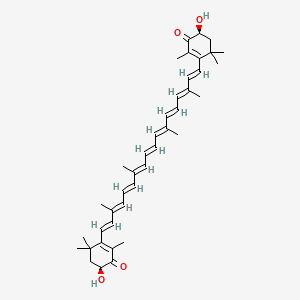
Astaxanthin is a red-orange pigment in the carotenoid family, the same family as beta-carotene and lutein. Microalgae make it, above all the freshwater alga Haematococcus pluvialis. This alga piles it up when it is stressed by strong light, salt, heat or too little nitrogen.
Many animals do not make it themselves. They take it in with their food, and that is what colors salmon flesh and the shells of shrimp and krill. It also adds to the pink of flamingos, although a related pigment, canthaxanthin, is the main one in the feathers of many flamingo species.
A live lobster is blue-black, not red. In its shell, astaxanthin is bound to a protein, and that binding shifts the color. Cooking breaks down (denatures) the protein and frees the pigment, so the shell turns pink-orange. Farmed salmon owe their color to feed too, and a 2024 review says synthetic astaxanthin makes up over 95% of the feed market.
You will often read that astaxanthin is the strongest antioxidant known. What was measured is narrower. In test-tube work from the early 1990s, it quenched singlet oxygen, an excited form of oxygen, more than 100 times better than vitamin E. A 2023 review describes this, and its authors work for astaxanthin makers.
In people, a meta-analysis (a study that pools earlier trials) of 12 trials found only a mild effect on oxidative stress markers.
Health benefits of astaxanthin
The top findings from 31 studies, strongest evidence first
What the stars mean
- Strong. Several randomized trials, pooled in a meta-analysis, point the same way, or regulators (FDA or EFSA) have approved the claim.
- Moderate. Good randomized trials support it, but there are fewer of them, or their results vary.
- Limited. Small, short or single trials, or mixed results. Promising, but it needs confirmation.
Population and lab studies get no stars: they show a link or a mechanism, not proof.
How we rate evidence →- ★★Slightly higher “good” HDL cholesterolAstaxanthin supplements raised HDL by 1.47 mg/dL across 14 trials, with no clear change in triglycerides, LDL or total cholesterol. A smaller pool of 8 studies found triglycerides also fell at 6 to 20 mg a day.
- ★★Better skin moisture and elasticity, not wrinklesIn 9 randomized trials, astaxanthin pills improved skin moisture and elasticity. Wrinkle depth did not clearly fall.
- ★★Mixed results for exerciseIn 24 trials, astaxanthin lowered creatine kinase, a muscle-damage marker, but time trials and peak oxygen use did not change. A smaller pool of 11 trials found better aerobic performance.
- ★★Lower marker of fat damage (MDA)In 12 trials with 380 people, malondialdehyde (MDA), a marker of fat damage, fell. The inflammation markers CRP and TNF-alpha did not change.
- ★★Slightly higher liver enzyme ALTIn 5 trials using 6 to 12 mg a day, ALT rose by 1.92 U/L. The other liver enzymes (AST, GGT and ALP) did not change.
All 31 studies, strongest evidence first
Across 14 studies, astaxanthin raised HDL cholesterol by about 1.5 mg/dL
This meta-analysis pooled 14 trials of astaxanthin supplements. HDL rose by 1.47 mg/dL. CRP, an inflammation marker, fell only in trials of 12 weeks or longer (0.53 mg/L) or with more than 12 mg a day. Total cholesterol, LDL, triglycerides, fasting glucose, HbA1c, BMI and blood pressure showed no clear link.
Astaxanthin pills improved skin moisture and elasticity, but not wrinkles
This meta-analysis pooled 9 randomized trials of oral astaxanthin (randomized means chance decided who got it). Moisture rose (standardized difference 0.53) and elasticity rose (0.77), though results varied moderately to widely between trials. Wrinkle depth did not clearly fall (-0.26). Two open-label studies of creams, or creams plus pills, suggested a slight benefit.
6 to 20 mg a day raised HDL and lowered triglycerides
This meta-analysis pooled 8 randomized studies (11 results) of 6 to 24 mg a day. It reported the HDL and triglyceride benefits at 6 to 20 mg. LDL and total cholesterol did not change. In the 12 mg groups, HDL went from 55 to 63 mg/dL. In the 18 mg groups, triglycerides went from 151 to 112 mg/dL. The authors say more research is needed in different patient groups.
At risk of metabolic syndrome, astaxanthin lowered LDL cholesterol
This systematic review and meta-analysis pooled 7 randomized trials with 321 adults at risk of metabolic syndrome. Effects on total cholesterol and systolic (top number) blood pressure were marginal. Six trials were rated excellent in methodological quality and one good. The authors say stronger evidence is needed.
Across 12 trials, astaxanthin lowered the oxidative stress marker MDA
This meta-analysis pooled 12 randomized trials with 380 people. Malondialdehyde (MDA), a marker of fat damage, fell (standardized difference -0.95), but CRP and TNF-alpha did not. IL-6 fell by 0.70 pg/mL in people with type 2 diabetes. The authors call the overall effect mild and note that few trials measured other markers.
Across 24 trials, astaxanthin lowered a muscle-damage marker, not performance
This meta-analysis pooled 24 randomized trials in healthy people and athletes. Creatine kinase, a muscle-damage marker, fell (standardized difference -0.45), and lactate dehydrogenase fell too (-0.93), though results varied a lot between trials. VO2max (peak oxygen use), time trials, power, MDA and IL-6 did not change. The authors conclude it may help recovery more than performance.
In 11 small trials, astaxanthin with training improved aerobic exercise performance
This meta-analysis pooled 11 randomized trials with 346 healthy people. Physical performance rose (standardized difference 0.62), more clearly for aerobic exercise (0.45) and with 20 mg or more a day (0.37). Thinking accuracy (0.12) and reaction time did not clearly change. The newer, larger analysis above found no gain in time trials.
Astaxanthin raised the liver enzyme ALT by 1.9 U/L
This meta-analysis pooled 5 randomized trials with 196 people, using 6 to 12 mg a day for 4 to 48 weeks. ALT rose by 1.92 U/L, with no change in the other liver enzymes AST, GGT or ALP. The authors call for longer, better-designed trials to confirm it.
6 to 18 mg a day lowered triglycerides and raised HDL cholesterol
In this placebo-controlled trial, 61 non-obese adults aged 25 to 60 had mildly raised fasting triglycerides, 120 to 200 mg/dL. By chance, they got 0, 6, 12 or 18 mg a day for 12 weeks. Triglycerides fell at 12 and 18 mg and HDL rose at 6 and 12 mg. LDL and BMI did not change, and adiponectin rose at 12 and 18 mg.
In prediabetes, 12 mg daily lowered LDL by 0.33 mmol/L
In this randomized trial, 34 adults with prediabetes and high blood fats took astaxanthin or a placebo (dummy pill) for 24 weeks. There were 22 on astaxanthin and 12 on placebo. Total cholesterol fell 0.30 mmol/L and three heart-risk markers fell. The main goal, insulin-stimulated glucose disposal, was missed: it only trended up. No clinically significant side effects were reported.
In type 2 diabetes, 8 mg daily lowered systolic pressure and triglycerides
In this placebo-controlled trial, 44 people with type 2 diabetes took astaxanthin for 8 weeks. Adiponectin rose, visceral (belly) fat mass fell, and fructosamine fell, while plasma glucose fell only marginally. The abstract does not give the size of the blood pressure drop.
4 mg daily raised the UV dose needed to redden skin
In this placebo-controlled trial, 23 healthy Japanese adults took astaxanthin for 9 weeks, 10 weeks in all. The astaxanthin group had a higher minimal erythema dose (the smallest UV dose that reddens skin). It also lost less moisture in irradiated skin than the placebo group. Authors work for FUJIFILM, the sponsor, and the abstract gives no size for the rise.
6 mg daily improved crow’s feet wrinkles and elasticity in men
In this randomized double-blind trial (neither the men nor the researchers knew who got what), 36 healthy men took part for 6 weeks. Water loss through the skin also improved, while moisture and oil level only tended to improve. The same paper reports an uncontrolled 8-week study in 30 women. They used 6 mg by mouth plus a topical solution, which cannot separate the two.
12 mg daily improved one thinking test score in forgetful adults
In this randomized trial, 96 healthy middle-aged and older adults who reported age-related forgetfulness took 6 mg, 12 mg or placebo for 12 weeks. CogHealth scores improved at 12 mg, and the Groton Maze test improved earlier at 6 and 12 mg. The authors say the sample was too small to show a clear difference, so the trial was not conclusive. No adverse effects were seen.
A review found only one of two astaxanthin trials improved memory
This systematic review covered randomized trials of lutein (5 trials) and astaxanthin (2 trials) for thinking skills in healthy adults. One astaxanthin trial reported better verbal memory in middle-aged adults. The authors say two studies are too few to conclude. Lion Corporation, a supplement maker, supported the work and employs some authors.
In children 10 to 14, 4 mg daily eased digital eye strain
In this randomized trial, 64 children with 4 or more hours of daily screen time took astaxanthin for 84 days. The symptom score fell 4.0 points against 1.7 on placebo, a 20% better score. Visual acuity, near point of accommodation and safety measures did not differ between groups. Several authors work for the supplement makers AstaReal and Fuji Chemical.
12 mg daily sped up blood flow in the eye’s choroid
In this placebo-controlled trial, 20 healthy volunteers took astaxanthin for 4 weeks, measured with laser speckle flowgraphy. Blood flow speed at the macula rose after 4 weeks on astaxanthin and did not change on placebo. No side effects were found. It measured blood flow, not eye symptoms or eye disease.
4 mg daily cut 2 minutes from a 20 km time trial
This randomized trial took 21 competitive cyclists for 28 days, but only 14 finished (7 per group). The astaxanthin group was 121 seconds faster in the cycling time trial and raised power by 20 W, against a 19-second change on placebo. Fat and carbohydrate burning did not differ, so the fat-burning explanation was not supported.
12 mg daily cut 51 seconds from a 40 km time trial
In this randomized double-blind crossover trial, 12 recreationally trained male cyclists tried astaxanthin for 7 days and placebo, in turn. Time fell from 70.76 to 69.90 minutes (1.2%), a small effect. Whole-body fat burning was higher late in the ride.
28 mg daily stretched cycling to exhaustion from 72 to 85 minutes
This randomized trial had only 10 active young men, who took astaxanthin for 4 days and cycled at 75% of VO2max. Creatine kinase, lactate dehydrogenase and MDA rose less with astaxanthin, while TNF-alpha and CRP did not respond. The dose was far above the 4 to 12 mg a day in most trials.
20 mg daily did not improve time trials in 32 cyclists
This double-blind trial had 32 young, well-trained male cyclists and triathletes, who took astaxanthin for 4 weeks. Blood astaxanthin rose from undetectable to measurable levels, but fat burning, total antioxidant capacity and MDA did not change. Power in the time trial of about 1 hour did not differ.
12 mg a day did not change muscle damage or inflammation markers
In this double-blind crossover trial, 13 resistance-trained men took astaxanthin for 4 weeks, then did hard exercise. Creatine kinase, CRP, IL-6, soreness and sprint results were unchanged. Systolic blood pressure was about 7% lower and baseline insulin about 24% lower on astaxanthin, both secondary findings.
3 weeks of astaxanthin did not ease soreness or damage after lifting
This trial had 20 resistance-trained men. The product was an algae extract with 4 mg of astaxanthin and 480 mg of lutein. The men took it for 3 weeks before and 96 hours after heavy eccentric exercise, in which muscles work while lengthening. Soreness, creatine kinase and muscle performance responded the same in both groups.
Young soccer players on astaxanthin had lower muscle enzymes after exercise
In this double-blind trial, 32 elite young male players took astaxanthin or placebo for 90 days. After a 2-hour exercise bout, the muscle enzymes CK and AST were lower than on placebo. The abstract does not give the dose. TBARS and AOPP did not change, and superoxide anion rose after exercise only in the placebo group.
An astaxanthin formula plus training raised leg strength 14% in older adults
In this randomized trial, 42 adults aged 65 to 82 trained for 4 months with the formula or a placebo. Training with placebo did not raise strength. The formula held 12 mg of astaxanthin, 10 mg of tocotrienol and 6 mg of zinc, so the effect cannot be tied to astaxanthin alone. Muscle size rose 2.7% on the formula, and walking endurance rose on both treatments with exercise.
In fertility treatment, astaxanthin raised egg maturation rates in small studies
This systematic review and meta-analysis covered clinical and animal studies. In the clinical trials, the oocyte (egg) maturation rate rose (mean difference 8.40). Antioxidant capacity in follicular fluid and redox markers did not clearly change. The authors point to small studies, high variation and risk of bias.
3 human trials found no improvement in any semen measure
This meta-analysis covered ten studies in all: 3 clinical trials and 7 in animals. The authors rate the human evidence as low certainty, and pregnancy rates were not assessed. In animals, sperm count, motility and viability improved.
16 mg daily for 3 months did not change any semen measure
In this double-blind trial, 80 men with low sperm counts took part, and 72 finished (37 on astaxanthin, 35 on placebo). Sperm number, concentration, movement, shape, DNA fragmentation and FSH did not change. Only the placebo group showed changes, in sperm number and concentration.
Very small trial: pregnancy in 54.5% of couples, against 10.5% on placebo
In this double-blind trial, 30 infertile men took 16 mg a day for 3 months (11 men) or a placebo (19 men), with standard treatment. Oxidative stress (ROS) and inhibin B fell and sperm speed rose, while the hamster egg test only tended to improve. The authors say a larger trial must confirm it first.
Mice given astaxanthin swam longer before exhaustion and had less body fat
This study was in mice, not people. Young male mice received 1.2, 6 or 30 mg/kg of body weight by stomach tube for 5 weeks. Blood lactate was lower, and blood fatty acids and glucose stayed higher after swimming, which the authors read as more fat used for fuel. Human trials above are mixed on fat burning.
In obese animals, astaxanthin lowered fat tissue weight and systolic blood pressure
This meta-analysis pooled 17 articles covering 21 animal studies of diet-induced obesity. Blood sugar fell in diabetic models, and liver and body weight fell in fatty-liver models. Animal results often do not carry over to people, and the human meta-analyses above found smaller effects.
Foods high in astaxanthin
Astaxanthin comes almost entirely from seafood, and salmon is the main dietary source. NutriScrolls has no USDA ranking for astaxanthin, so the table below uses published measurements. Where a paper gave mg/kg, we divided by 10 to get mg per 100 g.
The range is wide. Wild sockeye holds 26 to 38 mg/kg of flesh, wild chum about 3 and farmed Atlantic salmon 1 to 9, says a 2024 review. In one lab test, wild salmon had about 10 times more than farmed.
By that arithmetic, 4 mg, the dose in several trials above, is about 105 to 154 g of wild sockeye. It is 440 g or more of farmed Atlantic salmon. In the shellfish we found, the pigment sits mostly in the shell.
We found no measured astaxanthin values for crab, lobster or salmon roe meat. The microalga Haematococcus pluvialis is the usual source for supplements, not a food.
| Food | Amount per 100 g | Source |
|---|---|---|
| Wild sockeye salmon, flesh | 2.6 to 3.8 mg | 1, 2 |
| Wild Atlantic salmon, flesh | 0.3 to 1.0 mg | 1 |
| Wild chum salmon, flesh | 0.3 mg | 1 |
| Farmed Atlantic salmon, fillet | 0.1 to 0.9 mg (0.66 to 0.72 mg in one feeding trial) | 1, 3 |
| Salmon served in a human trial (wild Pacific and farmed Atlantic) | 0.5 mg | 5 |
| Farmed rainbow trout, fillet | 0.37 mg after 56 days on astaxanthin feed; 0.6 to 2.5 mg in large trout on the market | 4, 2 |
| Wild shrimp, muscle (two species) | 1.4 and 1.7 mg | 1 |
| Antarctic krill, flesh | 1.1 mg | 1 |
| Northern shrimp shells and snow crab shell (shell waste, not the meat) | Total carotenoids 14.8 and 12.6 mg, mainly astaxanthin and its esters | 6 |
| Haematococcus pluvialis algae (supplement source), dry weight | Up to 3,800 mg (3.8%) | 2 |
Sources
- Elbahnaswy S, Elshopakey GE. Recent progress in practical applications of a potential carotenoid astaxanthin in aquaculture industry: a review. Fish Physiol Biochem. 2024. Salmon, shrimp and krill values are quoted from EFSA (2005) and other studies.
- Ambati RR, Phang SM, Ravi S, Aswathanarayana RG. Astaxanthin: sources, extraction, stability, biological activities and its commercial applications, a review. Mar Drugs. 2014.
- Mørkøre T, Moreno HM, Borderías J, et al. Dietary inclusion of Antarctic krill meal during the finishing feed period improves health and fillet quality of Atlantic salmon (Salmo salar L.). Br J Nutr. 2020.
- Brizio P, Benedetto A, Righetti M, et al. Astaxanthin and canthaxanthin (xanthophyll) as supplements in rainbow trout diet: in vivo assessment of residual levels and contributions to human health. J Agric Food Chem. 2013.
- Rüfer CE, Moeseneder J, Briviba K, Rechkemmer G, Bub A. Bioavailability of astaxanthin stereoisomers from wild (Oncorhynchus spp.) and aquacultured (Salmo salar) salmon in healthy men: a randomised, double-blind study. Br J Nutr. 2008.
- Hossain A, Shahidi F. Upcycling shellfish waste: distribution of amino acids, minerals, and carotenoids in body parts of North Atlantic crab and shrimp. Foods. 2024.
- Chitchumroonchokchai C, Failla ML. Bioaccessibility and intestinal cell uptake of astaxanthin from salmon and commercial supplements. Food Res Int. 2017.
- Begum S, Cianci M, Durbeej B, et al. On the origin and variation of colors in lobster carapace. Phys Chem Chem Phys. 2015.
- Nishida Y, Berg PC, Shakersain B, et al. Astaxanthin: past, present, and future. Mar Drugs. 2023. Three authors work for Fuji Chemical or AstaReal.
How astaxanthin works
Most of what we know about how astaxanthin works comes from test tubes, cells and animals. Researchers keep coming back to three ideas. It calms a reactive form of oxygen, it guards the fats in cell membranes, and it switches on the cell’s own defenses. Here is each one, and what has been seen in people.
It calms singlet oxygen
Singlet oxygen is an excited, reactive form of oxygen. Carotenoids can quench it, which means they calm it before it reacts with something else. In test-tube work from 1991, astaxanthin quenched singlet oxygen more than 100 times better than vitamin E.
Drawn to scale, with vitamin E as 1. The arrow means the real figure is higher than 100.
It guards cell membranes
Astaxanthin is a long molecule with a slightly polar (water-friendly) ring at each end. That shape lets it sit across a cell membrane, with its end rings near the surfaces and its long chain in the fatty middle. Beta-carotene and lycopene have no polar ends. They stay in the fatty core, away from where damaging radicals first arrive.
Where carotenoids sit in a membrane. The tilt of about 20 degrees comes from a computer simulation; the positions of the others from lab tests on artificial membranes.
In lab tests on artificial membranes, astaxanthin’s end rings trapped radicals at the surface while its chain worked inside. That made it about twice as effective as beta-carotene at stopping fat damage. In another test it kept the membrane neatly ordered and cut fat damage by 40%, while beta-carotene and lycopene made it more than 85% worse. Not every test agrees: in a third study, zeaxanthin protected membranes better than astaxanthin.
Drawn to scale. The study reports the beta-carotene and lycopene result together as an increase of more than 85%.
It switches on the cell’s own defenses
In cell and animal studies, astaxanthin switches on Nrf2, a control protein that tells cells to make more of their own protective enzymes. Examples are superoxide dismutase and catalase. It also holds back NF-κB, a switch that turns on inflammation. And it seems to help mitochondria, the cell’s power plants and a main source of reactive oxygen, work better.
These findings are summed up in a 2023 review by authors who include people working for astaxanthin makers.
Two control switches inside the cell, as described in cell and animal studies.
What has been seen in people
These effects are much easier to show in a dish than in a person. Across 12 trials, people taking astaxanthin had less MDA, a blood marker of fat damage, though the authors call the effect mild. Another analysis found that CRP, a marker of inflammation, fell only in some trials. Those lasted 12 weeks or more or used more than 12 mg a day.
Both are among the study cards above.
Sources
- Nishida Y, Berg PC, Shakersain B, et al. Astaxanthin: past, present, and future. Mar Drugs. 2023. Three authors work for Fuji Chemical or AstaReal.
- Woodall AA, Britton G, Jackson MJ. Carotenoids and protection of phospholipids in solution or in liposomes against oxidation by peroxyl radicals: relationship between carotenoid structure and protective ability. Biochim Biophys Acta. 1997.
- Villalaín J. Location and dynamics of astaxanthin in the membrane. Chem Phys Lipids. 2025.
- Goto S, Kogure K, Abe K, et al. Efficient radical trapping at the surface and inside the phospholipid membrane is responsible for highly potent antiperoxidative activity of the carotenoid astaxanthin. Biochim Biophys Acta. 2001.
- McNulty HP, Byun J, Lockwood SF, Jacob RF, Mason RP. Differential effects of carotenoids on lipid peroxidation due to membrane interactions: X-ray diffraction analysis. Biochim Biophys Acta. 2007.
Is astaxanthin safe? Supplements, dose and interactions
Astaxanthin from seafood is not a safety concern. EFSA, the European food safety agency, estimated the highest intake from fish and crustaceans in adults. It put it at 0.06 mg per kg of body weight a day.
That is 30% of its acceptable daily intake (ADI) of 0.2 mg/kg, about 14 mg for a 70 kg adult. The ADI is the amount judged safe to eat every day. In 2020 its novel food panel concluded that 8 mg a day from supplements is safe for adults, even on top of a high-seafood diet.
In the US, the FDA had no questions about a Haematococcus extract giving 0.1 mg of astaxanthin per serving of food. That was GRAS notice 294 (Fuji Chemical, 2010). The FDA also allows astaxanthin in salmon feed up to 80 mg/kg of feed.
- Trial doses and side effects. Most trials used 4 to 12 mg a day, and a few used 16 to 28 mg for days or months. A 2019 review of 87 human studies of natural astaxanthin found no safety concerns, and 35 of them used 12 mg a day or more. A trial of 6 mg a day for 8 weeks found only tiny blood test differences with no clinical importance.
- Liver enzyme. A meta-analysis found ALT up by 1.9 U/L at 6 to 12 mg a day, with no change in AST, GGT or ALP. The rise is small, and the authors want longer trials.
- Blood thinners. One case report describes a 69-year-old woman on warfarin and several other drugs. Her INR (a clotting test) rose from 1.4 to 10.38, with bruising, one day after she started astaxanthin. The authors judged the link probable. One case cannot prove cause and we found no controlled interaction study, but people on warfarin should ask their clinic first.
- Children and pregnancy. EFSA found that 8 mg of supplement plus a high-seafood diet reaches the ADI at ages 14 to 17. It exceeds the ADI in children under 14. We found no safety trials in pregnancy or breastfeeding, so ask your doctor.
How to get more astaxanthin
- Best food. Wild sockeye salmon, at 2.6 to 3.8 mg per 100 g, holds many times more than farmed Atlantic salmon at 0.1 to 0.9 mg.
- Cook it gently. In lab tests, common ways of cooking salmon cut its astaxanthin by 48 to 57% in wild fish. In farmed fish the loss was 35 to 47%.
- Take it with fat. Astaxanthin dissolves in fat. In 32 healthy men, lipid-based formulas gave 1.7 to 3.7 times the absorption of a plain commercial supplement.
Sources
- EFSA Panel on Nutrition, Novel Foods and Food Allergens (NDA). Safety of astaxanthin for its use as a novel food in food supplements. EFSA J. 2020.
- GRAS Notice Inventory, GRN 000294: Haematococcus pluvialis extract containing astaxanthin esters. US Food and Drug Administration. Notifier: Fuji Chemical Industry. Closed January 6, 2010.
- 21 CFR 73.35: Astaxanthin. Code of Federal Regulations, US Food and Drug Administration.
- Brendler T, Williamson EM. Astaxanthin: how much is too much? A safety review. Phytother Res. 2019.
- Spiller GA, Dewell A. Safety of an astaxanthin-rich Haematococcus pluvialis algal extract: a randomized clinical trial. J Med Food. 2003.
- Arefpour H, Rasaei N, Amini MR, et al. The effects of astaxanthin supplementation on liver enzyme levels. Int J Vitam Nutr Res. 2024.
- Santiyanon N, Yeephu S. Interaction between warfarin and astaxanthin: a case report. J Cardiol Cases. 2019.
- Mercke Odeberg J, Lignell A, Pettersson A, Höglund P. Oral bioavailability of the antioxidant astaxanthin in humans is enhanced by incorporation of lipid based formulations. Eur J Pharm Sci. 2003.
- Chitchumroonchokchai C, Failla ML. Bioaccessibility and intestinal cell uptake of astaxanthin from salmon and commercial supplements. Food Res Int. 2017.
History of astaxanthin
Astaxanthin was first pinned down in lobster. In 1933 the chemists Richard Kuhn and Lederer isolated two pigments from the shell and eggs of the European lobster. In 1937 a lobster protein complex called ovoverdin was isolated.
In 1938 Kuhn and Sörensen characterized ovoverdin, identified the pigment as a xanthophyll and renamed it astaxanthin, after Astacus, a lobster genus. That same year Kuhn was awarded the Nobel Prize in Chemistry for his work on carotenoids and vitamins.
The molecule comes in three mirror-image forms. In 1976 researchers found that the yeast Phaffia rhodozyma, now called Xanthophyllomyces dendrorhous, makes only one of them. In the early 1980s a Hoffmann-La Roche group made astaxanthin from scratch in the lab. Since 1984 its synthetic version, sold as Carophyll Pink, has been used to color salmon and trout flesh and sea bream skin.
Supplements came next. Sweden gave the first authorization of astaxanthin in food supplements, at up to 8 mg a day, in 1995. A 2023 review by authors from two astaxanthin makers values the market at USD 647 million to 1.6 billion in 2021.
In the US, the FDA listed astaxanthin as a color additive for salmon feed. A Haematococcus extract received a no-questions letter for foods in 2010.
Sources
- Nishida Y, Berg PC, Shakersain B, et al. Astaxanthin: past, present, and future. Mar Drugs. 2023.
- Ambati RR, Phang SM, Ravi S, Aswathanarayana RG. Astaxanthin: sources, extraction, stability, biological activities and its commercial applications, a review. Mar Drugs. 2014.
- Elbahnaswy S, Elshopakey GE. Recent progress in practical applications of a potential carotenoid astaxanthin in aquaculture industry: a review. Fish Physiol Biochem. 2024.
- EFSA Panel on Nutrition, Novel Foods and Food Allergens (NDA). Safety of astaxanthin for its use as a novel food in food supplements. EFSA J. 2020.
- Richard Kuhn: facts. NobelPrize.org.
- Astaxanthin. Wikipedia.
Frequently asked questions about astaxanthin
What does astaxanthin do for the body?
The best-supported effects in trials are small. A meta-analysis of 14 studies found HDL cholesterol up by about 1.5 mg/dL. Another found better skin moisture and elasticity, and a 2025 one found lower triglycerides. The 2020 analysis found no change in triglycerides, LDL, blood sugar or blood pressure. Nearly all results come from supplements of 4 to 12 mg a day, and no finding here reaches strong evidence.
Which foods are high in astaxanthin?
Salmon is the main one, and species matter. Wild sockeye holds about 2.6 to 3.8 mg per 100 g, farmed Atlantic salmon 0.1 to 0.9 mg, and farmed rainbow trout 0.37 mg in one feeding trial. Two wild shrimp species held 1.4 and 1.7 mg per 100 g of muscle. We found no measured values for crab, lobster or salmon roe meat.
How much astaxanthin should you take a day?
No dose is proven best. Most trials used 4 to 12 mg a day, and a few went to 16 or 20 mg. EFSA judged 8 mg a day from supplements safe for adults on top of a high-seafood diet. It set an ADI of 0.2 mg per kg of body weight, about 14 mg for a 70 kg adult. Talk to a clinician before going higher.
Does astaxanthin have side effects?
Trials reported few. A review of 87 human studies of natural astaxanthin found no safety concerns, and a meta-analysis found a small ALT rise of 1.9 U/L. One case report links astaxanthin to a very high INR in a woman taking warfarin, so ask your clinic if you take a blood thinner. Pregnancy and breastfeeding have not been studied in the trials we found.
Is astaxanthin good for your skin?
Possibly, modestly. A meta-analysis of 9 trials found better moisture and elasticity but no clear drop in wrinkle depth. In 23 adults, 4 mg a day for 9 weeks raised the UV dose needed to redden skin. The study’s authors work for the sponsor, FUJIFILM. The trial did not test it as a replacement for sunscreen.
Does astaxanthin improve exercise performance?
The results are mixed. In small cycling trials, a 40 km ride was 51 seconds faster on 12 mg for 7 days. In another small trial, a 20 km ride was about 2 minutes faster on 4 mg for 4 weeks. In 32 trained cyclists, 20 mg for 4 weeks changed nothing. A 2026 meta-analysis of 24 trials found lower creatine kinase but no gain in VO2max, time trials or power.
Is wild salmon better than farmed for astaxanthin?
Wild sockeye has more per 100 g, but the picture is less clear for other species. Wild chum holds about 0.3 mg per 100 g, wild Atlantic salmon 0.3 to 1.0 mg and farmed Atlantic salmon 0.1 to 0.9 mg. In a trial, 28 men ate 250 g a day of wild or farmed salmon. Blood levels reached 39 nmol/L on wild and 52 nmol/L on farmed salmon. No study here tested health effects of one against the other.
When is the best time to take astaxanthin?
No trial here tested time of day. Astaxanthin dissolves in fat, and in a single-dose study of 32 men, lipid-based formulas gave 1.7 to 3.7 times the absorption of a plain supplement. Taking it with a meal that contains fat is therefore reasonable. Its half-life in that study was about 16 hours.