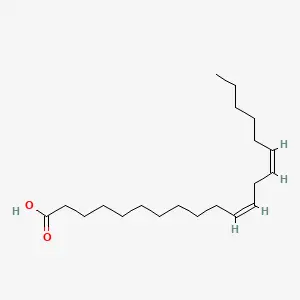
Eicosadienoic acid (EDA; 20:2 n-6) is an omega-6 fat. Its formula is C20H36O2, and its systematic name is (11Z,14Z)-icosa-11,14-dienoic acid. It is a 20-carbon polyunsaturated fat with two double bonds. Your body makes it by adding two carbons to linoleic acid.
In a diet study in healthy men, eating 10.5% of energy as linoleic acid instead of 3.8% raised plasma 20:2 n-6. Plasma is the liquid part of blood, and the authors call this fat the elongation product of linoleic acid. A cell study describes it as a rare fat found mainly in animal tissues. In our USDA ranking pine nuts lead, but even an ounce of them holds only about a tenth of a gram.
EDA sits on a side road of the omega-6 pathway. Cells can turn it into dihomo-gamma-linolenic acid (DGLA). Some cells also turn it into sciadonic acid, a rare fat that pine nut oil also contains.
Do not confuse it with arachidonic acid (ARA, 20:4 n-6). Both are omega-6 fats with 20 carbons, but arachidonic acid has four double bonds and EDA has two.
Evidence is scarce. We found no trial that gave people eicosadienoic acid and no supplement study. We found no Daily Value from the FDA and no EU Reference Intake. Nor did we find a health claim for it in the annex of Regulation (EU) No 432/2012.
What exists is blood and red cell levels in cohort studies (studies that follow groups of people over time). There are also a few trials that changed the level while testing something else, and work in cells and yeast.
Health benefits of eicosadienoic acid
The top findings from 12 studies, strongest evidence first
What the stars mean
- Strong. Several randomized trials, pooled in a meta-analysis, point the same way, or regulators (FDA or EFSA) have approved the claim.
- Moderate. Good randomized trials support it, but there are fewer of them, or their results vary.
- Limited. Small, short or single trials, or mixed results. Promising, but it needs confirmation.
Population and lab studies get no stars: they show a link or a mechanism, not proof.
How we rate evidence →- ★Blood EDA changes with diet and weight lossMore dietary linoleic acid raised blood EDA in men, while EPA plus DHA pills and a 12-week calorie cut lowered it. They show what moves the level, not what EDA does.
- Population studyLinked to lower type 2 diabetes riskIn a European study with 12,132 new diabetes cases, each standard deviation higher blood EDA went with 0.89 times the risk. Blood levels reflect both diet and the body’s own fat metabolism.
- Population studyNo link with peripheral artery diseaseIn pooled cohorts with 1,435 cases of peripheral artery disease, blood EDA was not linked to it. Only linoleic acid went with lower risk.
- Population studyLinked to liver cancer in people with cirrhosisIn 349 people with cirrhosis and liver cancer, red blood cell EDA was higher than in 550 people with cirrhosis alone. The disease may have shaped the levels.
- Population studyLinked to lower thinking scores two years laterIn 1,032 adults averaging 57 years old, higher red blood cell EDA went with lower thinking-test scores, a weak but statistically significant trend.
All 12 studies, strongest evidence first
More linoleic acid raised blood 20:2 n-6 in healthy men
Adult men ate controlled diets with 10.5% or 3.8% of energy as linoleic acid, and 1% as alpha-linolenic acid on both. The higher intake raised plasma phospholipid 20:2 n-6, the elongation product of linoleic acid in the authors’ words, and lowered EPA. Arachidonic acid did not change, and across individuals linoleic acid was inversely related to it (r = −0.761 and −0.817). The diets and men match the same group’s 2007 Journal of Nutrition trial: 22 men, 4 weeks per diet, randomized crossover. So we treat the two papers as one trial, which tests linoleic acid, not eicosadienoic acid itself.
EPA plus DHA supplements lowered EDA in red blood cells of runners
In this randomized trial (groups assigned by chance), 26 amateur runners trained for 12 weeks. 14 took 2,234 mg of EPA and 916 mg of DHA a day, and 12 took a placebo (dummy pill). Eicosadienoic acid fell along with linoleic, dihomo-gamma-linolenic and arachidonic acid. This tests an EPA plus DHA supplement, not eicosadienoic acid, and the summary does not give the size of the drop.
12 weeks of mild calorie cutting lowered blood EDA in 80 adults
Overweight adults with a high visceral fat area (fat around the organs) cut 300 kcal a day for 12 weeks, or kept their usual intake. In the weight-loss group, visceral fat area fell by 17.7 cm², and circulating EDA fell more than on the control diet. Many fatty acids fell together, including palmitic, oleic and dihomo-gamma-linolenic acid, and Δ5-desaturase activity rose. A lower level went with better health here, so a high EDA level is not a goal.
Higher blood EDA went with less type 2 diabetes in EPIC-InterAct
This case-cohort study in eight European countries had 12,132 new diabetes cases and a subcohort of 15,919 people. Each standard deviation higher plasma phospholipid EDA went with 0.89 times the risk. Linoleic acid was also linked to lower risk (0.80), but arachidonic acid was not. Gamma-linolenic, dihomo-gamma-linolenic and two longer omega-6 fats went with higher risk (1.13 to 1.46). The authors could not separate diet from the body’s own metabolism and note residual confounding (other factors that may explain the link).
Blood EDA was not linked to peripheral artery disease
The Fatty Acids and Outcomes Research Consortium pooled the raw data of cohorts with 27,538 people in all. Eicosadienoic acid was measured in 6 of the 9 cohorts, with 1,435 cases of clinical peripheral artery disease. Median follow-up across the 9 cohorts was 14 years. Only linoleic acid went with lower risk (hazard ratio 0.75, top versus bottom fifth); the other omega-6 fats were not linked.
Higher red cell EDA went with fewer advanced colorectal adenomas, weakly
Three US cohorts with 4,517 people had 493 conventional adenomas and 316 serrated polyps (growths in the bowel) over a median 20 years. Each standard deviation higher eicosadienoic acid went with 0.83 times the odds of an advanced adenoma, but this passed only the usual statistical test. No fatty acid passed the stricter threshold the authors set for testing many fats at once. They concluded that red cell fats in a typical American diet are unlikely to have a substantial influence on colorectal cancer precursors.
Red cell EDA was not linked to hardened neck arteries in China
This prospective cohort followed 4,040 Chinese adults aged 40 to 75 for a median of 8.8 years. There were 850 new cases of carotid plaque, and others with thickened artery walls; red cell eicosadienoic acid was not linked to this carotid atherosclerosis. Linoleic acid was not linked either. Higher DHA and arachidonic acid went with less thickening at the carotid bifurcation, and the authors suggest very long chain fats may protect.
Higher red cell EDA went with liver cancer in people with cirrhosis
This case-control study (CiRCE) in six French hospitals compared 349 people with cirrhosis and liver cancer with 550 who had cirrhosis alone. People with liver cancer also had higher linoleic acid and saturated fats, and lower stearic and arachidonic acid. The authors say the pattern may reflect diet or altered fat metabolism. So the disease may have shaped the levels rather than the other way round.
Higher red cell EDA went with lower thinking scores two years later
The Boston Puerto Rican Health Study followed 1,032 adults with an average age of 57. Higher eicosadienoic acid went with lower Mini-Mental State Exam and executive function scores, a weak but statistically significant trend. Only arachidonic acid predicted cognitive impairment (odds ratio 1.26). The authors read the results as some evidence that omega-6 metabolism favoring arachidonic acid could raise risk.
A common gene variant near FADS1 was linked to blood EDA
This genome-wide study of six omega-3 and omega-6 fatty acids in plasma looked at 1,075 older adults in the InCHIANTI Study. The same variant, rs174537, was strongest for arachidonic acid (18.6% of its variance) and was also linked to EPA. People carrying the allele tied to higher arachidonic acid, EDA and EPA also had higher LDL and total cholesterol. It shows that the body’s enzymes shape the level; it does not test an effect of EDA.
A baboon enzyme in yeast turned EDA into DGLA
This lab study tested a second route to long chain omega-6 fats, in yeast carrying the baboon FADS2 gene. The enzyme turned 11,14-eicosadienoic acid into dihomo-gamma-linolenic acid (20:3 n-6). When linoleic acid and EDA competed for it, Δ6 desaturation of linoleic acid was favored over Δ8 desaturation of EDA by 7-fold. The authors call EDA a substrate previously considered a dead end. This is yeast, not a person, so it shows what an enzyme can do, not what happens after a meal.
Mouse immune cells turned EDA into sciadonic acid and reacted differently
Mouse macrophages (immune cells of the RAW264.7 line) took up EDA quickly and were exposed to lipopolysaccharide, an inflammatory trigger. EDA lowered nitric oxide and raised prostaglandin E2 and tumor necrosis factor-α. It also raised the shares of linoleic, dihomo-gamma-linolenic and arachidonic acid in the cell fats. The authors found it a weaker pro-inflammatory agent than linoleic acid and not as anti-inflammatory as sciadonic acid. Cell work does not show an effect of eating it.
Foods high in eicosadienoic acid
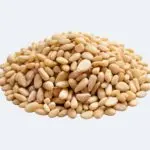
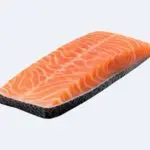
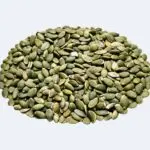
Pine nuts lead our USDA ranking by a wide margin, with 0.11 g in 1 oz (28 g) of pine nuts. Farmed Atlantic salmon follows with 0.05 g in 3 oz (85 g), 46% of the pine nut figure as the ranking shows it.
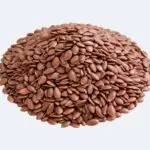
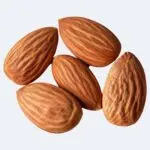
Then come a chicken drumstick with 0.02 g, and shrimp, one large egg and a 4 oz chicken breast with 0.01 g each. Mustard seeds give 0.01 g in a teaspoon (2 g), and flaxseeds and almonds 0.001 g in their servings. Per 100 g the order is pine nuts 0.4 g, farmed salmon 0.06 g and eggs 0.02 g. The drumstick, shrimp, flaxseeds and chicken breast follow at 0.01 g each.
These are small numbers from few measurements. For dried pine nuts, FoodData Central gives 0.404 g per 100 g from 7 analyses that ranged from 0.358 to 0.44 g. The USDA record says these include pignolia and Korean pine nuts.
Even a generous handful is a fraction of a gram. So no food on this list is a meaningful source, in the way fish is for EPA or DHA.
What the USDA value covers. USDA lists the nutrient as “PUFA 20:2 n-6 c,c”. Here c,c stands for cis,cis: the omega-6 form, the 11,14 fat described above.
Conifer seeds also hold a second 20-carbon fat with two double bonds, cis-5,cis-11-eicosadienoic acid. A gas chromatography method can separate the two in seed oil. We found no USDA document that says how its pine nut analyses treated the two. So read the pine nut value as USDA’s figure for 20:2 n-6, not as proof of one pure isomer.
We also found no study of how roasting, frying or refining changes it. Because your cells make EDA from linoleic acid, the share that comes straight from food may be small. But we found no study that measured that share.
Per serving. No daily amount is set, so bars compare each food with the top food.
Per 100 g. No daily amount is set, so bars compare each food with the top food.
Per 100 kcal: the same calories of each food, for a fair comparison. Bars compare each food with the top food.
Food labels have no Daily Value or Reference Intake for eicosadienoic acid, so the % compares each food with the top food.
- 1.
- 2.
- 3.

- 4.

- 5.

- 6.

- 7.
- 8.
- 9.

- 10.


- 1.
- 2.
- 3.
- 4.
- 5.
- 6.
- 7.
- 8.
- 9.
- 10.

- 1.
- 2.
- 3.
- 4.
- 5.
- 6.
- 7.
- 8.
- 9.
- 10.
Sources
- FoodData Central. US Department of Agriculture, Agricultural Research Service. Values as shown in the ranking above.
- Nuts, pine nuts, dried (SR Legacy, FDC ID 170591). FoodData Central. Nutrient number 672, “PUFA 20:2 n-6 c,c”: 0.404 g per 100 g, 7 data points, range 0.358 to 0.44 g. Record footnote: includes pignolia (Pinus pinea) and Korean (Pinus koraiensis).
- Destaillats F, Angers P, Wolff RL, et al. Regiospecific analysis of conifer seed triacylglycerols by gas-liquid chromatography with particular emphasis on delta5-olefinic acids. Lipids. 2001.
- Wolff RL, Lavialle O, Pédrono F, et al. Fatty acid composition of Pinaceae as taxonomic markers. Lipids. 2001.
- PubChem compound summary for eicosadienoic acid (CID 6439848). US National Library of Medicine. C20H36O2; (11Z,14Z)-icosa-11,14-dienoic acid.
How eicosadienoic acid works
Most of what is known comes from blood measurements, yeast and cells, not from trials of the fat itself. This section covers how the body makes it and where it can go next. It also covers the genes that shift its level, what the cohorts show side by side and what has been seen in people.
Your cells make it from linoleic acid
Where eicosadienoic acid sits. The lengthening step comes from a diet study in men, the Δ8 step from a yeast test and the sciadonic acid step from cell tests. The common route to DGLA runs through gamma-linolenic acid instead. Not to scale.
In the diet study, a higher linoleic acid intake raised plasma phospholipid 20:2 n-6 and lowered EPA. It did not change arachidonic acid. Across the men, linoleic acid and arachidonic acid were inversely related at both intakes. See our pages on linoleic acid and arachidonic acid for the fats on either side.
Where it can go next
The usual route from linoleic acid to dihomo-gamma-linolenic acid (DGLA, 20:3 n-6) passes through gamma-linolenic acid. EDA offers a second route: yeast carrying the baboon FADS2 gene turned EDA into DGLA, which is a Δ8 desaturation.
When the two substrates competed, Δ6 desaturation of linoleic acid was favored over Δ8 desaturation of EDA by 7-fold. So this side road is the minor one. The authors note that DGLA is the immediate precursor of prostaglandin E1 and thromboxane B1.
The other branch leads to sciadonic acid. Mouse macrophages took up EDA quickly and turned it into sciadonic acid, and also into more dihomo-gamma-linolenic and arachidonic acid. In MCF7 breast cancer cells, FADS2 does not work. There, FADS1 makes 5,11,14-20:3 (sciadonic acid) instead of the usual eicosanoid precursor, because the product lacks the 8-9 double bond.
A pilot study found sciadonic acid in three of nine human breast tumors and below detection in normal breast tissue. In plants, a genome study of Torreya grandis found that a C18 Δ9 elongase and a C20 Δ5 desaturase make sciadonic acid. Both genes occur in plant lineages other than flowering plants. That fits sciadonic acid showing up in conifer seeds.
Genes that shift its level
The FADS genes matter for this fat. In the InCHIANTI genome-wide study, a variant near FADS1 was linked to plasma EDA. In 2,066 people from EPIC-Potsdam, the variant rs174546 explained 3.4% of the variation in red cell EDA (r² 0.034). By comparison, it explained 18.2% of the variation in DGLA and 23.1% of estimated Δ5-desaturase activity.
So enzyme genes shape the level, but they explain only a small part of it.
Six cohort results, no common direction
Direction of the result for blood or red cell eicosadienoic acid in six observational studies. Teal marks a lower risk, grey no link, red a higher risk or lower scores. The measures differ, so this shows direction only and is not to scale.
Only the diabetes result was large and clear, and the colorectal result missed the authors’ stricter cut-off. In the liver cancer study the disease itself may have changed the red cell fats. No cohort tested whether changing the level changes the risk.
What has been seen in people
In people, higher linoleic acid intake raises plasma EDA, EPA plus DHA supplements and weight loss lower it, and the level differs with gene variants. Its links with disease are mixed. They include lower diabetes risk and no link to two artery outcomes. Two smaller studies found a higher risk of liver cancer and lower cognitive scores.
No trial has raised or lowered EDA to see what happens. Our reading: EDA looks like a marker of omega-6 handling in the body, not a fat to add to your diet.
Sources
- Angela Liou Y, Innis SM. Dietary linoleic acid has no effect on arachidonic acid, but increases n-6 eicosadienoic acid, and lowers dihomo-gamma-linolenic and eicosapentaenoic acid in plasma of adult men. Prostaglandins Leukot Essent Fatty Acids. 2009.
- Liou YA, King DJ, Zibrik D, Innis SM. Decreasing linoleic acid with constant alpha-linolenic acid in dietary fats increases (n-3) eicosapentaenoic acid in plasma phospholipids in healthy men. J Nutr. 2007.
- Park WJ, Kothapalli KS, Lawrence P, et al. An alternate pathway to long-chain polyunsaturates: the FADS2 gene product Delta8-desaturates 20:2n-6 and 20:3n-3. J Lipid Res. 2009.
- Huang YS, Huang WC, Li CW, et al. Eicosadienoic acid differentially modulates production of pro-inflammatory modulators in murine macrophages. Mol Cell Biochem. 2011.
- Park WJ, Kothapalli KS, Lawrence P, et al. FADS2 function loss at the cancer hotspot 11q13 locus diverts lipid signaling precursor synthesis to unusual eicosanoid fatty acids. PLoS One. 2011.
- Park HG, Zhang JY, Foster C, et al. A rare eicosanoid precursor analogue, sciadonic acid (5Z,11Z,14Z-20:3), detected in vivo in hormone positive breast cancer tissue. Prostaglandins Leukot Essent Fatty Acids. 2018.
- Lou H, Song L, Li X, et al. The Torreya grandis genome illuminates the origin and evolution of gymnosperm-specific sciadonic acid biosynthesis. Nat Commun. 2023.
- Tanaka T, Shen J, Abecasis GR, et al. Genome-wide association study of plasma polyunsaturated fatty acids in the InCHIANTI Study. PLoS Genet. 2009.
- Zietemann V, Kröger J, Enzenbach C, et al. Genetic variation of the FADS1 FADS2 gene cluster and n-6 PUFA composition in erythrocyte membranes in the European Prospective Investigation into Cancer and Nutrition-Potsdam study. Br J Nutr. 2010.
- Forouhi NG, Imamura F, Sharp SJ, et al. Association of Plasma Phospholipid n-3 and n-6 Polyunsaturated Fatty Acids with Type 2 Diabetes: The EPIC-InterAct Case-Cohort Study. PLoS Med. 2016.
- Nomura SO, Weir NL, Guan W, et al. Omega-6 Polyunsaturated Fatty Acids and Peripheral Artery Disease: An Individual Participant-Level Analysis of 9 International Prospective Studies. J Am Heart Assoc. 2026.
How much eicosadienoic acid do you need?
No health body sets a daily amount of eicosadienoic acid. The FDA has set no Daily Value for it and the EU no Reference Intake. We found no accepted need for it in the studies on this page.
Your body makes it from linoleic acid. In a diet study in men, raising linoleic acid intake from 3.8% to 10.5% of energy raised plasma 20:2 n-6.
We found no disease named for a lack of eicosadienoic acid and no accepted blood threshold. We also found no trial that raised blood levels to test an outcome, so there is no deficiency to describe. The levels in the cohort studies are markers of how your body handles omega-6 fats, not targets. The omega-6 fat that official bodies do set intakes for is linoleic acid, on its own page.
Sources
- Commission Regulation (EU) No 432/2012 establishing a list of permitted health claims made on foods: annex. Text as published on legislation.gov.uk. We found no entry for eicosadienoic acid.
- Angela Liou Y, Innis SM. Dietary linoleic acid has no effect on arachidonic acid, but increases n-6 eicosadienoic acid, and lowers dihomo-gamma-linolenic and eicosapentaenoic acid in plasma of adult men. Prostaglandins Leukot Essent Fatty Acids. 2009.
Forms of eicosadienoic acid: absorption and effects
Eicosadienoic acid reaches your tissues in two ways: made by your own cells from linoleic acid, and as part of the fat in some foods. We found no supplement. We also found no human study that compared one form with another or measured how well it is absorbed.
Claims that one form is better absorbed or works better have no trial behind them. The outcome studies above measured levels in blood or red cells, not a form.
| Form | What it is | What studies show | Source |
|---|---|---|---|
| Made in the body | Linoleic acid lengthened by two carbons | In men, 10.5% of energy as linoleic acid raised plasma 20:2 n-6 against 3.8%. | 1 |
| Food fat | EDA inside the fats of pine nuts, salmon, eggs and poultry | USDA lists 0.404 g per 100 g in dried pine nuts. Conifer seed oils also hold a second 20:2 isomer. We found no human study of how well food EDA is absorbed. | 2, 3 |
| Isolated eicosadienoic acid | The pure fat given alone | We found no human trial. In mouse macrophages in a dish it changed inflammatory signals. | 4 |
| A metabolite, 15-HEDE | A hydroxylated product made from EDA in allergic mice | It rose in nasal fluid after allergen exposure, and 3 µg given to mice narrowed nasal passages. This is not a form anyone takes. | 5 |
Sources
- Angela Liou Y, Innis SM. Dietary linoleic acid has no effect on arachidonic acid, but increases n-6 eicosadienoic acid, and lowers dihomo-gamma-linolenic and eicosapentaenoic acid in plasma of adult men. Prostaglandins Leukot Essent Fatty Acids. 2009.
- Destaillats F, Angers P, Wolff RL, et al. Regiospecific analysis of conifer seed triacylglycerols by gas-liquid chromatography with particular emphasis on delta5-olefinic acids. Lipids. 2001.
- Nuts, pine nuts, dried (SR Legacy, FDC ID 170591). FoodData Central. US Department of Agriculture.
- Huang YS, Huang WC, Li CW, et al. Eicosadienoic acid differentially modulates production of pro-inflammatory modulators in murine macrophages. Mol Cell Biochem. 2011.
- Miyata K, Horikami D, Tachibana Y, et al. 15-hydroxy eicosadienoic acid is an exacerbating factor for nasal congestion in mice. FASEB J. 2022.
Is eicosadienoic acid safe? Supplements, dose and interactions
At the amounts in food, we found no report of harm and no upper limit set for eicosadienoic acid. We also found no regulator’s safety assessment of it in the sources on this page. The foods that carry it hold small amounts, up to 0.11 g in an ounce of pine nuts. What follows is what the research does and does not show.
- No supplements to take. We found no human trial of eicosadienoic acid capsules, so there is no dose, no tested form and no known interaction. Do not mix it up with arachidonic acid products, which are a different fat.
- Blood levels are not a safety signal. Higher levels went with liver cancer in people with cirrhosis and with lower cognitive scores in cohorts. But these studies measured a marker and cannot show cause. The authors of the liver study say the pattern may come from altered fat metabolism.
- Cell and mouse findings. In macrophages, EDA raised prostaglandin E2 and tumor necrosis factor-α after an inflammatory trigger. In allergic mice, a metabolite of EDA caused signs of nasal congestion. We found no human data on either. If you have a health condition, ask a doctor before making large changes to your diet.
How to get more eicosadienoic acid wisely
- Eat the foods you like. Pine nuts lead our ranking at 0.11 g in 1 oz (28 g), ahead of farmed Atlantic salmon at 0.05 g in 3 oz. The amounts are tiny either way.
- Remember the input. Your body makes EDA from linoleic acid, and a higher linoleic acid intake raised plasma 20:2 n-6 in men. You do not need to seek EDA itself.
- Do not chase a level. No trial shows that raising it helps, and the cohorts point both ways. A weight-loss trial lowered it along with improvements in visceral fat and insulin resistance.
Sources
- Angela Liou Y, Innis SM. Dietary linoleic acid has no effect on arachidonic acid, but increases n-6 eicosadienoic acid, and lowers dihomo-gamma-linolenic and eicosapentaenoic acid in plasma of adult men. Prostaglandins Leukot Essent Fatty Acids. 2009.
- Huang YS, Huang WC, Li CW, et al. Eicosadienoic acid differentially modulates production of pro-inflammatory modulators in murine macrophages. Mol Cell Biochem. 2011.
- Miyata K, Horikami D, Tachibana Y, et al. 15-hydroxy eicosadienoic acid is an exacerbating factor for nasal congestion in mice. FASEB J. 2022.
- Mouillot T, Rizk M, Pais de Barros JP, et al. Fatty acid composition of the erythrocyte membrane and risk of hepatocellular carcinoma in cirrhotic patients. Aliment Pharmacol Ther. 2020.
- Bigornia SJ, Scott TM, Harris WS, et al. Prospective Associations of Erythrocyte Composition and Dietary Intake of n-3 and n-6 PUFA with Measures of Cognitive Function. Nutrients. 2018.
- Lee YJ, Lee A, Yoo HJ, et al. Effect of weight loss on circulating fatty acid profiles in overweight subjects with high visceral fat area: a 12-week randomized controlled trial. Nutr J. 2018.
- Tomczyk M, Kowalska A, Dzitkowska-Zabielska M, et al. Changes in erythrocyte fatty acid profile after 12 weeks of omega-3 fatty acid (EPA+DHA) supplementation and endurance training in amateur runners. Prostaglandins Leukot Essent Fatty Acids. 2026.
- Wang L, Hang D, He X, et al. A prospective study of erythrocyte polyunsaturated fatty acids and risk of colorectal serrated polyps and conventional adenomas. Int J Cancer. 2021.
- Ding D, Zhong QW, Zuo LS, et al. Association between erythrocyte membrane n-3 and n-6 polyunsaturated fatty acids and carotid atherosclerosis: A prospective study. Atherosclerosis. 2020.
Frequently asked questions about eicosadienoic acid
What is eicosadienoic acid?
Eicosadienoic acid (EDA, 20:2 n-6) is a 20-carbon omega-6 fat with two double bonds. Your cells make it by lengthening linoleic acid, and small amounts occur in some foods. We found no supplement trial for it, and no health body sets a daily amount.
Which foods are highest in eicosadienoic acid?
In our USDA ranking, pine nuts lead with 0.11 g in 1 oz (28 g). Farmed Atlantic salmon follows with 0.05 g in 3 oz, then chicken drumstick at 0.02 g, and shrimp, eggs and chicken breast at 0.01 g. All amounts are small.
Is eicosadienoic acid the same as arachidonic acid?
No. Arachidonic acid (ARA, 20:4 n-6) has four double bonds and EDA (20:2 n-6) has two. Both are omega-6 fats with 20 carbons, and EDA sits earlier on the same pathway.
Does the body turn eicosadienoic acid into arachidonic acid?
Cells can. In mouse macrophages, EDA raised the shares of dihomo-gamma-linolenic and arachidonic acid, and in yeast the FADS2 enzyme turned EDA into dihomo-gamma-linolenic acid. In men, eating more linoleic acid raised EDA without changing arachidonic acid. But we found no human study that traced EDA itself into arachidonic acid.
Is a high blood level of eicosadienoic acid good or bad?
We do not know. In EPIC-InterAct, higher plasma levels went with a lower risk of type 2 diabetes (0.89 times the risk per standard deviation). They did not go with peripheral artery disease or carotid atherosclerosis, and they went with a higher risk of liver cancer in people with cirrhosis. No trial has tested it, so it is best seen as a marker.
Does eicosadienoic acid cause inflammation?
Only cell work speaks to this. In mouse macrophages exposed to an inflammatory trigger, EDA lowered nitric oxide and raised prostaglandin E2 and tumor necrosis factor-α. It was a weaker pro-inflammatory agent than linoleic acid. We found no human evidence that eating it changes inflammation.
Should I take an eicosadienoic acid supplement?
No. We found no human trial of eicosadienoic acid capsules and no health claim for it, so there is no known dose or benefit. Nuts, fish, eggs and poultry supply small amounts as part of a normal diet.