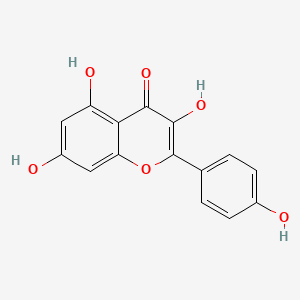
Kaempferol is a flavonol, a kind of flavonoid, and a yellow crystalline solid when purified. Plants build it from the amino acid phenylalanine. Flavonoids like it help leaves cope with strong light, partly by screening UV-B and partly by mopping up reactive oxygen.
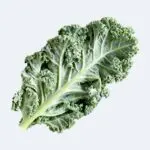
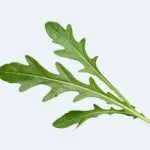
It is considered bitter. In the USDA data on this page, kale holds the most, at 46.8 mg per 100 g. Arugula (34.9 mg) and dill (13.3 mg) come next.
The name honors Engelbert Kaempfer, a 17th-century German physician and naturalist who was the first Western scholar to describe the ginkgo tree. Ginkgo is a source of kaempferol too: a 2008 paper calls it one of the most important constituents of ginkgo flavonoids.
Here is what most readers do not know. People have eaten kaempferol forever, but it has barely been tested. We found only five human trials of kaempferol itself, all published since 2023. Every one has authors from the same company, Otsuka Pharmaceutical.
The rest of the human evidence asks whether people who eat more kaempferol-rich food stay healthier. That cannot prove that kaempferol is the reason.
Health benefits of kaempferol
The top findings from 33 studies, strongest evidence first
What the stars mean
- Strong. Several randomized trials, pooled in a meta-analysis, point the same way, or regulators (FDA or EFSA) have approved the claim.
- Moderate. Good randomized trials support it, but there are fewer of them, or their results vary.
- Limited. Small, short or single trials, or mixed results. Promising, but it needs confirmation.
Population and lab studies get no stars: they show a link or a mechanism, not proof.
How we rate evidence →- ★Lower oxygen use in exercise, no faster racesA single 10 mg kaempferol dose lowered oxygen use and breathing rate during moderate exercise in 16 trained male athletes. In 13 male athletes, the same dose did not change 400 m race times.
- ★No adverse events at 50 mg a day24 healthy adults took a kaempferol supplement for 4 weeks, against 24 on placebo, with no adverse events or changes in blood and urine tests. It tested safety only, for a short time.
- ★Fewer weather-related headaches, without placeboIn an open-label study of 387 people with weather-related symptoms, 10 mg a day for 4 weeks was followed by fewer, milder headaches. There was no placebo group, so placebo effects and seasonal changes cannot be ruled out.
- ★More steps and better sleep in city workersIn 33 city workers wearing fitness trackers, 10 mg a day for 2 weeks raised steps and improved sleep compared with placebo. Heart rate during activity fell; the abstract gives no size for the changes.
- Population studyLinked to lower Alzheimer risk in older adultsAmong 921 older adults followed for Alzheimer dementia, the top fifth of kaempferol intake from food had 0.49 times the risk of the bottom fifth. Diet came from a questionnaire, so it cannot show cause.
All 33 studies, strongest evidence first
10 mg a day raised steps and improved sleep in city workers
In this double-blind crossover trial, 33 city workers (17 men and 16 women) wore a fitness tracker. Each took kaempferol and a placebo (dummy capsule) for 2 weeks, with a 7-day break between. Heart rate during activity fell and weekend recreation went up, but the abstract gives no size for the changes. Three authors work for Otsuka Pharmaceutical.
A single 10 mg dose cut oxygen use in moderate exercise
In this randomized, double-blind crossover trial, 16 well-trained male university athletes took kaempferol, about what 1 cup of raw kale holds, or a placebo. Oxygen uptake and breathing rate fell at 25%, 50% and 75% of maximal effort, with no rise in blood lactate. Time to exhaustion at 100% effort rose. Two authors work for Otsuka Pharmaceutical, which supplied the capsules.
A single 10 mg dose did not change 400 m race times
In this double-blind crossover trial, 13 male university athletes ran two 400 m races, as little as 90 minutes apart, on kaempferol or placebo. Heart and breathing rates on kaempferol were lower in the second run. Myoglobin and aspartate transaminase, markers of muscle damage, were lower on kaempferol (p less than 0.05). The abstract gives no sizes, and authors from Otsuka Pharmaceutical took part.
50 mg a day caused no adverse events or test changes
In this randomized, double-blind trial, 24 healthy adults took kaempferol for 4 weeks and 24 took a placebo. The dose was about five times the estimated dietary intake, roughly the amount in 5 cups of raw kale. Blood and urine tests did not change, but it tested safety only, and only for a short time. All authors are employees of Otsuka Pharmaceutical.
10 mg a day was followed by fewer weather-related symptoms (no placebo)
In this open-label pilot study, 458 people with moderate weather-related symptoms such as headache took kaempferol for 4 weeks. The 387 who took over 80% of doses were analyzed: headache frequency and severity fell (effect sizes 0.61 and 0.57). Over 80% said they improved, but without a placebo group, placebo effects and seasonal changes cannot be ruled out. The first author works for Otsuka Pharmaceutical, whose ethics committee approved the study.
In cohort studies, more kaempferol went with steadily lower cardiovascular risk
This dose-response meta-analysis (a study pooling earlier studies) covered 39 prospective cohorts on dietary flavonoids, with over a million people. The abstract does not say how many studies counted kaempferol. Quercetin was linked to lower coronary heart disease risk. Comparing highest with lowest intakes, every compound named was linked to lower cardiovascular risk, but food questionnaires cannot show cause.
In smokers only, more quercetin and kaempferol went with fewer smoking-related cancers
This meta-analysis pooled 35 studies (19 case-control and 15 cohort) of dietary flavonoids and cancers tied to smoking. Case-control studies compare people who have a disease with people who do not. Total flavonoids went with lower risk (odds ratio 0.82, range 0.72 to 0.93). The authors say the protective effects varied across studies.
Older adults eating most kaempferol had about half the Alzheimer risk
The Rush Memory and Aging Project followed 921 people without dementia at the start, average age 81, and 220 developed Alzheimer dementia. The highest fifth of kaempferol intake had 0.49 times the risk of the lowest; total flavonols gave 0.52 and myricetin and isorhamnetin 0.62. Quercetin showed no link (0.69, range 0.43 to 1.09). Results were adjusted for age, sex, education, APOE e4 (a gene variant linked to Alzheimer) and activity, and diet came from a questionnaire.
Higher kaempferol intake went with lower death rates, overall and from cancer
This NHANES cohort of 11,679 US adults had a median follow-up of 7.8 years. Higher intake went with 0.74 times the risk of death from any cause and 0.62 times the risk of cancer death. The abstract lists heart-disease death links for total flavonols, myricetin and quercetin, but not for kaempferol. Intake came from a single 24-hour dietary recall, a rough measure of usual diet.
In 38,408 women, flavonol intake was not linked to cancer risk
The Women’s Health Study followed them for 11.5 years and recorded 3,234 cancers. Comparing the highest with the lowest fifth of total flavonoid intake, relative risks were 1.03 for breast, 1.01 for colorectal and 1.03 for lung cancer. They were 1.15 for endometrial and 1.09 for ovarian cancer, none of them clear. Individual flavonoids, kaempferol among them, gave similar results, and the authors say the findings do not support a major role in cancer prevention.
In 10,054 Finns, more kaempferol went with less cerebrovascular disease
Diet came from a dietary history, and flavonoid intake was estimated mostly from levels in Finnish foods. Cases of cerebrovascular disease (stroke and other blood vessel problems in the brain) came from national health registers. Higher kaempferol intake went with 0.70 times the risk (range 0.56 to 0.86). In the same study, higher quercetin intake went with lower death from ischemic heart disease, caused by narrowed arteries (0.79).
Most kaempferol went with fewer coronary deaths, but total flavonols did not
The Nurses’ Health Study followed 66,360 US women for 12 years, with 938 nonfatal heart attacks and 324 coronary deaths. The highest kaempferol intake went with 0.66 times the risk of coronary death (range 0.48 to 0.93). The authors think the link was probably due to broccoli. They conclude their data do not support a link between more flavonol or flavone intake and less heart disease.
In middle-aged adults, more kaempferol went with less decline in thinking scores
This biracial cohort followed 10,041 adults aged 45 to 64 over 6 years, with three thinking tests at two visits. The pattern held for kaempferol, myricetin and quercetin (each P below .001). It was adjusted for age, ethnicity, sex, education, energy intake, smoking, activity, body mass index, diabetes and vitamin C. Intake came from a food questionnaire, and the abstract gives no effect sizes.
In 66,940 women, most kaempferol went with 40% less ovarian cancer
The Nurses’ Health Study recorded 347 cases between 1984 and 2002, and the highest intake had 0.60 times the risk (range 0.42 to 0.87). Luteolin showed a 34% drop, while the total of five flavonoids showed no clear link (0.75, range 0.51 to 1.09). Tea and broccoli were the main sources of kaempferol. The authors say more prospective studies are needed.
In 1,141 ovarian cancer cases, flavonoids were not linked to risk overall
This larger case-control study compared these cases with 1,183 controls, women without the cancer. Total intake of five flavonoids, kaempferol among them, gave a relative risk of 1.06 (range 0.78 to 1.45). Among single flavonoids, the abstract names only apigenin as borderline, so kaempferol was not singled out. The authors call the support limited.
In 183,518 people, more kaempferol leaned toward lower pancreatic cancer risk
The Multiethnic Cohort followed them for 8 years and found 529 cases. Kaempferol had the largest drop of the three flavonols (0.78 times the risk), but its range (0.58 to 1.05) includes 1 (no effect). The link was mostly in current smokers: their highest kaempferol quarter had 0.27 times the risk. No link was seen in people who never smoked or had quit.
More kaempferol went with less advanced prostate cancer, not prostate cancer overall
The Netherlands Cohort Study followed 58,279 men from 1986 to 2003: 3,362 got prostate cancer, and 1,164 cases were advanced. Catechin, epicatechin, kaempferol, myricetin and black tea were all linked to less stage III/IV or stage IV disease. The abstract gives no figure for kaempferol alone.
In smokers, kaempferol went with lower lung cancer odds; not in non-smokers
This case-control study had 558 cases and 837 controls, with intake from a food questionnaire. In smokers, each extra 2 mg a day went with 0.68 times the odds (range 0.51 to 0.90). Quercetin, catechin and epicatechin showed the same pattern. Case-control studies rely on what people recall eating.
Most kaempferol went with about half the stomach cancer odds in Spain
This Spanish case-control study matched 354 stomach cancer cases with 354 controls and used a dietary history questionnaire. The highest kaempferol intake had 0.48 times the odds (range 0.26 to 0.88). Total flavonoids gave 0.44, while carotenoids showed no link. Case-control studies rely on what people recall eating.
In Chinese women, more blood kaempferol went with lower breast cancer risk
This hospital-based case-control study measured flavonoids in the serum (blood) of 792 cases and 813 controls. Higher kaempferol went with 0.60 times the odds (range 0.45 to 0.80). Isorhamnetin gave 0.52 and total flavonols 0.66, while serum quercetin showed no link. The authors say prospective studies, which follow people forward, are needed.
Urine kaempferol: lower acute coronary syndrome odds, unclear trend
This case-control study, nested in the Danish Diet, Cancer and Health cohort, matched 393 cases with 393 people without the disease. Urine from a single spot was tested for 10 flavonoids, and kaempferol was one of two that showed any link. Higher levels went with 42% to 61% lower odds of this heart attack-type event, but the trend across levels was not clear. The authors say missing links elsewhere may come from using a short-term exposure measure.
In 90,630 women, kaempferol intake was not linked to breast cancer risk
The Nurses’ Health Study II followed premenopausal women aged 26 to 46 for 8 years, with 710 invasive cancers. The sum of flavonols gave 1.05 times the risk (range 0.83 to 1.34), and kaempferol, quercetin and myricetin showed no link on their own. Beans and lentils were the only foods with a link.
Kaempferol intake was not linked to colorectal cancer in large US cohorts
The Nurses’ Health Study (71,976 women) and Health Professionals Follow-Up Study (35,425 men) recorded 878 cases. Total flavonoids gave a relative risk of 1.19 (range 0.94 to 1.49). The authors say the data give little support to the idea.
In 38,018 women, kaempferol intake was not linked to type 2 diabetes
The Women’s Health Study followed them for 8.8 years and found 1,614 new cases. None of the flavonols or flavones was clearly linked, but eating 1 or more apples a day was (0.72 times the risk). In 344 women without diabetes, flavonol and flavone intake did not relate to insulin, HbA1c (long-term blood sugar), CRP or IL-6.
In Dutch adults, flavonols were not linked to colorectal cancer overall
The Netherlands Cohort Study followed 120,852 adults for 13.3 years, with 1,444 male and 1,041 female cases. A possible link for kaempferol in normal-weight women came from a subgroup analysis, which makes a chance result more likely. The authors say their findings generally do not support an association.
In a Chinese study, kaempferol was not linked to esophageal cancer
This case-control study in Yanting County had 820 cases and 863 controls, with intake from a 76-item questionnaire. Total flavonoids, flavonols, quercetin, myricetin and kaempferol showed no link, while isoflavones did (0.34 times the odds).
Each 5 mg of kaempferol went with 7% lower kidney damage odds
This NHANES study of 9,816 overweight or obese US adults covered 2007 to 2018, with a median follow-up of 117 months. Each step of that size a day gave 0.93 times the odds of kidney damage (range 0.88 to 0.99). The death rate was 7% lower per step (0.93 times the risk, range 0.85 to 0.98). Intake was estimated from national survey data, so other healthy habits may explain part of the link.
People with metabolic syndrome ate less kaempferol than healthy people
This small comparison of 90 Polish adults used a one-year food questionnaire. The difference was clear (p = 0.04), and less kaempferol went with a more advanced syndrome (p = 0.01). Flavonol intake did not correlate with blood fats, glucose or kidney function. It is a one-time snapshot, so it cannot show which came first.
In 64 cell studies, kaempferol slowed and killed solid tumor cells
This systematic review covered 64 test-tube (in vitro) studies. Kaempferol also curbed cell migration and the growth of new blood vessels. It made cancer cells more sensitive to the chemotherapy drugs cisplatin and 5-fluorouracil. These are cells in dishes, which says little yet about people.
Kaempferol stalled breast cancer cells before division in a dish
In triple-negative MDA-MB-231 cells, 48 hours of kaempferol raised the share in G2, just before division, from 9.27% to 37.5%. The share in G1 fell from 85.48% to 51.35%. Markers of cell death and DNA damage rose, and the effect was weaker in estrogen receptor-positive BT474 cells. The abstract does not give the kaempferol concentration.
Kaempferol slowed human stomach tumors grafted into mice
Two gastric cancer cell lines were stalled and died, while a normal stomach cell line showed no clear effect at the doses used. In the mice, liver, spleen and body weight showed no marked effect. Levels of the cell-cycle proteins cyclin B1, Cdk1 and Cdc25C fell. The abstract gives no doses.
Kaempferol reduced artery plaque in mice and calmed inflamed immune cells
Experiments used mouse macrophages (immune cells) loaded with oxidized LDL, and mice prone to atherosclerosis (artery plaque). Kaempferol lowered the NF-κB and MAPK inflammation signals and raised the protective Nrf2 and HO-1. The benefit shrank when mice lacked the Piezo1 channel in macrophages, which points to that channel as part of the route.
Kaempferol protected mouse liver from acetaminophen damage
Mice were fasted for 22 hours and given 250 mg/kg of acetaminophen (paracetamol), after kaempferol by mouth. It cut liver damage, inflammation and iron overload by switching on the Nrf2 pathway, and liver cells in a dish gave the same results. A computer docking model suggested it may bind Keap1, a protein in the Nrf2 pathway.
Foods high in kaempferol
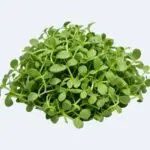
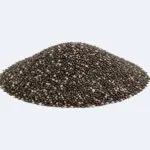
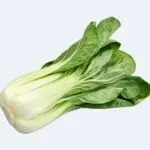
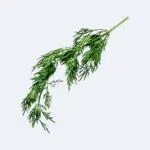
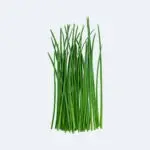
Kaempferol comes mostly from leafy greens and cabbage-family vegetables, plus a few herbs and seeds. In the USDA data on this page, kale leads at 46.8 mg per 100 g. Arugula (34.9 mg), dill (13.3 mg), garden cress (13 mg) and chia seeds (12.3 mg) follow.
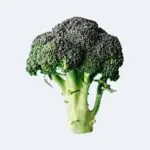
Broccoli holds 7.84 mg and spinach 6.38 mg. The Linus Pauling Institute’s table gives the same figures for kale and broccoli.
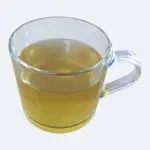
Serving size changes the picture. A cup of raw kale (21 g) holds 9.83 mg, and a cup of arugula (20 g) 6.98 mg. A cup of broccoli (76 g) has 5.96 mg and a cup of green tea 3.21 mg.
The 10 mg used in several trials above is about 1 cup of raw kale. In two large US studies of women, tea and broccoli were the main sources of kaempferol.
Per serving. No daily amount is set, so bars compare each food with the top food.
Per 100 g. No daily amount is set, so bars compare each food with the top food.
Per 100 kcal: the same calories of each food, for a fair comparison. Bars compare each food with the top food.
Food labels have no Daily Value or Reference Intake for kaempferol, so the % compares each food with the top food.
- 1.
- 2.
- 3.
- 4.
- 5.
- 6.
- 7.
- 8.
- 9.
- 10.



- 1.
- 2.
- 3.
- 4.
- 5.
- 6.
- 7.
- 8.
- 9.
- 10.


- 1.
- 2.
- 3.
- 4.
- 5.
- 6.
- 7.
- 8.
- 9.
- 10.
How kaempferol works
Most of what we know about how kaempferol works comes from test tubes, cells and animals. Three ideas keep coming up. It switches on the cell’s own defenses and quiets inflammation signals, and it stalls cancer cells in a dish. But very little of it reaches the blood, which limits what the first two can mean for people.
It switches on the cell’s own defenses
In mouse and cell studies, kaempferol raises Nrf2, a control protein that switches on protective genes such as HO-1. It also lowers NF-κB and MAPK, signals linked to inflammation.
In macrophage cells loaded with oxidized LDL and in mice prone to artery plaque, it did both and cut plaque. But the benefit shrank when the Piezo1 channel was removed from macrophages. In mice given a liver-damaging dose of acetaminophen, it also activated Nrf2 and protected the liver.
Two control switches inside the cell, as described in cell and mouse studies.
Kaempferol itself may not be the active form. In a 2023 lab study, an oxidation product of kaempferol protected cultured intestinal cells. It blocked NF-κB activation at 1 nanomolar, about 5,000 times less than kaempferol itself needed. We found no study showing this in people.
It stalls cancer cells in a dish
A 2024 review of 64 cell studies found that kaempferol slowed the division of solid tumor cells, triggered cell death and curbed their spread.
In triple-negative breast cancer cells, 48 hours of kaempferol cut the share of cells in the G1 phase from 85.48% to 51.35%. It lifted the share in G2, the stretch just before a cell divides, from 9.27% to 37.5%. Cell death and DNA damage markers rose, and it worked less well in a different type of breast cancer cell.
In stomach cancer cells it stalled division too, while a normal stomach cell line showed no clear effect at the doses used. It also slowed tumor growth in mice.
Drawn to scale. The study does not give the kaempferol concentration used.
Very little reaches the blood
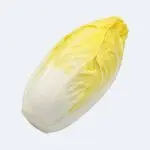
In a human study, eight people ate 9 mg of kaempferol in endive. Blood levels peaked at 0.1 µM about 6 hours later. An average of only 1.9% of the dose appeared in urine within 24 hours.
Most of what circulated was kaempferol-3-glucuronide, a conjugate with glucuronic acid attached, not free kaempferol. In rats, the bioavailability (the share reaching the blood) was about 2%, which the authors link to heavy conversion in the gut and liver. The human study found kaempferol was absorbed better than quercetin, which was not detected at all.
Drawn to scale. Of every 100 parts eaten, about 2 turned up in urine.
Lab doses are far higher. In lung cancer cells, the share of dying cells rose from 5.2% at 17.5 µM to 37.8% at 70 µM. That is 175 to 700 times the blood peak above.
The endive dose was low, and capsules give more. But we found no blood levels measured after the trial capsule doses. So the cell and mouse results may not carry over to a plate of kale.
Drawn to scale, except the blood bar, which would be under 1 unit wide and is drawn 4 units wide so it can be seen.
What has been seen in people
These effects are much easier to show in a dish than in a person. Five small trials found that single 10 mg doses changed oxygen use, heart rate and breathing during exercise. They also found that 10 mg a day for 2 to 4 weeks went with more steps, better sleep and fewer weather-related symptoms. The last study, though, was open-label with no placebo group.
All came from researchers tied to one company, and none tested disease. Cohort studies link higher intake to a lower risk of Alzheimer dementia (0.49 times the risk), coronary heart disease death (0.66) and ovarian cancer (0.60). Others found no link for breast cancer, colorectal cancer or diabetes. All of these are among the study cards above.
Sources
- Chu T, Wang Y, Wang S, et al. Kaempferol regulating macrophage foaming and atherosclerosis through Piezo1-mediated MAPK/NF-κB and Nrf2/HO-1 signaling pathway. J Adv Res. 2025.
- Li H, Weng Q, Gong S, et al. Kaempferol prevents acetaminophen-induced liver injury by suppressing hepatocyte ferroptosis via Nrf2 pathway activation. Food Funct. 2023.
- Speisky H, Arias-Santé MF, Fuentes J. Oxidation of quercetin and kaempferol markedly amplifies their antioxidant, cytoprotective, and anti-inflammatory properties. Antioxidants (Basel). 2023.
- de Morais EF, de Oliveira LQR, Farias Morais HG, et al. The anticancer potential of kaempferol: a systematic review based on in vitro studies. Cancers (Basel). 2024.
- Zhu L, Xue L. Kaempferol suppresses proliferation and induces cell cycle arrest, apoptosis, and DNA damage in breast cancer cells. Oncol Res. 2019.
- Song H, Bao J, Wei Y, et al. Kaempferol inhibits gastric cancer tumor growth: an in vitro and in vivo study. Oncol Rep. 2015.
- DuPont MS, Day AJ, Bennett RN, Mellon FA, Kroon PA. Absorption of kaempferol from endive, a source of kaempferol-3-glucuronide, in humans. Eur J Clin Nutr. 2004.
- Barve A, Chen C, Hebbar V, Desiderio J, Saw CL, Kong AN. Metabolism, oral bioavailability and pharmacokinetics of chemopreventive kaempferol in rats. Biopharm Drug Dispos. 2009.
- Nguyen TT, Tran E, Ong CK, et al. Kaempferol-induced growth inhibition and apoptosis in A549 lung cancer cells is mediated by activation of MEK-MAPK. J Cell Physiol. 2003.
Is kaempferol safe? Supplements, dose and interactions
Kaempferol from food is not a safety concern that we could find. The Linus Pauling Institute at Oregon State University reports no adverse effects from high dietary intakes of flavonoids from plant foods. It gives no recommended or upper intake for flavonoids. We found no official upper level for kaempferol itself.
- Trial doses and side effects. The trials used 10 mg, once or daily for up to 4 weeks. In the one safety trial, 50 mg a day for 4 weeks caused no adverse events and no blood or urine changes in 24 adults. But it was short and run by company employees.
- High doses are untested. In rat liver cells, 50 µM kaempferol protected against peroxide damage. But when no peroxide was present, it also halved cell viability and broke DNA. The authors judged high-dose supplements may not be advisable, and a 2000 review makes the same point for flavonoids in general. These are cell-level warnings, and nothing like them was reported in the 50 mg trial.
- Drug interactions. In rats, kaempferol raised blood levels of the drugs nifedipine, etoposide and tamoxifen. The authors link this to blocking the gut pump P-glycoprotein and the enzyme CYP3A. We found no human interaction study, and the Linus Pauling Institute says flavonoid supplements may affect anticoagulants (blood thinners). If you take prescription drugs, ask a pharmacist before trying kaempferol capsules.
- Pregnancy and breastfeeding. The Linus Pauling Institute says the safety of flavonoid supplements in pregnancy and lactation has not been established. A 2017 review found concern for some flavonoids and few studies of development. Ask your doctor before using supplements.
How to get more kaempferol
- Best food. Kale has 46.8 mg per 100 g, and a cup of raw kale gives about 10 mg, the dose used in several trials. Arugula follows at 34.9 mg per 100 g.
- Steam, do not boil. In broccoli, boiling caused significant loss of all the flavonoids measured, including seven kaempferol glycosides. Steaming and microwaving led to minor losses or even increases. In another test on kale and related vegetables, cooking caused the biggest losses, up to 70% to 80%.
- Food versus capsule. In plants, most kaempferol is attached to sugars, and the foods with the most are not always the best absorbed. The trial capsules held free kaempferol, and no trial compared them with food. None tested taking it with fat or at a certain time of day.
Sources
- Flavonoids. Linus Pauling Institute Micronutrient Information Center, Oregon State University.
- Akiyama M, Mizokami T, Ito H, Ikeda Y. A randomized, placebo-controlled trial evaluating the safety of excessive administration of kaempferol aglycone. Food Sci Nutr. 2023. All authors work for Otsuka Pharmaceutical.
- Niering P, Michels G, Wätjen W, et al. Protective and detrimental effects of kaempferol in rat H4IIE cells: implication of oxidative stress and apoptosis. Toxicol Appl Pharmacol. 2005.
- Skibola CF, Smith MT. Potential health impacts of excessive flavonoid intake. Free Radic Biol Med. 2000.
- Park JW, Choi JS. Role of kaempferol to increase bioavailability and pharmacokinetics of nifedipine in rats. Chin J Nat Med. 2019.
- Li C, Li X, Choi JS. Enhanced bioavailability of etoposide after oral or intravenous administration of etoposide with kaempferol in rats. Arch Pharm Res. 2009.
- Piao Y, Shin SC, Choi JS. Effects of oral kaempferol on the pharmacokinetics of tamoxifen and one of its metabolites, 4-hydroxytamoxifen, after oral administration of tamoxifen to rats. Biopharm Drug Dispos. 2008.
- Barenys M, Masjosthusmann S, Fritsche E. Is intake of flavonoid-based food supplements during pregnancy safe for the developing child? A literature review. Curr Drug Targets. 2017.
- Wu X, Zhao Y, Haytowitz DB, Chen P, Pehrsson PR. Effects of domestic cooking on flavonoids in broccoli and calculation of retention factors. Heliyon. 2019.
- Sikora E, Cieślik E, Filipiak-Florkiewicz A, Leszczyńska T. Effect of hydrothermal processing on phenolic acids and flavonols contents in selected brassica vegetables. Acta Sci Pol Technol Aliment. 2012.
- Dabeek WM, Marra MV. Dietary quercetin and kaempferol: bioavailability and potential cardiovascular-related bioactivity in humans. Nutrients. 2019.
History of kaempferol
Kaempferol is named for Engelbert Kaempfer (1651 to 1716), a German physician and naturalist. He traveled through Russia, Persia, India, Siam and Japan. In 1690 he reached Nagasaki as physician to the Dutch East India Company trading post. In February 1691 he became the first Western scholar to describe the ginkgo tree.
He brought ginkgo seeds home, and the trees planted from them in the Utrecht botanical garden have survived into the 21st century.
Chemists describe kaempferol as 3,4′,5,7-tetrahydroxyflavone. Plants build it in four main steps, starting from phenylalanine and passing through naringenin chalcone, naringenin and dihydrokaempferol. Ginkgo, the tree Kaempfer described, is itself a source, but we found no source saying that this is why the compound carries his name.
The first trial of kaempferol itself that we found dates from 2023. It asked only whether 50 mg a day was safe. Its authors noted that despite a large body of lab work, no clinical trial of the safety of kaempferol aglycone had been reported.
Sources
- Kaempferol. Wikipedia.
- Engelbert Kaempfer. Wikipedia.
- Zhang Y, Chen AY, Li M, Chen C, Yao Q. Ginkgo biloba extract kaempferol inhibits cell proliferation and induces apoptosis in pancreatic cancer cells. J Surg Res. 2008.
- Agati G, Brunetti C, Di Ferdinando M, et al. Functional roles of flavonoids in photoprotection: new evidence, lessons from the past. Plant Physiol Biochem. 2013.
- Akiyama M, Mizokami T, Ito H, Ikeda Y. A randomized, placebo-controlled trial evaluating the safety of excessive administration of kaempferol aglycone. Food Sci Nutr. 2023.
Frequently asked questions about kaempferol
What does kaempferol do for the body?
No one knows yet whether it does much. Five small trials of kaempferol itself found changes in oxygen use during exercise, daily steps and sleep. But all came from one company’s researchers, and none tested disease.
Cohort studies link a higher intake to lower risk of Alzheimer dementia (0.49 times the risk), cardiovascular disease and some cancers. Other large studies found no link for breast cancer, colorectal cancer or diabetes. None of this reaches strong evidence.
Which foods are high in kaempferol?
Kale is highest in the USDA data on this page, at 46.8 mg per 100 g. Then come arugula (34.9 mg), dill (13.3 mg), garden cress (13 mg) and chia seeds (12.3 mg). Per serving, a cup of raw kale holds 9.83 mg and a cup of broccoli 5.96 mg. In two large US studies of women, tea and broccoli were the main sources.
How much kaempferol should you take a day?
No dose is established, and we found no official intake level. The trials used 10 mg, about a cup of raw kale. One safety trial used 50 mg a day for 4 weeks without adverse events. No trial tested the best time of day.
Food is the better-studied route, so ask a clinician before using capsules.
Does kaempferol have side effects?
None were reported in the trials we found. In the safety trial, 24 adults took 50 mg a day for 4 weeks with no adverse events and no blood or urine changes. But it was one short trial run by company employees.
In rats kaempferol raised the blood levels of three drugs, so ask a pharmacist if you take prescriptions. Safety in pregnancy is not established.
Can kaempferol help prevent cancer?
It is unproven. Some studies link a higher intake to lower risk of ovarian cancer (0.60 times the risk), advanced prostate cancer and lung cancer in smokers. But the Women’s Health Study of 38,408 women found no link for total cancer, breast or colorectal cancer. In dishes, kaempferol stalls and kills cancer cells at levels far above the 0.1 µM seen in blood after a serving of endive.
Is kaempferol good for your brain?
It may be linked to brain health, but only observational data exist. Among 921 older adults, those with the highest kaempferol intake had about half the risk of Alzheimer dementia, and quercetin showed no link. In 10,041 middle-aged adults, a higher intake went with less decline in thinking tests over 6 years. No trial has tested whether kaempferol protects memory.
Kaempferol vs quercetin: what is the difference?
Both are flavonols, but they come in different amounts and may act differently. Quercetin supplied about three quarters of flavonol and flavone intake in US health professionals, so kaempferol is the smaller share.
In the Alzheimer cohort, kaempferol was linked to lower risk and quercetin was not. In a human absorption study, kaempferol was absorbed better, and quercetin was not detected. Results for one should not be read as results for the other.
Does cooking destroy kaempferol?
Boiling does the most harm. In broccoli, boiling caused significant loss of all the flavonoids measured, while steaming and microwaving led to minor losses or even increases. In another test on kale and related vegetables, cooking caused losses of up to 70% to 80%. Steaming or microwaving is the safer choice.