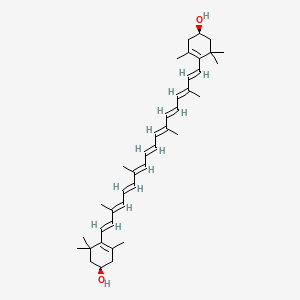
Zeaxanthin is a yellow-orange pigment from the carotenoid family, the same family as beta-carotene and lutein. It is a xanthophyll, a carotenoid that carries oxygen. Plants and algae make it. In yellow sweet corn it is, with lutein, one of the two main pigments that give the kernels their color.
People and other animals cannot make it, so it has to come from food.
Plants use it as a safety valve. In strong light, leaf cells turn another pigment, violaxanthin, into zeaxanthin, which helps them shed light energy they cannot use. In one alga the first steps took 15 seconds.
Your eyes use it too. The center of the retina, the macula, is yellow because of three carotenoids: lutein, zeaxanthin and meso-zeaxanthin. At the very center, zeaxanthin leads.
In donor eyes the lutein to zeaxanthin ratio averaged about 1 to 2.4 there. Yet a typical diet holds about five times more lutein than zeaxanthin.
Here is the part most people do not know. Dark green leafy vegetables, the usual advice for eye health, are rich in lutein. But in one analysis, only 0 to 3% of their carotenoids were zeaxanthin.
The same analysis found orange pepper had the most zeaxanthin of the vegetables tested, and corn and egg yolk are mostly lutein plus zeaxanthin. The third macular carotenoid, meso-zeaxanthin, is rare in food, and the eye appears to make it from lutein.
Health benefits of zeaxanthin
The top findings from 28 studies, strongest evidence first
What the stars mean
- Strong. Several randomized trials, pooled in a meta-analysis, point the same way, or regulators (FDA or EFSA) have approved the claim.
- Moderate. Good randomized trials support it, but there are fewer of them, or their results vary.
- Limited. Small, short or single trials, or mixed results. Promising, but it needs confirmation.
Population and lab studies get no stars: they show a link or a mechanism, not proof.
How we rate evidence →- ★★Supplements raised pigment density in the eyeIn 20 trials, supplements of lutein, zeaxanthin and meso-zeaxanthin raised eye pigment density by 0.07 in people with macular degeneration and 0.09 in healthy people. It measures the eye, not vision.
- ★★No clear slowing of late macular degenerationIn the AREDS2 trial (4,203 people), 10 mg of lutein plus 2 mg of zeaxanthin did not clearly slow advanced disease (0.90 times the risk). A Cochrane review found little or no difference too.
- ★★Slightly sharper vision in macular degenerationIn 8 trials of 1,176 people with macular degeneration, lutein plus zeaxanthin supplements improved sharpness a little (0.04 logMAR) and contrast vision, compared with placebo.
- ★★No fewer cataract operations overallIn 3,159 people in AREDS2, lutein plus zeaxanthin did not reduce cataract surgery overall (0.96 times as likely). In people with the lowest diet intake it was 0.68 times, a subgroup result.
- ★Zeaxanthin alone gave mixed pigment resultsIn 60 older people with early macular degeneration, 8 mg of zeaxanthin a day raised eye pigment, but no better than lutein. In 22 healthy people, 10 mg did not raise it, while lutein did.
All 28 studies, strongest evidence first
Across 20 trials, supplements raised macular pigment density
This meta-analysis pooled 20 randomized trials of lutein, zeaxanthin and meso-zeaxanthin. It covered 938 people with age-related macular degeneration (AMD), an eye disease of later life, and 826 healthy people. Density rose by 0.07 in AMD and by 0.09 in healthy people, more with higher doses and in trials that included meso-zeaxanthin. The trials used the three carotenoids in different mixes, so the result is not specific to zeaxanthin. It measures the pigment in the eye, not vision or disease.
Lutein plus zeaxanthin did not clearly slow progression to advanced AMD
AREDS2, a randomized, double-masked trial (neither people nor researchers knew who got what), had 4,203 people at risk of advanced AMD. It gave 10 mg of lutein plus 2 mg of zeaxanthin, with a median follow-up of 5 years. By 5 years, 29% on lutein plus zeaxanthin and 31% on placebo had progressed (0.90 times the risk, a gap that could be chance). Everyone also took an AREDS-type vitamin formula. Zeaxanthin was always given with lutein, so its own effect cannot be separated.
Cochrane: lutein and zeaxanthin made little or no difference to late AMD
This systematic review covered 26 trials with 11,952 people. For lutein with or without zeaxanthin against control, the only large trial was AREDS2 (4,176 people). Late AMD was 0.94 times as likely and vision loss 0.98 times, both rated low-certainty evidence. In exploratory analyses, swapping beta-carotene for lutein and zeaxanthin in the AREDS formula gave 0.82 times the risk of late AMD.
In 8 AMD trials, supplements slightly improved sharpness and contrast vision
This meta-analysis pooled 8 randomized trials of lutein and zeaxanthin together, with 1,176 people with AMD. Acuity improved by 0.04 logMAR against placebo, and contrast sensitivity improved at all four spatial frequencies tested. Each extra 1 mg a day went with a 0.003 logMAR gain.
In 38 trials, lutein, zeaxanthin and fatty acids ranked best for pigment
This network meta-analysis compared 8 antioxidant combinations with placebo, in 38 randomized trials drawn from 60 articles. The evidence was rated low quality. All groups raised macular pigment density and low-frequency contrast sensitivity. Lutein plus zeaxanthin shortened recovery after a bright light (photostress recovery time) by 5.75. The authors warn of indirect comparisons and likely publication bias.
In 3,159 people, lutein plus zeaxanthin did not reduce cataract surgery overall
This was part of the AREDS2 trial of 10 mg lutein plus 2 mg zeaxanthin a day, with a median follow-up of 4.7 years. Cataract surgery was 0.96 times as likely. In people in the lowest fifth of dietary lutein and zeaxanthin intake it was 0.68 times, a subgroup result.
Exploratory AREDS2 analyses: 18% less late AMD than beta-carotene
These were secondary analyses of the 4,203-person AREDS2 trial (10 mg lutein plus 2 mg zeaxanthin). Against beta-carotene, lutein and zeaxanthin gave 0.82 times the risk of late AMD and 0.78 times for neovascular (wet) AMD. For geographic atrophy (a dry form) it was 0.94, which could be chance. Against no lutein or zeaxanthin at all it was 0.90, and these were not the planned main analyses.
Ten years on, lutein and zeaxanthin went with 9% less late AMD
This follow-up study covered 3,882 AREDS2 participants. During follow-up everyone took a formula with lutein and zeaxanthin, so the comparison against no lutein or zeaxanthin rests on the original randomization. Late AMD was 0.91 times as likely. Lung cancer odds were 1.82 times higher for beta-carotene, and not clearly higher for lutein and zeaxanthin (1.15). Bausch and Lomb supplied supplements in the last 5 years.
8 mg zeaxanthin daily raised macular pigment from 0.33 to 0.51
In this randomized trial, 60 older people (57 men) with mild to moderate early AMD took a supplement for a year. Groups got 8 mg of zeaxanthin (25), zeaxanthin plus 9 mg of lutein (25) or 9 mg of lutein as the comparison group (10). Pigment rose in all three groups, with no clear difference between them, so zeaxanthin did no better than lutein only. The zeaxanthin group gained 1.5 lines of high-contrast acuity, while the lutein group did better on low-contrast acuity and glare recovery. There was no true placebo, and no adverse effects were reported.
10 mg zeaxanthin daily did not raise macular pigment; lutein did
In this randomized trial, 22 healthy Japanese volunteers took the same dose of lutein or zeaxanthin for 3 months. Pigment, measured two ways, rose more than 20% from baseline at 2 and 3 months on lutein. It stayed unchanged on zeaxanthin, whether or not people had high myopia. The abstract does not give the group sizes.
Goji with 20 mg zeaxanthin beat 2 mg lutein for macular pigment
In this randomized trial, 54 people with high myopia (severe nearsightedness) were split into groups for 3 months. They got 10 g of goji berries (10 mg zeaxanthin, 1 mg lutein) or 1 mg of lutein. Others got 20 g of goji berries (20 mg zeaxanthin, 2 mg lutein), 2 mg of lutein, or nothing. At 3 months the high-dose goji group had higher pigment than the high-dose lutein group, and the low-dose groups did not differ. The zeaxanthin dose was ten times the lutein dose, and goji holds other compounds too.
In 8 people with an eye disease, zeaxanthin did not improve vision
This randomized, open-label trial gave zeaxanthin at 10 or 20 mg a day for up to 2 years. The patients had macular telangiectasia type 2, a rare disease of the macula. Most showed more pigment in a ring around the center, but none gained pigment at the fovea itself. So the central pigment peak was not rebuilt. No objective vision gain was documented. One patient on 20 mg developed yellowish crystals in the macula with no change in acuity, and they disappeared several months after stopping.
After 6 months, lutein improved contrast acuity in dim light
This analysis covered 34 people from a supplement trial. They took zeaxanthin, lutein, both or placebo for 6 months, then double the dose for 6 more. Contrast acuity in dim light clearly improved in the lutein group and only trended better with zeaxanthin and the combination. Pigment density at the fovea rose with supplements, but the vision gains did not track it.
Six eggs a week raised serum zeaxanthin and macular pigment in women
In this trial, 24 women aged 24 to 59 got a sugar pill or 6 eggs a week for 12 weeks. The yolks held 331 or 964 µg of lutein plus zeaxanthin each. Serum zeaxanthin, but not lutein, rose in both egg groups, and macular pigment rose. That is about 0.3 to 0.8 mg a day of the two carotenoids together (our arithmetic), and cholesterol did not change in the egg groups.
Enriched eggs for 8 weeks raised blood levels but not macular pigment
This single-blind controlled trial compared eggs enriched with lutein and meso-zeaxanthin with ordinary eggs; average ages in the two groups were 41 and 35. Serum lutein, zeaxanthin and meso-zeaxanthin all rose, more on enriched eggs. Neither group gained macular pigment or visual performance, and the authors say a longer study is needed.
A goji berry formula raised plasma zeaxanthin by 26% in older adults
In this double-masked, placebo-controlled trial, 150 healthy adults aged 65 to 70 (75 per group) took a milk-based goji product. The dose was 13.7 g a day for 90 days. Placebo users showed less macular pigment and more soft drusen (small deposits under the retina), while the goji group stayed stable. Antioxidant capacity rose 57%. The authors note that the rise in plasma zeaxanthin did not track the macular changes.
5 mg of goji-ester zeaxanthin reached the blood better than free zeaxanthin
In this randomized, single-blind crossover study, 12 volunteers took a single dose of zeaxanthin dipalmitate from wolfberry (goji), or free zeaxanthin, in yoghurt with breakfast. Blood levels peaked 9 to 24 hours later. The total amount reaching the blood favored the ester, a borderline result. No meso-zeaxanthin appeared in the blood during the period observed.
One year of lutein plus zeaxanthin sped recovery from a bright flash
In this double-blind trial, 115 healthy young people took 10 mg lutein plus 2 mg zeaxanthin (57) or a placebo (58). Macular pigment rose at every distance from the center, and chromatic contrast and recovery after a bright flash improved against placebo. Glare disability did not clearly improve. The carotenoids were tested together.
A formula with meso-zeaxanthin raised macular pigment and contrast sensitivity
This single-masked, placebo-controlled trial had 36 people over 6 months. One group took 20 mg lutein and 2 mg zeaxanthin, and another 10 mg lutein, 2 mg zeaxanthin and 10 mg meso-zeaxanthin. Pigment rose at nearly every distance, and acuity and contrast sensitivity improved, mostly only in the group with meso-zeaxanthin. The lutein plus zeaxanthin group did not raise pigment, and it was a small trial.
Meso-zeaxanthin formulas raised pigment at every distance tested in early AMD
This 12-month trial had 52 people with early AMD and no placebo group. They took 20 mg lutein plus 2 mg zeaxanthin (17 people) or 10 mg meso-zeaxanthin plus 10 mg lutein plus 2 mg zeaxanthin (21). The other group (14) took 17 mg meso-zeaxanthin plus 3 mg lutein plus 2 mg zeaxanthin. The lutein plus zeaxanthin group raised pigment at only one distance. Contrast sensitivity also improved, most with the high meso-zeaxanthin formula.
Adding meso-zeaxanthin to AREDS2 made no difference in early AMD
This head-to-head trial had 121 people with early AMD. There were 60 on the AREDS2 formula plus 10 mg of meso-zeaxanthin and 61 on the formula alone. Contrast sensitivity, glare, reading speed and macular pigment all improved over time, and the two groups improved by the same amount. So the addition made no difference to vision or pigment, but there was no placebo group.
A lutein, zeaxanthin and meso-zeaxanthin formula raised macular pigment in glaucoma
In this double-masked, placebo-controlled trial, 62 people had open-angle glaucoma. They took 10 mg lutein, 2 mg zeaxanthin and 10 mg meso-zeaxanthin (42 people) or a placebo (20). Pigment rose at every visit over 18 months on the supplement and did not change on placebo. Contrast sensitivity under glare improved at 18 months, and no other structure or function changed. There were no serious adverse events.
Mostly meso-zeaxanthin, 20 mg daily, raised macular pigment
In this trial, 10 people took the supplement for 120 days and 9 took a placebo. Pigment density at 460 nm rose by 0.59 milli-absorbance units a day on the supplement and fell by 0.17 on placebo. All three carotenoids appeared in the blood, which shows that meso-zeaxanthin is absorbed. It was a small study.
In 6 cohorts, top intake went with 26% less late AMD
This meta-analysis of 6 prospective cohorts (which follow people forward in time) compared the highest with the lowest intake of the two carotenoids together. Late AMD was 0.74 times as likely and neovascular AMD 0.68 times. Early AMD was 0.96 times, which could be chance.
In 41,999 people, top intake went with 25% less nuclear cataract
This dose-response meta-analysis pooled 6 prospective cohorts, comparing the highest lutein and zeaxanthin intakes with the lowest. Nuclear cataract was 0.75 times as likely, and each extra 300 µg a day went with about 3% less. Cortical cataract (0.85) and posterior subcapsular cataract (0.77) did not clearly differ.
A high lutein-zeaxanthin diet did not lower intermediate AMD overall
The CAREDS study recruited 1,787 women aged 50 to 79 for high or low intake. Intermediate AMD was 0.96 times as likely on the high-intake diet. In women under 75 with stable diets and no chronic disease it was 0.57 times, an exploratory subgroup.
In quail, more zeaxanthin in the retina meant fewer light-damaged cells
Quail ate a carotenoid-free diet for 6 months, then 35 mg of zeaxanthin for 1, 3 or 7 days, with 16 birds per group. Then they were exposed to bright light. Dying rods and cones fell as retinal zeaxanthin rose (r = -0.61 and -0.54), but not with serum zeaxanthin. Retinal lutein tracked zeaxanthin (r = 0.95), so the two effects cannot be separated.
In monkeys, lutein or zeaxanthin restored the fovea’s blue-light protection
Eight rhesus monkeys raised without xanthophylls had no macular pigment. They were hit with low-power 476-nm laser light. The protection that normal monkeys had at the fovea was missing. It was back after 22 to 28 weeks on pure lutein or pure zeaxanthin, but this was not a human study.
Foods high in zeaxanthin
The NutriScrolls ranking below comes from USDA data, which measures lutein and zeaxanthin together as one number. So it cannot show how much of each a food has. Dark green leafy vegetables rank high. But in one analysis they held 15 to 47% of their carotenoids as lutein and only 0 to 3% as zeaxanthin.
Where zeaxanthin itself stands out, the papers point to orange pepper, corn, egg yolk and goji berries. Orange pepper had 37% of its carotenoids as zeaxanthin, the highest of the vegetables tested. In corn and egg yolk, lutein plus zeaxanthin made up more than 85% of the carotenoids. Yellow and orange chili peppers were also among the best pepper sources.
Amounts are small in everyday foods. Fresh yellow sweet corn holds about 0.2 to 0.3 mg of zeaxanthin per 100 g. So the 2 mg in the AREDS2 supplement would take about 670 to 1,000 g of kernels. A sweet corn bred for zeaxanthin reached more than 2.0 mg per 100 g.
Dried goji berries held 1,143.7 µg of zeaxanthin dipalmitate per gram, about 114 mg per 100 g, as the form the berry makes. They held only 1.4 µg per gram as free zeaxanthin. Meso-zeaxanthin turns up in few foods, such as shrimp shell and fish skin.
Per serving. No daily amount is set, so bars compare each food with the top food.
Per 100 g. No daily amount is set, so bars compare each food with the top food.
Per 100 kcal: the same calories of each food, for a fair comparison. Bars compare each food with the top food.
Food labels have no Daily Value or Reference Intake for lutein + zeaxanthin, so the % compares each food with the top food.
- 1.
- 2.
- 3.
- 4.
- 5.
- 6.
- 7.
- 8.
- 9.
- 10.


- 1.
- 2.
- 3.
- 4.
- 5.
- 6.
- 7.
- 8.
- 9.
- 10.


- 1.
- 2.
- 3.
- 4.
- 5.
- 6.
- 7.
- 8.
- 9.
- 10.

Sources
- Sommerburg O, et al. Fruits and vegetables that are sources for lutein and zeaxanthin: the macular pigment in human eyes. Br J Ophthalmol. 1998.
- O’Hare TJ, et al. Zeaxanthin biofortification of sweet-corn and factors affecting zeaxanthin accumulation and colour change. Arch Biochem Biophys. 2015.
- Inbaraj BS, et al. Determination of carotenoids and their esters in fruits of Lycium barbarum Linnaeus by HPLC-DAD-APCI-MS. J Pharm Biomed Anal. 2008.
- Thurnham DI. Macular zeaxanthins and lutein: a review of dietary sources and bioavailability and some relationships with macular pigment optical density and age-related macular disease. Nutr Res Rev. 2007.
- Pugliese A, et al. The effect of domestic processing on the content and bioaccessibility of carotenoids from chili peppers (Capsicum species). Food Chem. 2013.
- Wenzel AJ, et al. A 12-wk egg intervention increases serum zeaxanthin and macular pigment optical density in women. J Nutr. 2006.
How zeaxanthin works
Most of what we know about how zeaxanthin works comes from donor eyes, test tubes, plants and animals, not from people taking pills. Researchers keep coming back to four ideas. It gathers at the center of the macula, and the eye makes a twin of it there. It filters blue light, and in plants it helps leaves shed excess light.
Here is each one, plus how it sits in a membrane and what has been seen in people.
It gathers at the center of the macula
The macula is the small part of the retina that sees fine detail. Xanthophylls pile up there at about 1 mM. A 2020 review says zeaxanthin is about 2.5 times more concentrated than lutein in the cone-dense center.
In donor eyes, the lutein to zeaxanthin ratio averaged about 1 to 2.4 in the central 0.25 mm. At the far edge it was over 2 to 1.
In about 90% of 87 donors aged 3 to 95, zeaxanthin was the main pigment. The authors tied the change to the ratio of rods to cones, and suggested that cones take up zeaxanthin and rods take up lutein. That is a proposal, not a proven mechanism.
Drawn to scale, with equal amounts at the line. The arrow means the real figure is higher than 2. Averages from donor retinas, measured with chemical analysis.
It has a twin that the eye makes itself
A third pigment sits at the very center. Meso-zeaxanthin has the same atoms as zeaxanthin but a different arrangement at one end. It does not occur in plants and has no common dietary source. In cultured cells, and in chicken eye tissue, an enzyme called RPE65 turned lutein into meso-zeaxanthin by shifting a double bond.
In a 1997 study of donor eyes, infant retinas had less meso-zeaxanthin, relative to zeaxanthin, than adult ones. That fits the idea that the eye makes it over time. A 2013 review adds a caution: the story that retinal meso-zeaxanthin comes only from lutein needs another look. Eating zeaxanthin did not produce it in a 12-person trial.
Which carotenoid is the main one in each part of the macula, as described in a review. The enzyme RPE65 turns lutein into meso-zeaxanthin in the chicken eye and in cell cultures. The rings are a schematic, not drawn to scale.
It filters blue light
Macular pigment absorbs blue light before it reaches the light-sensing cells behind it. In a 2007 trial it was measured at 460 nm, in the blue range. A 2003 review says this may protect the cells from damage started by reactive oxygen.
Monkeys give some support. Normal monkeys had a fovea that was less sensitive to blue-light damage than the area beside it. Monkeys raised without xanthophylls lost that protection, and pure lutein or pure zeaxanthin brought it back. In quail, more zeaxanthin in the retina went with fewer dying rods and cones. Still, the 2003 review says a causal link has not been shown by experiment.
Filtering may not explain everything people notice. In a 59-person trial, higher pigment went with better contrast sensitivity and more sensitive edge detection. The authors point out that a filter would dim light and dark bars the same, so they suggest the nerve cells themselves are involved.
It lets plants shed excess light
Zeaxanthin is a working part of every green leaf. In strong light, an enzyme turns violaxanthin into antheraxanthin and then zeaxanthin, and in darkness the pigment returns to violaxanthin. A review of photosystem II says zeaxanthin is the major player in calming excited chlorophyll, which is how plants shed excess energy. It also works as an antioxidant in the membrane.
Lutein, by comparison, mostly calms a different excited form of chlorophyll. In the alga Chlorella, cells held in the zeaxanthin state resisted flash damage better than cells in the violaxanthin state. Making zeaxanthin was a prerequisite for the protection.
Plants that cannot make zeaxanthin pay for it. An Arabidopsis mutant without the enzyme suffered in strong light, above 500 µmol of light per square meter per second. Its mature leaves showed oxidative stress and chlorophyll loss. It also had lipid damage when singlet oxygen was generated. Young leaves of the same mutant coped, with extra vitamin E.
And the cycle is not one fixed speed: its pool size and pace vary by species and environment. In the alga Heterosigma akashiwo, antheraxanthin and zeaxanthin appeared within 15 seconds of strong light, while in Platymonas only antheraxanthin did.
The xanthophyll cycle in leaves and algae, simplified. In one alga, the first steps took about 15 seconds.
It lies across cell membranes
Zeaxanthin has a hydroxyl group at each end, which makes it polar (water-loving) and suits it to spanning a membrane. How it sits depends on the test. A 1999 study of lipid layers found that zeaxanthin stood roughly upright, while lutein split into two groups.
A 2017 study with microscopy and computer simulation found that both lutein and zeaxanthin tilt about 40 degrees. That is because the membrane is thinner than the molecule is long. In the 1999 tests, both pigments slowed fat damage by free radicals about equally. Zeaxanthin was better during long UV exposure, because lutein itself broke down.
Two test results for where zeaxanthin sits in a membrane. The studies used different lipids and methods, and the second one includes computer simulation. The drawings are not to scale.
What has been seen in people
These ideas are easier to show in a dish than in a person. In people, supplements do raise macular pigment, but only by small amounts: 0.07 to 0.09 density units in the meta-analysis above. Whether that protects the macula is less certain.
The main AREDS2 result was not clear (0.90 times the risk), and the 18% lower risk against beta-carotene came from exploratory analyses. Zeaxanthin alone raised pigment in one trial of older people with early macular degeneration and in goji berry users with high myopia. But it did not in healthy volunteers who took 10 mg of it. All of these are among the study cards above.
Sources
- Widomska J, SanGiovanni JP, Subczynski WK. Why is zeaxanthin the most concentrated xanthophyll in the central fovea?. Nutrients. 2020. One author reports receiving imaging equipment from ZeaVision.
- Bone RA, Landrum JT, Fernandez L, Tarsis SL. Analysis of the macular pigment by HPLC: retinal distribution and age study. Invest Ophthalmol Vis Sci. 1988.
- Thurnham DI. Macular zeaxanthins and lutein: a review of dietary sources and bioavailability and some relationships with macular pigment optical density and age-related macular disease. Nutr Res Rev. 2007.
- Bone RA, Landrum JT, Friedes LM, et al. Distribution of lutein and zeaxanthin stereoisomers in the human retina. Exp Eye Res. 1997.
- Shyam R, et al. RPE65 has an additional function as the lutein to meso-zeaxanthin isomerase in the vertebrate eye. Proc Natl Acad Sci U S A. 2017.
- Nolan JM, et al. What is meso-zeaxanthin, and where does it come from?. Eye (Lond). 2013.
- Breithaupt DE, et al. Comparison of plasma responses in human subjects after the ingestion of 3R,3R’-zeaxanthin dipalmitate from wolfberry (Lycium barbarum) and non-esterified 3R,3R’-zeaxanthin using chiral high-performance liquid chromatography. Br J Nutr. 2004.
- Krinsky NI, Landrum JT, Bone RA. Biologic mechanisms of the protective role of lutein and zeaxanthin in the eye. Annu Rev Nutr. 2003.
- Bone RA, et al. Macular pigment response to a supplement containing meso-zeaxanthin, lutein and zeaxanthin. Nutr Metab (Lond). 2007.
- Barker FM 2nd, et al. Nutritional manipulation of primate retinas, V: effects of lutein, zeaxanthin, and n-3 fatty acids on retinal sensitivity to blue-light-induced damage. Invest Ophthalmol Vis Sci. 2011.
- Thomson LR, et al. Elevated retinal zeaxanthin and prevention of light-induced photoreceptor cell death in quail. Invest Ophthalmol Vis Sci. 2002.
- Stringham JM, et al. Contrast sensitivity and lateral inhibition are enhanced with macular carotenoid supplementation. Invest Ophthalmol Vis Sci. 2017.
- Jahns P, Holzwarth AR. The role of the xanthophyll cycle and of lutein in photoprotection of photosystem II. Biochim Biophys Acta. 2012.
- Schubert H, et al. In vivo manipulation of the xanthophyll cycle and the role of zeaxanthin in the protection against photodamage in the green alga Chlorella pyrenoidosa. J Biol Chem. 1994.
- Havaux M, et al. Photodamage of the photosynthetic apparatus and its dependence on the leaf developmental stage in the npq1 Arabidopsis mutant deficient in the xanthophyll cycle enzyme violaxanthin de-epoxidase. Plant Physiol. 2000.
- Sun KM, et al. Rapid formation of antheraxanthin and zeaxanthin in seconds in microalgae and its relation to non-photochemical quenching. Photosynth Res. 2020.
- Demmig-Adams B, et al. Zeaxanthin, a molecule for photoprotection in many different environments. Molecules. 2020.
- Sujak A, et al. Lutein and zeaxanthin as protectors of lipid membranes against oxidative damage: the structural aspects. Arch Biochem Biophys. 1999.
- Grudzinski W, et al. Localization and orientation of xanthophylls in a lipid bilayer. Sci Rep. 2017.
Is zeaxanthin safe? Supplements, dose and interactions
Zeaxanthin from food is not a safety concern in the sources we read. A typical diet gives about 1 to 3 mg of lutein a day, with roughly five times less zeaxanthin than lutein.
For synthetic zeaxanthin in supplements, EFSA, the European food safety agency, reached a conclusion in 2012. Intakes of 0.75 mg per kg of body weight a day do not raise safety concerns. That is 53 mg for a 70 kg adult.
EFSA took a no-effect dose from a rat study (150 mg/kg a day) and divided it by 200, because no long-term study existed. The applicant had asked for use up to 2 mg a day.
In the US, the FDA had no questions about a marigold-derived zeaxanthin extract at up to 300 µg per serving of food. That was GRAS notice 639 (Kemin, 2016).
- Trial doses and side effects. The AREDS2 supplement held 2 mg of zeaxanthin with 10 mg of lutein. One trial gave 8 mg of zeaxanthin a day for a year with no adverse effects reported. EFSA lists studies at up to 20 mg a day for up to 6 months without adverse effects.
- A rare eye finding. In 8 people with macular telangiectasia, one patient on 20 mg a day developed yellowish crystals in the macula, with no change in acuity. They disappeared several months after the dose was stopped. We did not see this in other trials.
- Smokers and lung cancer. Beta-carotene raised lung cancer in AREDS2 (1.82 times the odds at 10 years). Lutein and zeaxanthin did not clearly do so (1.15). EFSA considers a risk from zeaxanthin unlikely but notes that no human or animal data exist.
- Eye disease, pregnancy and drugs. The AREDS2 formulas were tested with vitamins and zinc. So ask an eye doctor before swapping or adding supplements for macular degeneration. We found no drug interactions and no pregnancy or breastfeeding data in the sources, so ask your doctor.
How to get more zeaxanthin
- Best foods. Look past the greens: orange pepper, corn and egg yolk were the standouts. Six eggs a week for 12 weeks raised serum zeaxanthin and macular pigment in women. Yellow sweet corn gives only 0.2 to 0.3 mg per 100 g.
- Egg yolk absorbs well. A review suggests the xanthophylls in egg yolk may be more easily absorbed than those in other foods. In a test-tube digestion model, the type of fat barely changed how much lutein and zeaxanthin could be absorbed, unlike beta-carotene and lycopene.
- Cooking and storage. In a digestion model, tortilla gave the most absorbable zeaxanthin of three maize foods (18.5%), and boiled kernels the least absorbable carotenoids. Goji berries stored for 28 days lost about 80% of their zeaxanthin dipalmitate in one lab study, at both room and hot, humid conditions.
Sources
- EFSA Panel on Dietetic Products, Nutrition and Allergies (NDA). Statement on the safety of synthetic zeaxanthin as an ingredient in food supplements. EFSA J. 2012;10(10):2891.
- GRAS Notice Inventory, GRN 000639: zeaxanthin (marigold extract), agency response letter. US Food and Drug Administration. Notifier: Kemin Foods. Letter dated September 28, 2016.
- Thurnham DI. Macular zeaxanthins and lutein: a review of dietary sources and bioavailability and some relationships with macular pigment optical density and age-related macular disease. Nutr Res Rev. 2007.
- AREDS2 Research Group. Lutein + zeaxanthin and omega-3 fatty acids for age-related macular degeneration: the Age-Related Eye Disease Study 2 (AREDS2) randomized clinical trial. JAMA. 2013.
- Chew EY, et al. Long-term outcomes of adding lutein/zeaxanthin and omega-3 fatty acids to the AREDS supplements on age-related macular degeneration progression: AREDS2 report 28. JAMA Ophthalmol. 2022.
- Richer SP, et al. Randomized, double-blind, placebo-controlled study of zeaxanthin and visual function in patients with atrophic age-related macular degeneration: the Zeaxanthin and Visual Function Study (ZVF). Optometry. 2011.
- Choi RY, et al. Macular pigment distribution responses to high-dose zeaxanthin supplementation in patients with macular telangiectasia type 2. Retina. 2017.
- Sommerburg O, et al. Fruits and vegetables that are sources for lutein and zeaxanthin: the macular pigment in human eyes. Br J Ophthalmol. 1998.
- O’Hare TJ, et al. Zeaxanthin biofortification of sweet-corn and factors affecting zeaxanthin accumulation and colour change. Arch Biochem Biophys. 2015.
- Wenzel AJ, et al. A 12-wk egg intervention increases serum zeaxanthin and macular pigment optical density in women. J Nutr. 2006.
- Failla ML, et al. Unsaturated fatty acids promote bioaccessibility and basolateral secretion of carotenoids and alpha-tocopherol by Caco-2 cells. Food Funct. 2014.
- Zhang S, et al. Effects of three cooking methods on content changes and absorption efficiencies of carotenoids in maize. Food Funct. 2020.
- Ren R, et al. Carotenoid contents of Lycium barbarum: a novel QAMS analyses, geographical origins discriminant evaluation, and storage stability assessment. Molecules. 2021.
History of zeaxanthin
The story of zeaxanthin is mostly the story of the macula. In 1985, researchers tentatively identified the human macular pigment as lutein and zeaxanthin by comparing chromatograms of retinal extracts with standards.
In 1988 a second group measured the pigments in the whole retina. They found that zeaxanthin was concentrated in the macular region, while lutein was spread through the entire retina. The same year, a donor-eye study showed how the lutein to zeaxanthin ratio shifts across the retina. It went from 1 to 2.4 at the center to over 2 to 1 at the edge.
In 1997 the donor-eye work added a puzzle. Meso-zeaxanthin, a form not found in the diet, was present in the macula, and the authors proposed that the eye makes it from lutein. In 2017 a team showed that the enzyme RPE65 can do that conversion in chicken tissue and in cultured cells.
Meanwhile the regulators moved too. In 2008 EFSA said the safety of synthetic zeaxanthin at up to 20 mg a day in supplements had not been established. After a rat reproduction study arrived, its 2012 statement found no safety concern at the levels the applicant proposed. In 2013 the AREDS2 trial tested 2 mg of zeaxanthin with 10 mg of lutein in 4,203 people.
Sources
- Bone RA, Landrum JT, Tarsis SL. Preliminary identification of the human macular pigment. Vision Res. 1985.
- Handelman GJ, Dratz EA, Reay CC, van Kuijk JG. Carotenoids in the human macula and whole retina. Invest Ophthalmol Vis Sci. 1988.
- Bone RA, Landrum JT, Fernandez L, Tarsis SL. Analysis of the macular pigment by HPLC: retinal distribution and age study. Invest Ophthalmol Vis Sci. 1988.
- Bone RA, Landrum JT, Friedes LM, et al. Distribution of lutein and zeaxanthin stereoisomers in the human retina. Exp Eye Res. 1997.
- Shyam R, et al. RPE65 has an additional function as the lutein to meso-zeaxanthin isomerase in the vertebrate eye. Proc Natl Acad Sci U S A. 2017.
- Statement on the safety of synthetic zeaxanthin as an ingredient in food supplements. EFSA Panel on Dietetic Products, Nutrition and Allergies (NDA). EFSA J. 2012.
- AREDS2 Research Group. Lutein + zeaxanthin and omega-3 fatty acids for age-related macular degeneration: the Age-Related Eye Disease Study 2 (AREDS2) randomized clinical trial. JAMA. 2013.
- Zeaxanthin. Wikipedia. Used only for the origin of the name.
Frequently asked questions about zeaxanthin
What does zeaxanthin do for the body?
It builds up in the macula, where it helps filter blue light. Supplements raise the density of macular pigment, as a meta-analysis of 20 trials found. Whether that protects sight is less clear. In AREDS2, 2 mg of zeaxanthin with 10 mg of lutein did not clearly lower progression to advanced macular degeneration (0.90 times the risk). Most studies tested zeaxanthin together with lutein, so its own effect is hard to separate.
Which foods are high in zeaxanthin?
Orange pepper, corn, egg yolk and goji berries stand out in the papers we read. Orange pepper had the highest share of zeaxanthin (37% of carotenoids) among the vegetables tested. Fresh yellow sweet corn holds only about 0.2 to 0.3 mg per 100 g. Dark green leafy vegetables are rich in lutein but held 0 to 3% of their carotenoids as zeaxanthin.
How much zeaxanthin should you take a day?
No dose is proven best. AREDS2 used 2 mg of zeaxanthin with 10 mg of lutein, and single trials used 8 mg, 10 mg and up to 20 mg. EFSA found that 53 mg a day of synthetic zeaxanthin for a 70 kg adult does not raise safety concerns. But the applicant asked only for up to 2 mg. Ask a clinician before going higher.
Does zeaxanthin have side effects?
Trials reported few. EFSA lists studies at up to 20 mg a day for up to 6 months without adverse effects. One patient with macular telangiectasia on 20 mg developed yellowish crystals in the macula that faded after stopping. We found no drug interactions or pregnancy data in the sources, so ask your doctor.
Is zeaxanthin better than lutein?
No study here shows a clear winner. In the diet, lutein outweighs zeaxanthin about five to one, but at the center of the macula zeaxanthin leads. Lutein raised macular pigment more than zeaxanthin in 22 healthy volunteers (10 mg each). The two raised it about equally in older people with early macular degeneration. And a goji berry dose with 20 mg of zeaxanthin beat 2 mg of lutein in people with high myopia. Most supplements and trials give both.
What is meso-zeaxanthin, and do you need it?
Meso-zeaxanthin is a form of zeaxanthin found at the very center of the macula. It is rare in food, and the eye appears to make it from lutein. Formulas with it raised macular pigment at more distances in small trials. But adding 10 mg to the AREDS2 formula made no difference to vision in a trial of 121 people. Nothing here shows you need it.
Does zeaxanthin help with macular degeneration or cataracts?
Possibly, but the trials are not convincing. In cohort studies, diets high in lutein and zeaxanthin went with 26% lower risk of late macular degeneration and 25% lower risk of nuclear cataract. These studies cannot prove cause. In AREDS2, lutein and zeaxanthin did not clearly lower either macular degeneration progression or cataract surgery overall.
Are goji berries a good source of zeaxanthin?
They are a rich source, mostly as zeaxanthin dipalmitate: 1,143.7 µg per gram of dried fruit in one analysis. In 12 people, that ester reached the blood better than free zeaxanthin. A goji milk product raised plasma zeaxanthin by 26% in older adults. Stored berries lost about 80% of the ester in 28 days in a lab study.