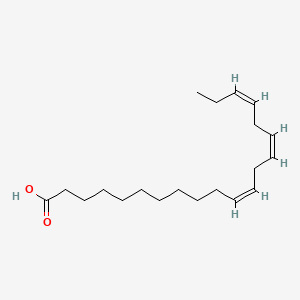
Eicosatrienoic acid (icosatrienoic acid, 20:3, C20H34O2) is a 20-carbon polyunsaturated fat with three double bonds. The name covers three different molecules, not one.
Dihomo-gamma-linolenic acid (DGLA, 20:3 n-6) is the one the body makes from gamma-linolenic acid (GLA), the fat in evening primrose and borage oil. Mead acid (20:3 n-9, 5,8,11-eicosatrienoic acid) is made from oleic acid when the body runs short of essential fats. The third is an omega-3 form (20:3 n-3, 11,14,17-eicosatrienoic acid). The structure drawing on this page shows that omega-3 form, the least studied of the three.
USDA does not separate them. Its documentation says specific isomers are always summed into the undifferentiated 20:3 value (nutrient 689). It lists named lines for 20:3 n-3 and 20:3 n-6 but none for 20:3 n-9.
So the food ranking below is a total for 20:3 as USDA reports it. We cannot tell which of the three forms a food holds. The amounts are tiny, a fraction of a gram a serving.
The best-known use is as a measurement. When the body lacks linoleic acid and alpha-linolenic acid (ALA), Mead acid builds up in the blood. Doctors compare it with arachidonic acid. That triene to tetraene ratio, at or above 0.20, has been the classic sign of essential fatty acid deficiency.
For DGLA the story is about GLA oils sold as supplements, and the trials mostly found no benefit. We found no randomized trial of the omega-3 form and no EU health claim for any of the three. We also found no daily intake set by a health body. Evidence is scarce, and this page says where.
Health benefits of eicosatrienoic acid
The top findings from 16 studies, strongest evidence first
What the stars mean
- Strong. Several randomized trials, pooled in a meta-analysis, point the same way, or regulators (FDA or EFSA) have approved the claim.
- Moderate. Good randomized trials support it, but there are fewer of them, or their results vary.
- Limited. Small, short or single trials, or mixed results. Promising, but it needs confirmation.
Population and lab studies get no stars: they show a link or a mechanism, not proof.
How we rate evidence →- ★★★No better than placebo for eczemaEvening primrose oil and borage oil supplements did no better than placebo for eczema in a Cochrane review of 27 trials (1,596 people). A separate 12-week trial of borage oil in 140 people with eczema also found no gain.
- ★★Less pain in rheumatoid arthritisIn 7 trials of GLA-rich seed oils for rheumatoid arthritis, pain fell by 32.83 points on a 100-point scale. Side effects were 20% against 3% on placebo, which could be chance.
- ★★No essential fatty acid deficiency on IV fatIn 101 children, mostly preterm infants, fed by vein with olive-oil or soybean-oil fat for about 10 days, no one developed essential fatty acid deficiency. Two record reviews of children fed by vein long-term (47 and 26) found none passed 0.2, the deficiency mark on the triene to tetraene ratio.
- ★Less sneezing and blocked nose in one trialIn 33 healthy Japanese adults in cedar pollen season, 314 mg of DGLA a day gave lower sneezing and blocked-nose scores than olive oil. Runny nose and total symptoms showed only trends.
- ★No clear asthma improvementIn 24 people with mild to moderate asthma, borage oil (2.0 g of GLA a day) for 12 months raised DGLA in white blood cells. Asthma scores did not improve significantly.
All 7 studies, strongest evidence first
In 101 children, no one developed essential fatty acid deficiency
This randomized, double-blind trial at several centers fed 101 children, 94 of them preterm infants, by vein (parenteral nutrition). The fat was either an 80% olive oil and 20% soybean oil emulsion or 100% soybean oil. Treatment lasted about 10 days (10.3 and 11.3 days on average). Mead acid rose in the olive oil group and fell in the soybean group, giving similar changes in the triene to tetraene ratio. The authors conclude that the ratio alone is not enough: the full fatty acid profile and desaturase gene variants should be considered too.
62% of 63 preterm babies had detectable Mead acid at 7 days
Researchers tracked plasma (blood) fatty acids in 63 premature infants over time. At 7 days, 67% had low linoleic acid, 62% had readily detectable 20:3 n-9 and 44% had a high triene to tetraene ratio. Infants fed by day 2 had normal linoleate at 7 days. None of those fed by day 2 had detectable Mead acid by 10 days. Infants not fed until day 7 had a very high rate of abnormal fatty acid status. Regression models put the average linoleate needed for normal fatty acid status at 1.19 g per kg of body weight a day.
6 of 9 preterm babies given no fat had a raised ratio
In this prospective study, 9 low birthweight infants (about 1,145 g, 28 weeks) got no fat for 2 to 9 days after birth. Plasma linoleic acid fell by 0.75% of total fatty acids a day while Mead acid rose, and only 1 developed symptoms. Fat by vein or by mouth corrected the abnormal profiles within a few days. The authors say at least 0.25 g of linoleic acid per kg a day corrected the depletion. That equals 0.50 g per kg of 20% Intralipid, or 30 to 50 mL per kg of breast milk, but the study is tiny.
None of 47 children on IV feeding reached a ratio of 0.2
This ten-year retrospective cohort (a look back at records) covered 144 fatty acid profiles from 47 children with intestinal failure on parenteral nutrition. They got a soybean oil, composite or fish oil lipid emulsion. Essential fatty acid deficiency, defined as a ratio of 0.2 or more, did not occur in any group. No group saw essential fatty acid levels fall, and a ratio of 0.05 or more was no more common on one emulsion than another. Because no one became deficient, the effect of lipid dose could not be judged.
No child on mixed-oil IV fat had a ratio above 0.2
This retrospective study looked at 26 children aged 0 to 17 (median age 4.1 years) with intestinal failure, fed almost fully by vein. Over a median 1,367 days, they got a composite lipid emulsion at 1.7 g of fat per kg a day. The median ratio was 0.1, and Mead acid was normal in all. This was despite low linoleic acid in 85% of the children and low arachidonic acid in 19%. The authors conclude that, without lipid restriction, deficiency is not a concern on a mixed-oil emulsion.
Top-third milk 20:3 n-3, lower odds of HIV transmission
This case-control study looked at 46 breastfeeding mothers with HIV: 23 whose infants acquired HIV after 6 weeks of age, and 23 matched controls. Mothers in the top third of milk eicosatrienoic acid (20:3 n-3) had 0.16 times the odds of those in the bottom third. This was adjusted for the mother’s CD4 count (an immune cell count), and the trend was statistically significant. Milk 20:3 n-3 correlated negatively with HIV RNA load (the amount of virus). The authors read it as a change in fatty acid synthesis in the breast, not protection; the small study cannot show cause.
In cells, Mead acid and the omega-3 form blocked vessel growth
This lab study used human umbilical vein endothelial cells and fibroblasts stimulated with VEGF-A, a growth signal. At 0.1 to 10 µmol/L, both 20:3 n-9 and 20:3 n-3 reduced vessel growth, more with higher doses. They beat the control drug suramin, while arachidonic acid, EPA, DGLA and oleic acid did not work. The authors link Mead acid to cartilage, which is rich in it and has no blood vessels. The work was partly supported by Polyene Project, Inc., and these are cells, not people.
Foods high in eicosatrienoic acid
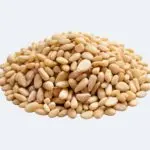
In our USDA ranking per serving, pine nuts lead with 0.1 g in 1 oz (28 g). A chicken drumstick with skin (133 g) has 0.03 g. Half an avocado and 3 oz of farmed Atlantic salmon have 0.02 g each, and chicken breast and a large egg 0.01 g each.
Per 100 g, pine nuts reach 0.35 g and no other food passes 0.02 g. Per 100 kcal pine nuts lead at 0.05 g, ahead of eggs at 0.02 g. These are USDA totals for undifferentiated 20:3. So the ranking does not say whether the fat is the n-3, n-6 or n-9 form.
Mead acid is not a food fat to look for. The body makes it from oleic acid when essential fats run short. DGLA is also made by the body. Evening primrose and borage oil supply GLA, and in a trial of 64 healthy adults borage oil raised blood GLA and DGLA.
Whole foods hold fractions of a gram of 20:3, and no study links a food amount of it to health.
Per serving. No daily amount is set, so bars compare each food with the top food.
Per 100 g. No daily amount is set, so bars compare each food with the top food.
Per 100 kcal: the same calories of each food, for a fair comparison. Bars compare each food with the top food.
Food labels have no Daily Value or Reference Intake for eicosatrienoic acid, so the % compares each food with the top food.
- 1.
- 2.

- 3.

- 4.

- 5.

- 6.

- 7.

- 8.

- 9.
- 10.



- 1.
- 2.
- 3.
- 4.
- 5.
- 6.
- 7.
- 8.
- 9.
- 1.
- 2.
- 3.
- 4.
- 5.
- 6.
- 7.
- 8.
- 9.
Sources
- FoodData Central. US Department of Agriculture, Agricultural Research Service. Values as shown in the ranking above.
- US Department of Agriculture, Agricultural Research Service. USDA National Nutrient Database for Standard Reference, Release 28: documentation and user guide. 2015. Table 2 and the section on fatty acid totals.
- Sergeant S, Hallmark B, Mathias RA, et al. Prospective clinical trial examining the impact of genetic variation in FADS1 on the metabolism of linoleic acid- and ɣ-linolenic acid-containing botanical oils. Am J Clin Nutr. 2020.
How eicosatrienoic acid works
Most of what is known comes from cells and from blood tests in people. This section covers the three molecules behind the name and why Mead acid rises when essential fats are missing. It also covers why the body’s DGLA response to GLA oils differs from person to person, and what has been seen in people.
Three molecules share one name
The three 20:3 fatty acids and where each comes from. The first panel rests on trials and reviews of GLA oils, the second on tests in cells, the third on single cell and milk studies. Not to scale.
The body makes DGLA in two steps from linoleic acid. An enzyme called delta-6-desaturase makes GLA, and GLA is then lengthened to DGLA. A review of evening primrose and borage oil in rheumatologic conditions notes that a diet rich in evening primrose oil raises DGLA. DGLA can form series-1 prostaglandins such as PGE1.
The same review says DGLA itself cannot be turned into leukotrienes. But it can form a 15-hydroxyl derivative that blocks the way arachidonic acid becomes leukotrienes. The review frames this as a possible way to calm inflammation. That is a mechanism from cells and animals, and the human trials below test whether it matters.
Mead acid takes a different road. In cultured cells, knocking down the enzymes Elovl5, Fads1 or Fads2 lowered Mead acid. The authors mapped two routes from oleic acid (18:1 n-9) through 20:2 n-9 to 20:3 n-9. For the omega-3 form we found no study of how the body makes it or how much it makes.
Mead acid rises when essential fats run short
When enough linoleic acid and alpha-linolenic acid (ALA) are available, the same enzymes work on them and Mead acid stays low. When they are scarce, the enzymes work on oleic acid instead. In a clinical review’s words, a raised ratio reflects more oleic acid turned into Mead acid when essential fats are missing.
In a cell test, adding ALA to nerve-like cells that were low in omega-3 fats markedly lowered Mead acid.
Share of 63 premature infants with each sign at 7 days, drawn to scale from zero. Infants fed by day 2 had normal linoleate at 7 days.
The cutoff is debated. A 2026 review defends the Holman index, the Mead acid to arachidonic acid ratio in plasma. It says the historical diagnostic threshold is 0.20 or more and that the index still detects deficiency reliably. It also notes concerns about the ratio and about using absolute fatty acid values or population-specific reference ranges instead.
A narrative review adds that the assay and its reference range matter. The 2025 trial above argues for reading the full profile and not the ratio alone.
How much DGLA you make depends on your genes
Rise in serum DGLA after 4 weeks of borage oil (37% linoleic acid, 23% GLA) by genotype of the FADS1 variant rs174537, drawn to scale from zero.
In 64 healthy adults, a modest daily dose of borage oil raised blood GLA and DGLA. The size of the DGLA rise depended on a variant in the FADS1 gene. The authors suggest this unexplained variation may help explain why trials of GLA oils disagree.
Diet matters too. In healthy men, 10.5% of energy as linoleic acid, against 3.8%, lowered plasma DGLA and EPA with no change in arachidonic acid.
What has been seen in people
For Mead acid, people studies show a clear link. It rises when infants or patients get too little linoleic acid and falls when fat is supplied, and the ratio is used in the clinic.
For DGLA, blood levels rise on GLA oils. But the trials of those oils found no benefit in eczema, mixed results in rheumatoid arthritis and small or null results elsewhere. One small trial of pure DGLA is the only one we found. For the omega-3 form, one small case-control study and a cell study are all we found.
Sources
- Ichi I, Kono N, Arita Y, et al. Identification of genes and pathways involved in the synthesis of Mead acid (20:3n-9), an indicator of essential fatty acid deficiency. Biochim Biophys Acta. 2014.
- Belch JJ, Hill A. Evening primrose oil and borage oil in rheumatologic conditions. Am J Clin Nutr. 2000.
- Simon D, Eng PA, Borelli S, et al. Gamma-linolenic acid levels correlate with clinical efficacy of evening primrose oil in patients with atopic dermatitis. Adv Ther. 2014.
- Gramlich L, Ireton-Jones C, Miles JM, et al. Essential Fatty Acid Requirements and Intravenous Lipid Emulsions. JPEN J Parenter Enteral Nutr. 2019.
- Msika O, Brand A, Crawford MA, Yavin E. NGF blocks polyunsaturated fatty acids biosynthesis in n-3 fatty acid-supplemented PC12 cells. Biochim Biophys Acta. 2012.
- Kang J, et al. In defense of the Holman index: Defining fatty acid deficiency. Nutrition. 2026.
- Sergeant S, Hallmark B, Mathias RA, et al. Prospective clinical trial examining the impact of genetic variation in FADS1 on the metabolism of linoleic acid- and ɣ-linolenic acid-containing botanical oils. Am J Clin Nutr. 2020.
- Liou YA, Innis SM. Dietary linoleic acid has no effect on arachidonic acid, but increases n-6 eicosadienoic acid, and lowers dihomo-gamma-linolenic and eicosapentaenoic acid in plasma of adult men. Prostaglandins Leukot Essent Fatty Acids. 2009.
How much eicosatrienoic acid do you need?
No health body sets a daily amount of eicosatrienoic acid in any of its forms. The FDA has set no Daily Value for it and the EU no Reference Intake. We found no claim for it in Regulation (EU) No 432/2012.
The body makes DGLA and Mead acid itself. So the question that matters is whether you get enough of the two essential fats, linoleic acid and alpha-linolenic acid (ALA). The table lists the thresholds and amounts that studies reported. They are study findings, not official values.
| Source | Group | Value | Notes |
|---|---|---|---|
| Kang 2026 review (1) | Plasma, all ages | Mead acid to arachidonic acid (triene to tetraene) ratio of 0.20 or more | The historical threshold for diagnosing essential fatty acid deficiency. Criticized by some, defended by the authors. |
| Johnson 2024 (2) | Children with intestinal failure | Ratio of 0.2 or more counted as deficiency; 0.05 or more as a secondary outcome | Study definitions in a retrospective cohort. |
| Lee 1993 (3) | Preterm infants | At least 0.25 g of linoleic acid per kg a day | Corrected depleted profiles within a few days in 9 infants. |
| Farrell 1988 (4) | Premature infants | About 1.19 g of linoleate per kg a day | Average amount for normal fatty acid status, from regression models in 63 infants. |
Essential fatty acid deficiency: signs and who is at risk
Essential fatty acid deficiency is rare. A narrative review says it may occur in people with conditions that severely limit the intake, digestion, absorption or metabolism of fat. It is diagnosed by a raised triene to tetraene ratio.
The 2026 Holman index review lists delayed growth and development, weaker immune response and reproductive problems among its effects. It names preterm infants and people on long-term parenteral nutrition (feeding by vein) as the groups most at risk. A case series adds that abnormal liver function tests can be an early clinical hint, but the diagnosis rests on the blood ratio.
Premature infants given no fat for several days showed the shift within days, and fat corrected it. For healthy people who eat fat, we found no study showing a deficiency. See the pages on linoleic acid and alpha-linolenic acid (ALA) for the essential fats themselves.
Sources
- Kang J, et al. In defense of the Holman index: Defining fatty acid deficiency. Nutrition. 2026.
- Johnson P, et al. Effect of parenteral lipids on essential fatty acid deficiency in pediatric intestinal failure: A retrospective cohort study. JPEN J Parenter Enteral Nutr. 2024.
- Lee EJ, Simmer K, Gibson RA. Essential fatty acid deficiency in parenterally fed preterm infants. J Paediatr Child Health. 1993.
- Farrell PM, Gutcher GR, Palta M, DeMets D. Essential fatty acid deficiency in premature infants. Am J Clin Nutr. 1988.
- Gramlich L, Ireton-Jones C, Miles JM, et al. Essential Fatty Acid Requirements and Intravenous Lipid Emulsions. JPEN J Parenter Enteral Nutr. 2019.
- Gramlich L, Meddings L, Alberda C, et al. Essential Fatty Acid Deficiency in 2015: The Impact of Novel Intravenous Lipid Emulsions. JPEN J Parenter Enteral Nutr. 2015.
- European Commission. Commission Regulation (EU) No 432/2012 establishing a list of permitted health claims made on foods. Official Journal of the European Union. 2012. Text searched for eicosatrienoic, dihomo-gamma-linolenic, gamma-linolenic, Mead, evening primrose and borage.
Forms of eicosatrienoic acid: absorption and effects
People rarely take eicosatrienoic acid itself. What is sold is GLA in evening primrose oil or borage oil, which the body turns partly into DGLA, and, in one trial, DGLA capsules. Mead acid and the omega-3 form are not supplements: the body makes the first, and we found no product or trial for the second.
The honest bottom line is that no trial compared one form with another. So claims that borage beats evening primrose oil, or that DGLA capsules beat GLA oils, have no trial behind them.
Here are the forms used in the key trials. GLA as the free fatty acid was given at 2.8 g a day in rheumatoid arthritis. Borage seed oil gave 1.4 g of GLA a day in a second arthritis trial and 920 mg a day in an eczema trial. A Cochrane review pooled evening primrose and borage oil, and a pollen allergy trial used 314 mg a day of DGLA.
A 4-week trial in 64 adults showed that borage oil raised blood DGLA and soybean oil did not. The size of the rise depended on genotype.
| Form | What it is | What studies show | Source |
|---|---|---|---|
| Evening primrose oil | A seed oil rich in GLA | In 27 eczema trials (19 on this oil), no better than placebo. Mild stomach side effects, the same as placebo. | 1 |
| Borage oil | A seed oil rich in GLA (23% in one trial) | No better than placebo in eczema in 140 people. Raised blood DGLA in 64 healthy adults, more in some genotypes. In one arthritis trial of 37 people, 1.4 g of GLA a day cut tender joints by 36%. | 2, 7, 5 |
| GLA free fatty acid | Purified GLA capsules | 2.8 g a day in 56 people with active rheumatoid arthritis gave a meaningful response in 14 of 22, against 4 of 19 on placebo. | 4 |
| Mixed GLA oils (evening primrose, borage, blackcurrant seed oil) | GLA from three oils pooled | Seven trials pooled in a Cochrane review lowered rheumatoid arthritis pain by 32.83 points on a 100-point scale. | 3 |
| DGLA capsules | Purified DGLA, 314 mg a day | One trial of 33 healthy adults: less sneezing and blocked nose in cedar pollen season. Two authors work at a food company. | 6 |
| Borage oil in gum disease | 3,000 mg of borage oil a day | In 30 adults, improved gum inflammation against placebo after 12 weeks. A pilot study. | 9 |
| Borage oil in asthma | 2.0 g of GLA a day (borage oil) | In 24 people, raised DGLA in white blood cells but no significant gain in asthma scores over 12 months. | 8 |
| Mead acid and 20:3 n-3 | Made by the body or found in tiny amounts in food | No supplement and no trial. Mead acid is a marker, not a treatment. | 10 |
Here are the form-specific studies, strongest evidence first, 9 in all.
All 9 studies, strongest evidence first
Evening primrose and borage oil did no better than placebo for eczema
This Cochrane review pooled 27 trials with 1,596 people: 19 trials of evening primrose oil and 8 of borage oil. For evening primrose oil, participant-rated global symptoms differed from placebo (a dummy pill) by -2.22 points on a 0 to 100 scale (7 trials). Doctor-rated symptoms differed by -3.26 (8 trials). Borage trials were not pooled but also showed no gain, and side effects were mild, mostly stomach-related, and the same as on placebo. The authors say the narrow ranges exclude a useful difference and that long-term use was not studied.
Borage oil did not beat placebo for eczema in 140 people
This randomized, double-blind trial gave borage oil (920 mg of GLA a day) or placebo to 151 patients with atopic eczema. It ran 12 weeks; 140 could be evaluated, 69 of them children. Adults took four capsules twice a day (920 mg of GLA), and children took half as many. The mean eczema score fell from 30 to 27 on borage oil and from 28 to 23 on placebo. That is a difference of 1.4 points in favor of placebo, which could be chance. Other measures did not differ, and both were well tolerated.
In 7 trials, GLA oils lowered arthritis pain by 32.83 points
This Cochrane review of herbal therapy for rheumatoid arthritis covered 22 studies. It pooled seven trials of GLA from evening primrose, borage or blackcurrant seed oil. Pain fell by 32.83 points on a 100-point scale, and disability by 15.75%. Adverse events were 20% on GLA and 3% on placebo, a difference that could be chance (relative risk 4.24). The authors call the evidence moderate and say many trials had design flaws; the oils are mixtures, so the result cannot be credited to DGLA.
GLA helped 14 of 22 with arthritis, against 4 of 19
This randomized, double-blind trial in 56 people with active rheumatoid arthritis ran 6 months, followed by 6 months in which everyone took GLA. GLA was given as the free fatty acid, 2.8 g a day, with sunflower seed oil as placebo. A meaningful response meant at least 25% improvement in four measures, and the gap with placebo was unlikely to be chance. The authors found it well tolerated but note that it is usually taken in far lower doses than the 2.8 g used here. It is not approved in the US for any condition, they add.
1.4 g of GLA daily from borage oil cut tender joints 36%
In this randomized, double-blind, placebo-controlled trial, 37 people with rheumatoid arthritis took borage seed oil or cottonseed oil (the placebo) for 24 weeks. GLA also cut the tender joint score by 45%, the swollen joint count by 28% and the swollen joint score by 41%. Placebo did not improve significantly in any measure, and no one stopped because of side effects. The authors note that GLA is usually taken at far lower doses than these.
314 mg of DGLA a day eased sneezing and blocked nose
In this randomized, double-blind, parallel trial, 33 healthy Japanese adults took four 250 mg capsules a day for 15 weeks in cedar pollen season. The capsules gave 314 mg of DGLA (18 people) or olive oil (15 people). Sneezing and blocked nose scores were lower than on olive oil, with only trends for runny nose and total symptom score. The authors call it the first human study of DGLA. Two of the three authors are affiliated with Nissui Corporation, a food company.
Borage oil raised DGLA 57% in one genotype, 141% in another
In this randomized, double-blind crossover trial, 64 healthy adults took borage oil (37% linoleic acid, 23% GLA) and soybean oil (50% linoleic acid, no GLA). Each oil was taken for 4 weeks, with an 8-week washout between. After 4 weeks, borage oil had raised serum GLA and DGLA, and arachidonic acid rose modestly; soybean oil changed no long-chain omega-6 fat. The authors conclude that FADS genotype may need to be considered in future GLA trials; the oil is a mixture, not pure DGLA.
2.0 g of GLA raised DGLA but did not clearly improve asthma
In this randomized trial, 24 people aged 16 to 75 had mild to moderate asthma. They took borage oil (2.0 g of GLA a day) or corn oil for 12 months. DGLA and its metabolite 15-HETrE rose in white blood cell phospholipids, and generation of the inflammatory molecule LTB4 fell. But the asthma scores did not improve significantly. The authors call for studies at higher doses.
3,000 mg of borage oil a day improved gum inflammation
This 12-week pilot trial in 30 adults with gum disease had four arms. The arms were fish oil 3,000 mg, borage oil 3,000 mg, fish oil 1,500 mg plus borage oil 1,500 mg, or placebo. Against placebo, borage oil improved the gingival index (a gum inflammation score) and probing depth, with no change in a gum fluid enzyme. The abstract gives the oil dose, not the GLA content, and the 30 adults were split across four arms.
Sources
- Bamford JT, Ray S, Musekiwa A, et al. Oral evening primrose oil and borage oil for eczema. Cochrane Database Syst Rev. 2013.
- Takwale A, Tan E, Agarwal S, et al. Efficacy and tolerability of borage oil in adults and children with atopic eczema: randomised, double blind, placebo controlled, parallel group trial. BMJ. 2003.
- Cameron M, Gagnier JJ, Chrubasik S. Herbal therapy for treating rheumatoid arthritis. Cochrane Database Syst Rev. 2011.
- Zurier RB, Rossetti RG, Jacobson EW, et al. gamma-Linolenic acid treatment of rheumatoid arthritis. A randomized, placebo-controlled trial. Arthritis Rheum. 1996.
- Leventhal LJ, Boyce EG, Zurier RB. Treatment of rheumatoid arthritis with gammalinolenic acid. Ann Intern Med. 1993.
- Yokoi K, Yanagimoto K, Hayamizu K. Supplementation of Dihomo-γ-Linolenic Acid for Pollen-Induced Allergic Symptoms in Healthy Subjects: A Randomized, Double-Blinded, Placebo-Controlled Trial. Nutrients. 2023.
- Sergeant S, Hallmark B, Mathias RA, et al. Prospective clinical trial examining the impact of genetic variation in FADS1 on the metabolism of linoleic acid- and ɣ-linolenic acid-containing botanical oils. Am J Clin Nutr. 2020.
- Ziboh VA, Naguwa S, Vang K, et al. Suppression of leukotriene B4 generation by ex-vivo neutrophils isolated from asthma patients on dietary supplementation with gammalinolenic acid-containing borage oil: possible implication in asthma. Clin Dev Immunol. 2004.
- Rosenstein ED, Kushner LJ, Kramer N, Kazandjian G. Pilot study of dietary fatty acid supplementation in the treatment of adult periodontitis. Prostaglandins Leukot Essent Fatty Acids. 2003.
- Ichi I, Kono N, Arita Y, et al. Identification of genes and pathways involved in the synthesis of Mead acid (20:3n-9), an indicator of essential fatty acid deficiency. Biochim Biophys Acta. 2014.
Is eicosatrienoic acid safe? Supplements, dose and interactions
At the amounts in food, we found no safety concern for any form of eicosatrienoic acid. No authority we found sets an upper limit or a recommended intake. The questions are about GLA oils and the one DGLA trial, because those deliver far more of the fat than food does.
- Side effects in trials. In the eczema review, evening primrose and borage oil caused the same fairly common, mild, transient side effects as placebo, mainly stomach-related. In the rheumatoid arthritis review, adverse events were 20% on GLA and 3% on placebo, a difference that could be chance.
- Blood thinners. The eczema review reports that evening primrose oil may increase bleeding in people taking warfarin. People on blood thinners should ask a doctor before trying it.
- Long-term use. The short trials do not show long-term safety. The eczema review cites a case report warning of possible inflammation, thrombosis and immunosuppression with evening primrose oil taken for more than a year. It is a single report, not a proven risk.
- Pregnancy. One reviewer proposed that borage oil may be unwise in pregnancy, because GLA could raise prostaglandin E levels that can induce labor. That is a theory from a review, not a trial result, and we found no trial in pregnancy.
- High doses. The arthritis trials used 1.4 to 2.8 g of GLA a day, and the authors judged them well tolerated. But the doses are far above what labels usually provide. DGLA at 314 mg a day was tested for 15 weeks in 33 adults only.
How to get enough essential fats (not eicosatrienoic acid itself)
- Eat the essential fats. The body makes DGLA and Mead acid from other fats, so food sources of linoleic acid and alpha-linolenic acid (ALA) cover the need. A raised Mead acid level in the clinic means too little of them.
- Do not chase 20:3. No daily need is set, the top food gives 0.1 g, and in trials GLA oils did no better than placebo for eczema.
- Ask before using GLA oils. If you take evening primrose or borage oil for another reason, tell your doctor, especially if you take warfarin or are pregnant.
Sources
- Bamford JT, Ray S, Musekiwa A, et al. Oral evening primrose oil and borage oil for eczema. Cochrane Database Syst Rev. 2013.
- Cameron M, Gagnier JJ, Chrubasik S. Herbal therapy for treating rheumatoid arthritis. Cochrane Database Syst Rev. 2011.
- Kast RE. Borage oil reduction of rheumatoid arthritis activity may be mediated by increased cAMP that suppresses tumor necrosis factor-alpha. Int Immunopharmacol. 2001.
- Yokoi K, Yanagimoto K, Hayamizu K. Supplementation of Dihomo-γ-Linolenic Acid for Pollen-Induced Allergic Symptoms in Healthy Subjects: A Randomized, Double-Blinded, Placebo-Controlled Trial. Nutrients. 2023.
- Zurier RB, Rossetti RG, Jacobson EW, et al. gamma-Linolenic acid treatment of rheumatoid arthritis. A randomized, placebo-controlled trial. Arthritis Rheum. 1996.
History of eicosatrienoic acid
The idea of using Mead acid as a deficiency marker goes back to 1960. That year R. T. Holman published a paper in the Journal of Nutrition. Its title was “The ratio of trienoic: tetraenoic acids in tissue lipids as a measure of essential fatty acid requirement”.
The acid carries the name of the biochemist James F. Mead. That ratio is still called the Holman index and still appears in recent papers.
In 1988 Farrell and colleagues used it to show that many premature infants not fed early had abnormal fatty acid status. They also estimated the linoleate needed for normal status. The GLA story is a few years younger. Trials of GLA in rheumatoid arthritis appeared in 1993 and 1996, and a 2003 trial in eczema found no benefit.
Pure DGLA reached a human trial only in 2023, when the authors said no human intervention study had examined it before.
Sources
- Holman RT. The ratio of trienoic: tetraenoic acids in tissue lipids as a measure of essential fatty acid requirement. J Nutr. 1960. Title read in PubMed; no abstract is available.
- Mead acid. Wikipedia. Accessed October 2026.
- Farrell PM, Gutcher GR, Palta M, DeMets D. Essential fatty acid deficiency in premature infants. Am J Clin Nutr. 1988.
- Yokoi K, Yanagimoto K, Hayamizu K. Supplementation of Dihomo-γ-Linolenic Acid for Pollen-Induced Allergic Symptoms in Healthy Subjects: A Randomized, Double-Blinded, Placebo-Controlled Trial. Nutrients. 2023.
- Kang J, et al. In defense of the Holman index: Defining fatty acid deficiency. Nutrition. 2026.
Frequently asked questions about eicosatrienoic acid
What is eicosatrienoic acid?
Eicosatrienoic acid (20:3, C20H34O2) is a 20-carbon fat with three double bonds. The name covers three molecules: DGLA (20:3 n-6), Mead acid (20:3 n-9) and an omega-3 form (20:3 n-3). USDA reports them as one undifferentiated total, so a food ranking cannot tell them apart. Pine nuts lead our ranking with 0.1 g in an ounce.
What is Mead acid?
Mead acid (20:3 n-9) is a fat the body makes from oleic acid when it lacks essential fats. A rise in blood Mead acid relative to arachidonic acid signals essential fatty acid deficiency. In 63 premature infants, 62% had detectable Mead acid at 7 days when feeding started late.
What is the triene to tetraene ratio?
It is the ratio of Mead acid to arachidonic acid in plasma, also called the Holman index. A value of 0.20 or more has been the historical threshold for essential fatty acid deficiency. A 2025 trial and a clinical review say the full fatty acid profile and the assay used matter too.
What is dihomo-gamma-linolenic acid (DGLA)?
DGLA (20:3 n-6) is the fat the body makes from GLA, which comes from linoleic acid. It can form series-1 prostaglandins in the body. In 64 healthy adults, borage oil raised blood DGLA by 57% to 141%, depending on a FADS1 genotype. We found only one trial of DGLA capsules, in 33 healthy adults.
Does evening primrose oil or borage oil work for eczema?
No. A Cochrane review of 27 trials with 1,596 people found that evening primrose oil and borage oil did no better than placebo. A 140-person borage oil trial found the same. Side effects were mild and similar to placebo.
Do GLA oils help rheumatoid arthritis?
Maybe, at high doses. A Cochrane review pooled 7 trials of GLA oils and found less pain, but the trials had design flaws and the oils were mixtures. In one trial, 2.8 g of GLA a day gave a response in 14 of 22 people against 4 of 19 on placebo. That dose is far more than supplement labels usually provide.
Is eicosatrienoic acid an omega-3?
Only one form is. The 20:3 n-3 form is an omega-3, while DGLA is an omega-6 and Mead acid is an omega-9. USDA reports all three together as 20:3, and the structure on this page is the omega-3 form. We found one small case-control study and one cell study of it.
For the best-known omega-3s see alpha-linolenic acid (ALA).
Is it safe to take GLA or DGLA supplements?
Trials found mostly mild stomach side effects, and one review reports that evening primrose oil may increase bleeding on warfarin. We found no trial in pregnancy and no long-term safety data. Ask a doctor first if you take blood thinners or are pregnant.